
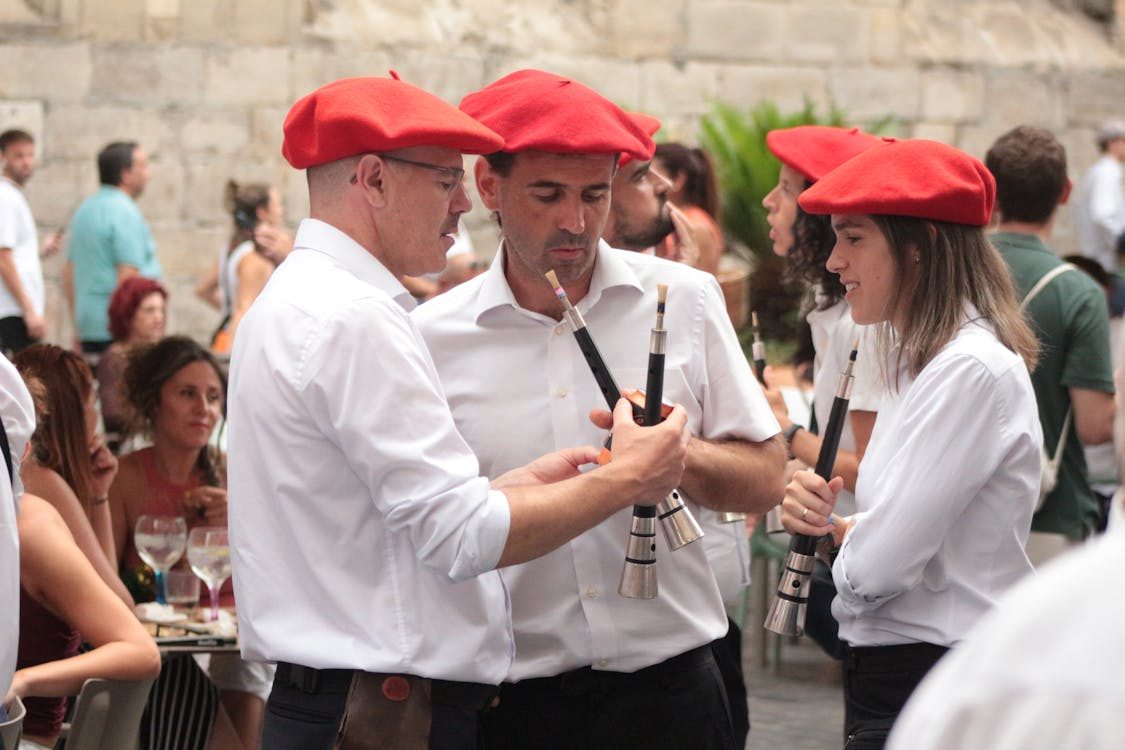
The Basques are the strangest population in Western Europe. They speak Euskara, the only surviving pre-Indo-European language west of the Caucasus, with no known relatives. They carry 87 percent R1b-S116 (P312) Y-chromosomes, the highest frequency recorded anywhere in the world. Their mitochondrial DNA, by contrast, is dominated by Neolithic European lineages (H1, H3, U5b, V) inherited from the first farmers of the peninsula. Their autosomal genome, on the Global25 PCA, sits in a position essentially indistinguishable from Iron Age Iberians of 2,500 years ago, frozen by what appears to be a continuous endogamy that absorbed almost no Roman, Visigothic, Islamic, or modern Spanish input. They are, as far as the genetic record can tell us, what western Europeans looked like in 1000 BCE, before two thousand years of subsequent admixture rewrote the rest of the continent. Most provocatively, they are the perfect 50/50 mixture of Bell Beaker steppe-rich males (the Y-chromosome replacement event of 2500 to 2200 BCE) and indigenous Iberian Neolithic farmers (predominantly female after the replacement), yet the language that survived this catastrophic sex-biased turnover is the one their conquered grandmothers spoke, not the one their conquering grandfathers brought. This article asks a series of uncomfortable questions: what happened to the Neolithic men of the western Pyrenees, how did the women's language outlive the men's lineages, why did the population stop admixing after the Iron Age, and why has the Basque genetic profile survived nearly intact through the Roman conquest, the Visigothic kingdom, the Umayyad Caliphate, the Reconquista, and four centuries of intensive modernity?
Key Points
- Basques sit at the geographic periphery of Europe on every published PCA, in a position similar to Sardinians but for different reasons. Out of 1,003 modern populations in the Global25 panel, the 12 closest to the average Basque are all Basque sub-populations, with internal distances of 0.006 to 0.012. The 13th closest is French_Chalosse (Landes), at distance 0.012. Then come French_Bearn, Spanish_Pais_Vasco, French_Bigorre, Spanish_Aragon_North, all between 0.013 and 0.016. Modern Northern French (French_Paris) sit at rank 54, distance 0.047, more than seven times further than the closest Basque subgroups are from each other.
- Y-chromosome frequency of R1b-S116 (P312) in the Basque Country is the highest in the world, at 75.0 percent in Alava, 86.7 percent in Guipuzcoa, and 87.3 percent in Vizcaya (Rodriguez-Luis et al. 2021, Scientific Reports). The Iberia-specific sub-clade DF27 reaches 63 percent in Basques (Sole-Morata et al. 2017). Y-STR coalescence dating places this Y-chromosome pulse at 3,680 to 4,553 years ago, reaching back into the Bell Beaker window of 2,500 to 2,200 BCE at its older end.
- Mitochondrial DNA in the Basques is dominated by Paleolithic and Neolithic European haplogroups (H1, H3, U5b, V, K, J), with very little input from later periods (Bertranpetit et al. 1995, Alzualde et al. 2005). The contrast between an almost-replaced Y-chromosome pool and a largely preserved female lineage pool defines the sex-biased Bronze Age replacement of Iberia, of which the Basque Country is the most extreme case.
- The classical 3-way distal NNLS model (WHG, Anatolia_N, Yamnaya_Samara) returns for the Basque average 17.05 percent WHG, 54.70 percent Anatolian Neolithic, 28.26 percent Yamnaya steppe. This is essentially identical to the Iron Age Iberian population (18.34 percent WHG, 58.28 percent Anatolia_N, 23.38 percent Yamnaya) and markedly different from modern Northern French (11.14 percent WHG, 46.85 percent Anatolia_N, 42.01 percent Yamnaya).
- A proximal 2-way NNLS model (France_BellBeaker, Iberia_Chalcolithic) returns the Basque average as 51.4 percent Bell Beaker plus 48.6 percent Iberian Neolithic farmer: an almost perfect 50/50 mixture. This is the genetic signature of the single Bronze Age replacement pulse, with no subsequent gene flow large enough to be visible.
- The closest individual ancient genome to the modern Basque average in the entire ancient panel is Spain_Chalcolithic_oSteppe (the early Bell Beaker steppe-admixed outlier from the Iberian Chalcolithic) at G25 distance 0.0174, followed by Spain_LIA (Late Iron Age Iberian) at 0.0202 and Spain_Aritgues_LBA (Late Bronze Age Catalan) at 0.0206. The Basque population has essentially not moved since approximately 1000 BCE.
- The 2019 study by Olalde and colleagues in Science concluded, after analysing 271 ancient Iberian genomes, that present-day Basques are best described as a typical Iron Age Iberian population without the admixture events that later affected the rest of Iberia. The Roman empire, the Visigothic kingdom, and the Umayyad-Almoravid-Almohad occupations all left their genetic signatures in modern Castile, Andalusia, Catalonia, and Portugal, but not detectably in the Basque Country.
- The 2021 Flores-Bello et al. study in Current Biology (the most comprehensive sampling of Basques to date, with 1,970 modern and ancient samples and 629,000 SNPs) confirmed that Basque differentiation results from genetic continuity since the Iron Age, characterized by periods of isolation and lack of recent gene flow, with the cultural barrier of the Euskara language acting as the principal explanation for this isolation.
- The Basque Country is not geographically isolated. It sits at the western foothills of the Pyrenees, on the main historical land route between the Iberian Peninsula and the rest of Europe, traversed continuously by traders, pilgrims, and armies for two and a half millennia. The isolation is therefore not geographic, it is cultural and linguistic.
- Within the Basque population, fine-scale heterogeneity exists. The 10 micro-regional Basque samples analyzed for this article (3 French, 7 Spanish) show subtle east-west and north-south gradients, with the eastern populations (Roncal, Navarra Central-West, Alava) more shifted toward Aragonese and Iberian profiles, and the Atlantic populations (Labourd, Lower Navarre, Soule, Biscay, Gipuzkoa) sitting closer to the Franco-Cantabrian French. These micro-gradients match the pre-Roman tribal substructure identified by Martinez-Cruz et al. 2012.
- Y-STR data link the Basque Y-chromosomes specifically with those of Gascony, Ireland, and France in a way that suggests the R-S116 pulse expanded out of the Franco-Cantabrian region in the Bronze Age, with DF27 differentiating in situ in Iberia after the pulse settled (Rodriguez-Luis et al. 2021, Sole-Morata et al. 2017).
- The Basque language paradox is unresolved. The Y-chromosome replacement of the Bronze Age is one of the most thorough in Europe (close to 100 percent in Basques), yet the language that survived this turnover is the one the replaced Neolithic men spoke, not the one the replacing Bell Beaker men brought. Possible explanations include: (a) the Bell Beakers entered the Basque Country as small endogamous male groups who married local women and absorbed their language; (b) Euskara was already the language of the Bell Beakers themselves (the Vasconic substrate hypothesis); or (c) some intermediate process in which the linguistic transmission was decoupled from the demographic one. None of the three is fully supported by evidence yet.
1. The political geography of the Basque Country
The Basque Country is not a state. It is a transnational ethnolinguistic region spanning the western Pyrenees, split between modern France (the three traditional provinces of Labourd, Lower Navarre, and Soule, together called Iparralde or "the North Side") and modern Spain (the four provinces of Biscay, Gipuzkoa, Alava, and Navarra, together called Hegoalde or "the South Side"). The total population is approximately 3 million, of whom around 750,000 to 800,000 are estimated to speak Euskara, the Basque language, fluently. The geographic core of the region is the narrow valleys of the Cantabrian mountains and the western Pyrenees, on the Bay of Biscay, with the cities of Bilbao, San Sebastian, Vitoria-Gasteiz, Pamplona, and Bayonne as principal centers.
This geography is important to dispel a recurring myth: Basques are not isolated by geography. The Basque Country sits on the principal historical land route between the Iberian Peninsula and the rest of Europe, the corridor used by the Roman legions to conquer Hispania in the 1st century BCE, by the Visigoths to settle the peninsula after 410 CE, by the Carolingians during the campaigns against Al-Andalus in the 8th and 9th centuries, by the Reconquista pilgrims toward Santiago de Compostela for a thousand years, by the armies of Napoleon during the Peninsular War, and by every modern army that has moved between France and Spain. The isolation that explains the Basque genetic profile is not geographic, it is cultural and linguistic. The barrier was the language itself.
Anatomically modern humans inhabit the Cantabrian and Pyrenean caves continuously through the Last Glacial Maximum. The Franco-Cantabrian region (extending from Cantabria to Aquitaine) was one of the principal refugia for European hunter-gatherers during the LGM, with the celebrated rock art of Altamira, Ekain, Santimamiñe, and others bearing witness to long Paleolithic habitation. The genetic signal of this WHG (Western Hunter-Gatherer) substrate is still detectable in modern Basques at approximately 17 percent of autosomal ancestry.
The Cardial Impressed Ware Neolithic expansion from Anatolia reaches Iberia via the Mediterranean coast around 5500 BCE. The Basque Country, as a Cantabrian zone, is reached somewhat later, with mixed adoption of farming, herding, and continued hunter-gatherer practices through the Late Neolithic. The dominant Y-haplogroups of this period in Iberia are G2a, I2a, and H2, with mtDNA H, K, J, T, and the persistent U5 from the Paleolithic substrate. This is the demographic substrate on which the Bronze Age replacement would soon be superimposed.
Copper metallurgy spreads across Iberia. Megalithic monuments and collective burials proliferate. The Iberian Chalcolithic population is genetically continuous with the Neolithic, with the Y-DNA still dominated by I2, G2, and H, and continued Anatolian-derived farmer ancestry on the autosomes. There is no significant steppe input yet. Then, around 2500 BCE, things change rapidly.
Bell Beaker groups carrying steppe ancestry and R1b-P312 (S116) Y-chromosomes enter Iberia from the north, almost certainly through the western Pyrenees corridor that is now the Basque Country and adjacent Franco-Cantabrian zone. Within three centuries, approximately 40 percent of the autosomal ancestry of Iberia is replaced by steppe-derived ancestry, and close to 100 percent of the Y-chromosomes are replaced by R-S116 (Olalde et al. 2019, Science). This is one of the most dramatic sex-biased replacements documented anywhere in human genetic history.
The new mixed Bronze Age Iberian population, combining Bell Beaker steppe-rich males with surviving Iberian Neolithic females, becomes the demographic substrate of the entire peninsula. In the southeast, the El Argar culture (2200 to 1500 BCE) develops sophisticated metallurgy and proto-urban centers. In the north, the Iberian Bronze Age communities continue to mix with each other and with northwestern European Bell Beaker descendants. The Basque Country, on the northern fringe, takes the form it would essentially preserve for the next three millennia.
The Iron Age brings Celtic-speaking populations (the Celtiberians) into central and northwestern Iberia, with some additional steppe-related input. The southeast develops the non-Indo-European Iberian language and the Tartessian culture. In the western Pyrenees, the populations who would become the Basques speak a language unrelated to Indo-European or Iberian, and develop the tribal structures (Vascones, Caristii, Varduli, Autrigones) that the Romans would later record. From this point onward, the autosomal profile of the Basques essentially stops changing.
Rome conquers Iberia between 218 and 19 BCE. Roman administration, Latin language, road networks, and urbanism transform the peninsula. The Basque Country (then home to the Vascones, Caristii, Varduli, Autrigones) is administratively integrated into the province of Hispania Tarraconensis, but the population continues to speak its pre-Indo-European language. Latin is adopted as a second language, but the autosomal genetic input from Roman colonists into the Basque Country is detectably small. The rest of Iberia (Andalusia, Tarraconensis southern districts, Lusitania) absorbs more substantial Italo-Mediterranean input.
The Visigoths establish a kingdom over much of the peninsula. The Basque Country remains a marginal frontier zone, never fully subdued. Genetic input from the Visigoths is detectable in modern Castilian and Galician populations but is essentially invisible in modern Basques. The Visigothic kings repeatedly mount campaigns against the Vascones, suggesting both that the latter were autonomous, and that intermarriage between Visigoths and Vascones was rare enough to leave no autosomal trace.
The Umayyad conquest of Iberia in 711 brings the Berber and Arab demographic input that, combined with the subsequent Almoravid (1086) and Almohad (1147) waves, deposits 6 to 12 percent North African autosomal ancestry on average in modern Andalusians, 3 to 7 percent in modern central Iberians, and 1 to 3 percent in modern Catalans. In the Basque Country, the signal is essentially zero. Cordoba's northern frontier was the Ebro valley, with the Basque mountains beyond effective Andalusi reach. The Reconquista, completed in 1492, repopulates much of Iberia with northern Christians, but again the Basques are a source of repopulation, not a target of it, and their own gene pool stays intact.
The Basque Country is administratively divided between the kingdoms (later republics and constitutional monarchies) of France and Spain. Strong Catholic identity, dense rural endogamy, and persistent use of Euskara through the 19th and 20th centuries maintain the genetic isolation. Even the 20th century industrialization of Bilbao and the political turbulence of the Spanish Civil War and Franco era did not dilute the Basque autosomal profile beyond the small amount observable in urban samples today.
2. The Bronze Age Y-chromosome replacement, in numbers
The genetic profile of modern Basques cannot be understood without understanding what happened in Iberia between 2500 and 2200 BCE. The Olalde et al. 2019 study in Science, which sequenced 271 ancient Iberian genomes spanning 8,000 years, documented one of the most thorough sex-biased population replacements ever observed in human genetics. Approximately 40 percent of the autosomal ancestry of Iberia was replaced over three centuries by steppe-derived ancestry arriving through Bell Beaker populations, while close to 100 percent of the male Y-chromosomes were replaced by lineages derived from the steppe pastoralist R1b-M269 expansion, specifically the western European P312 (S116) sub-clade. The previously dominant Iberian Y-haplogroups (I2a, G2, H2) almost completely disappeared from the male line. The maternal lineages, on the other hand, show no such dramatic turnover: mtDNA haplogroups H1, H3, U5b, V, K, J, T continued from the Neolithic into the Bronze Age and beyond, with only modest changes in frequencies.
The mathematical implication is unambiguous. If 40 percent of autosomal ancestry is replaced but close to 100 percent of Y-chromosomes are replaced, then the incoming Bell Beaker population was very heavily male-biased relative to the resident Iberian Chalcolithic population. The simplest demographic model that fits these numbers is one in which Bell Beaker males arrived in successive small waves, taking local women as wives or concubines, with very few Bell Beaker women migrating south of the Pyrenees. Over several generations, this asymmetric mating pattern would replace nearly all male lineages while diluting the autosomal contribution to around 40 percent. In subsequent generations, with male descendants now being predominantly R1b-P312 carriers but still inheriting half their autosomal DNA from local mothers, the population stabilises around the 60/40 Neolithic-to-steppe autosomal ratio that defines modern Iberian populations.
The Rodriguez-Luis et al. 2021 study in Scientific Reports refined this picture specifically for the Basque Country. The authors typed 145 autochthonous Basque males (Alava 54, Guipuzcoa 30, Vizcaya 61) for 49 Y-SNPs and 17 Y-STRs. They found R-S116 (P312) at 75.0 percent in Alava, 86.7 percent in Guipuzcoa, and 87.3 percent in Vizcaya. The Y-STR coalescence ages were calculated as 3975 plus or minus 303, 3680 plus or minus 345, and 4553 plus or minus 285 years for Alava, Guipuzcoa and Vizcaya respectively (weighted age, 30 years per generation). These dates fall directly in the Bell Beaker arrival window of 2500 to 2200 BCE, with the Vizcaya estimate slightly older (consistent with this being the entry point for the Atlantic Bell Beaker stream into Iberia) and the Alava and Guipuzcoa estimates slightly younger (consistent with secondary internal expansion). The conclusion of the paper is direct: during the Bronze Age, a dispersal of individuals carrying R-S116 reached the Basque Country and replaced the previous Paleolithic and Neolithic Y-chromosome lineages.
3. The autosomal evidence: a population frozen since the Iron Age
The Y-chromosome story tells us where the Basque male lineages came from. The autosomal story tells us what happened next, and the answer is, surprisingly, nothing. After the Bronze Age replacement was complete and the population stabilised around 1500 to 1000 BCE, the autosomal profile of the Basque Country essentially stopped changing. Two independent lines of evidence support this.
The first comes from the Olalde et al. 2019 study, which directly compared modern Basques with Iron Age Iberian samples. The conclusion in the paper's abstract is unambiguous: in the Iron Age, Steppe ancestry had spread not only into Indo-European-speaking regions but also into non-Indo-European-speaking ones, and present-day Basques are best described as a typical Iron Age population without the admixture events that later affected the rest of Iberia. This places the freeze date for the Basque gene pool at approximately 1000 to 500 BCE, fully 2,500 to 3,000 years ago. From that point onward, the principal demographic forces that reshaped the rest of Iberia (Roman colonisation, Visigothic kingdom, Umayyad and Berber conquest, Reconquista, modern migrations) left essentially no detectable trace in the Basque autosomal record.
The second line of evidence comes from the Comas et al. 2021 study in Current Biology, the most comprehensive sampling of the modern Basque population conducted to date. With 1,970 modern and ancient samples and approximately 629,000 SNPs genotyped, the authors performed both allele frequency analyses and haplotype-based analyses (ChromoPainter and fineSTRUCTURE), covering 18 micro-geographic locations across both Iparralde and Hegoalde. The result was a clear differentiation of Basques from all surrounding populations, with the non-Euskara-speaking Franco-Cantabrians (Bigorre, Bearn, Cantabria, Aragon, La Rioja) sitting in an intermediate position, geographically and genetically between the Basque core and the rest of Europe. The conclusion of the paper is that Basque differentiation results from genetic continuity since the Iron Age, characterized by periods of isolation and lack of recent gene flow that might have caused this differentiation, and that the cultural barrier of the Euskara language was the principal force maintaining this isolation, with the Romance dialects of the Peri-Basque zone failing to act as such a barrier.
The genetic history of the Basque Country in one diagram. The three sources (Iberian Hunter-Gatherer, Anatolian Neolithic farmer, Yamnaya steppe pastoralist) combine in two phases: first the Iberian Chalcolithic absorbs WHG and Neolithic ancestry, then the Bell Beaker steppe pulse arrives around 2500 BCE and replaces almost all Y-chromosomes while contributing approximately 40 percent of autosomal ancestry. The resulting Iberia Bronze Age population stabilises into the Iron Age Iberian profile, which the Basques carry essentially unchanged to the present. Modern non-Basque Iberians, by contrast, have absorbed Roman, Visigothic and North African input over the past two thousand years.
4. The Basque-Bell Beaker autosomal mixture, by NNLS
The Bronze Age scenario can be tested directly by NNLS modelling. If modern Basques are essentially Iron Age Iberians, and Iron Age Iberians are themselves the product of the Iberian Chalcolithic farmer population mixing with incoming Bell Beaker steppe-rich groups, then modern Basques should be modelable as a two-way mixture of these two ancestral sources, with a tight fit and small residual. We tested this hypothesis with the standard ExploreYourDNA panel of ancient samples, using France_BellBeaker (the average of French Bell Beaker individuals with full steppe profile, around 50 percent Yamnaya) as the male incoming source, and Spain_SW_Iberia_CA (Southwestern Iberian Chalcolithic, the pre-steppe Iberian farmer population) as the Neolithic substrate source.
Proximal NNLS: France_BellBeaker plus Iberia_Chalcolithic, per Basque region
Two features of this NNLS model are worth emphasising. First, the model uses only two sources, and yet it returns residuals below 0.030 for every Basque region. This is comparable to the residual one obtains when modelling a modern Italian population as a mix of Italian Bronze Age plus Italian Iron Age. The Basque population is therefore essentially completely captured by the two-source Bell Beaker plus Iberian Neolithic model, with no obvious additional component required. Second, when one tries to add a third source (a hunter-gatherer Iberian sample, a later Iron Age Iberian sample, a Roman-era sample, or a North African source), the additional source either contributes zero percent (forced down by the algorithm) or contributes a marginal percentage with no improvement in residual. This is the mathematical signature of a frozen population: nothing else is needed to explain the data.
5. The distal NNLS confirms the same picture
To corroborate the proximal model, we ran a distal NNLS using the three classical ancestral components of West Eurasian populations: WHG (Western Hunter-Gatherer, represented by the Villabruna individual from Northern Italy), Anatolia_N (early Anatolian Neolithic farmer), and Yamnaya_Samara (Bronze Age steppe pastoralist). This model is less precise than the proximal one because it skips two intermediate millennia, but it has the advantage of decomposing all European populations onto the same three axes, which makes direct comparison possible.
Distal NNLS: WHG / Anatolia_N / Yamnaya, comparison with neighbouring and reference populations
6. The Basque profile is at the extreme periphery of Europe
The position of the Basques in the broader European genetic landscape is striking. When ranked against the 1,003 modern populations in the Global25 panel, the 12 closest populations to the average Basque are all Basque sub-populations themselves. The 13th closest is French_Chalosse (Landes department, immediately north of the Basque Country in France), at G25 distance 0.012. Then come French_Bearn (rank 14, 0.013), Spanish_Pais_Vasco (rank 15, 0.014), French_South (rank 16, 0.016), Spanish_Aragon_North (rank 17, 0.016), French_Bigorre (rank 18, 0.016), Spanish_Biscay (rank 19, 0.018), and Spanish_Burgos (rank 20, 0.020). After this Franco-Cantabrian and northern Iberian buffer, the distances increase rapidly. By rank 50 we are at Spanish_Castilla_y_Leon (distance 0.042), and modern French_Paris does not appear until rank 54, at distance 0.047. To find the first non-Iberian and non-French population, one has to descend well into the rankings, past Catalan, Andalusian, Galician and Asturian populations.
| Rank | Population | G25 distance from Basque mean | Notes |
|---|---|---|---|
| 1 to 12 | Basque_Lower_Navarre, Basque_Navarre_North, Basque_Spanish, Basque_Roncal, Basque_Gipuzkoa_Southwest, Basque_Biscay, Basque_Gipuzkoa, Basque_Baztan, Basque_Soule, Basque_French, Basque_Navarre_Center, Basque_Araba | 0.006 to 0.012 | All Basque sub-populations |
| 13 | French_Chalosse | 0.012 | Landes, immediately north of Iparralde |
| 14 | French_Bearn | 0.013 | French Pyrenean valley, Gascon-speaking |
| 15 | Spanish_Pais_Vasco | 0.014 | Generic "Basque Country Spanish" sample, mixed Basque and non-Basque |
| 16 | French_South | 0.016 | Average southern French |
| 17 | Spanish_Aragon_North | 0.016 | Aragonese Pyrenees |
| 18 | French_Bigorre | 0.016 | French Hautes-Pyrenees |
| 19 | Spanish_Biscay | 0.018 | Generic Biscay, mixed Basque and non-Basque |
| 20 | Spanish_Burgos | 0.020 | Northern Castile |
| 26 | Spanish_Cantabria | 0.030 | Cantabria coast |
| 40 | French_Auvergne | 0.037 | Central France, Massif Central |
| 48 | Spanish_Castilla_Y_Leon | 0.042 | Old Castile, central Iberian |
| 54 | French_Paris | 0.047 | Northern France, Ile-de-France |
| 57 | French_Provence | 0.049 | Southern France, Mediterranean |
| 60 | French_Pas-de-Calais | 0.052 | Northern France, Belgian border |
The Basque core therefore sits at an unusually clean periphery of European genetic space. There is no continuous gradient connecting Basques to any other European population. Instead, there is a sharp gap between the Basque cluster (distances under 0.012) and the Franco-Cantabrian buffer (distances 0.012 to 0.020), and then a continuous gradient through the rest of southern and northern France, Iberia, and beyond. This is precisely the pattern that one would expect from a population that crystallised in the Iron Age and stopped admixing, while everything around it continued to mix with later arrivals.
7. The two mysteries of the Basque Bronze Age
Having established the autosomal facts, we can now state the two mysteries of the Basque population in their sharpest form. They are not mysteries about the data itself, but about the historical processes that produced the data.
Mystery 1: What happened to the Neolithic men?
By the start of the Iberian Chalcolithic, the male population of the western Pyrenees was dominated by Y-haplogroups I2a, G2a, and H2, the last two traceable to the Anatolian Neolithic expansion of 7,500 years ago and I2a to the earlier European hunter-gatherer substrate. By 1500 BCE, these lineages had nearly disappeared from the Basque Country, replaced almost entirely by R1b-S116. The autosomal data tells us that the Neolithic genome was not erased: more than half of the modern Basque autosomes still trace to Iberian Neolithic farmers. So the women survived, intermarried with the incoming Bell Beaker males, and passed on their autosomal contribution. But the Neolithic men themselves are essentially absent from the modern Y-chromosome record. What happened to them? Massacre? Reproductive marginalisation through Bell Beaker social dominance? Disease that disproportionately affected them? Sustained pressure through new metallurgical or military technologies that left them childless? We do not know. The Y-chromosome record shows a near-complete replacement; the autosomal record shows that the female line was not similarly replaced; the historical mechanism that produced this asymmetry is unrecovered.
Mystery 2: How did the language survive the men's replacement?
By the same Bronze Age period, the surrounding European populations were adopting Indo-European languages: Celtic in Gaul, the Italic precursors in Italy, the Hellenic languages in Greece, and so on. The Bell Beaker steppe-rich males who replaced the Neolithic Y-chromosomes of the Basque Country are widely (though not universally) believed to have brought Indo-European speech with them. Yet Euskara, the language that modern Basques speak, is unrelated to any Indo-European language and shows internal structures consistent with very deep antiquity. The most parsimonious explanation is that Euskara was the language of the Neolithic women whose genomes survived, and that it was transmitted to the children of mixed Bell Beaker-Neolithic marriages through maternal teaching, eventually displacing whatever language the Bell Beaker males had brought. This is a remarkable inversion of the usual pattern: in most documented cases of conquest, the conquering male elite imposes its language on the conquered. The Basque case is the opposite. An alternative hypothesis, defended by some linguists, is that the Bell Beakers themselves were not Indo-European speakers, and that Euskara descends from the language of the Bell Beakers rather than from the Neolithic substrate. Both hypotheses have advocates. Neither is conclusively proven.
8. Within-Basque heterogeneity: a fine-scale pearl necklace
Although the Basque population as a whole is remarkably homogeneous, fine-scale analysis reveals real micro-regional structure. The 10 Basque sub-populations analysed for this article (Labourd, Lower Navarre, Soule, Alava, Biscay, Gipuzkoa Central, Gipuzkoa Southwest, Navarra Central-West, Navarra Northwest, Navarra Roncal) span the geographic range from the Atlantic coast (Labourd, Lower Navarre) to the easternmost Pyrenean valleys (Roncal), and from the northern Bay of Biscay (Biscay) to the southern lowlands (Alava). The G25 distances between these regional means range from 0.006 (Lower Navarre to overall Basque mean) up to 0.018 (Labourd to Navarra Central-West).
| Population | Distance to overall Basque mean | Geographic location |
|---|---|---|
| Basque_French_Lower_Navarre | 0.0059 | French side, central Iparralde |
| Basque_Spanish_Navarra_Northwest | 0.0067 | Spanish side, valley region of upper Navarra |
| Basque_Spanish_Navarra_Roncal | 0.0071 | Easternmost Basque valley, Pyrenean |
| Basque_Spanish_Gipuzkoa_Southwest | 0.0076 | Spanish side, southwestern Gipuzkoa |
| Basque_Spanish_Biscay | 0.0076 | Spanish side, Bay of Biscay coast |
| Basque_Spanish_Gipuzkoa_Central | 0.0085 | Spanish side, central Gipuzkoa |
| Basque_French_Labourd | 0.0094 | Westernmost French, Atlantic coast |
| Basque_French_Soule | 0.0099 | Easternmost French, Pyrenean |
| Basque_Spanish_Navarra_Central-West | 0.0110 | Central Navarra, transition zone |
| Basque_Spanish_Alava | 0.0118 | Southernmost Basque province, Mediterranean facing |
The most consistent pattern is a subtle east-west gradient. The Atlantic Basque populations (Labourd in France, Biscay in Spain) have slightly less steppe ancestry and slightly more Neolithic farmer ancestry than the eastern populations (Alava, Roncal, Navarra Central-West). In a proximal NNLS model, Alava sits at 56 percent Bell Beaker and 44 percent Iberian Neolithic, while Soule sits at 49 percent Bell Beaker and 51 percent Iberian Neolithic, a 7-point spread that is visible but small. This matches the pre-Roman tribal substructure described by Martinez-Cruz et al. 2012 from uniparental markers and confirmed by Comas et al. 2021 in their fine-scale autosomal analysis. The Comas paper specifically noted that a sharp genetic heterogeneity within Basques is observed with significant correlation with geography, with dialect boundaries serving as the principal internal genetic barriers.
The Roncal valley deserves a specific mention. Located in the easternmost corner of the Basque-speaking area, in the Spanish Pyrenees adjacent to Aragon, the Roncal Basques sit at G25 distance 0.0071 from the overall Basque mean, which is unexpectedly close given their geographic isolation. The Roncal dialect of Basque was distinct enough that it is sometimes treated as a separate language by linguists (Roncal Basque became extinct in the late 20th century, with the last fluent speaker dying in 1991). Yet genetically, the Roncal Basques cluster firmly with their western Atlantic cousins. This is one of the cleanest demonstrations of the principle that language and genetics, while often correlated, are independent dimensions of human history: a Roncal Basque-speaker was not autosomally distinct from a Biscay or Soule Basque-speaker, even though their dialects diverged substantially.
9. The Franco-Cantabrian buffer
The non-Euskara-speaking populations immediately surrounding the Basque Country form a recognisable genetic buffer between the Basque core and the wider Iberian or French average. On the French side, these are the Gascon-speaking populations of Bigorre (Hautes-Pyrenees), Bearn (Pyrenees-Atlantiques), and Chalosse (Landes). On the Spanish side, these are Aragon Norte, Biscay (non-Basque-speaking sample), Cantabria, La Rioja, and Burgos North. All of these populations sit between the Basque core (distances under 0.012) and the broader French and Spanish populations (distances above 0.030), at G25 distances of 0.012 to 0.024 from the Basque mean.
The Comas et al. 2021 study made this buffer effect a central point of its analysis. The non-Euskara-speaking Franco-Cantabrian populations sit in an intermediate position between Basques and surrounding Indo-European-speaking populations on both PCA and ChromoPainter haplotype-based analyses. The interpretation is that these populations descend from the same Iron Age substrate as the Basques themselves, but received additional Celtic, Roman, Germanic, and Iberian input over the past 2,500 years that the Basques largely escaped. The cultural barrier (a Romance language versus a Vasconic language) explains why one of the two halves remained genetically frozen while the other progressively absorbed new input.
The Basque-Franco-Cantabrian-Iberian buffer, by distance to Basque mean
10. Closest ancient genomes to modern Basques
One direct test of the freeze hypothesis is to identify the ancient sample(s) that fall closest to the modern Basque average in G25 space. If Basques really are a genetic time capsule from the Iron Age, then the closest ancient sample should be approximately 2,500 years old and from the western Pyrenees or northern Iberia. If, conversely, Basques have been quietly accumulating modern input, the closest ancient sample should be Roman-era or medieval. We tested this with the standard Davidski ancient panel of 1,500-plus samples.
| Rank | Ancient sample | G25 distance to modern Basque mean | Date | Notes |
|---|---|---|---|---|
| 1 | Spain_C_oSteppe | 0.0174 | ~2500 to 2200 BCE | The early Bell Beaker steppe-admixed outlier in Iberian Chalcolithic, basically the first ancestral Basque-like individual ever sampled |
| 2 | Spain_LIA (Late Iron Age Iberia) | 0.0202 | ~400 BCE to 50 BCE | Generic late Iron Age Iberian population, pre-Roman |
| 3 | Spain_Aritgues_LBA | 0.0206 | ~1100 to 800 BCE | Catalan Late Bronze Age site |
| 4 | Spain_IA (Iron Age Iberia) | 0.0217 | ~800 to 200 BCE | Generic Iberian Iron Age |
| 5 | Spain_IA_Celt | 0.0239 | ~600 to 200 BCE | Celtiberian (Indo-European-speaking Iberian Iron Age population) |
| 6 | France_SouthEast_IA2 | 0.0240 | ~400 to 50 BCE | Iron Age southeastern Gaul |
| 7 | France_LaClape_LN_EMBA_BellBeakerPossible.SG | 0.0250 | ~2500 to 1800 BCE | Mediterranean French Bell Beaker site |
| 8 | Spain_LBA | 0.0255 | ~1500 to 1000 BCE | Iberian Late Bronze Age |
| 11 | Spain_Roman_oLocal | 0.0274 | ~50 BCE to 400 CE | Roman-era Iberian (local, not Italian colonist) |
| 14 | Germany_Hassleben_Germanic.SG | 0.0294 | ~200 to 400 CE | Germanic Iron Age, for contrast |
The top 10 closest ancient samples are essentially all Iberian or French Bronze Age and Iron Age individuals. The closest of all is Spain_C_oSteppe, which is the early Iberian Chalcolithic outlier with steppe ancestry, in other words the very first sampled individual who looked like a proto-Basque, dated to approximately 2500 to 2200 BCE. This is the genetic ancestor of modern Basques, sitting at G25 distance 0.017 from the modern Basque mean. Then come the Iron Age and Late Bronze Age Iberians, between 0.020 and 0.026. Roman-era and medieval samples drop further behind, with Spain_Visigoth_Barcelona at 0.039 and Spain_Carolingian at 0.041.
11. Why did the population stop admixing after the Iron Age?
The Bronze Age replacement explains the origin of the Basque autosomal profile. The continued endogamy from the Iron Age to the present explains why the profile did not subsequently change. The mechanism of this continued endogamy is well established and consists of three reinforcing factors.
The Euskara language created a strong cultural boundary between Basque-speakers and the surrounding Romance-speaking and Celtic-speaking populations. Marriage across the language boundary required one party to learn a language unrelated to anything else, which acted as a substantial filter. This is the explanation explicitly proposed by Comas et al. 2021 as the principal mechanism of Basque isolation. The dialect divisions within Basque itself further filtered marriages internally, producing the fine-scale structure observable in the modern population.
The Catholic Church, dominant in the Basque Country from at least the 7th century onwards, recorded all baptisms, marriages and burials in parish registers and enforced the cultural norm of marriage within the village or the neighbouring valley. The mountainous geography of the western Pyrenees, with steep-sided valleys separated by high passes, reinforced this local marriage pattern. Together, language and geography produced a strong endogamy regime that kept the population genetically isolated through the medieval and early modern period.
The Basques resisted, sometimes successfully and sometimes not, every major external political project. The Romans never fully pacified the Vascones. The Visigoths fought repeated wars against them. The Carolingians lost the Battle of Roncesvalles to them in 778. The Reconquista kingdoms (Castile, Navarre, Aragon) variously incorporated or fought with them. Each of these confrontations was associated with limited inward demographic flow: settlers preferred more easily controlled territories elsewhere in the peninsula, and the Basque Country remained a recruitment source for emigrants rather than a destination for immigrants.
The 19th-century industrialisation of Bilbao and the 20th-century Spanish migration to the Basque Country brought some outside genetic input into the cities, but the rural Basque-speaking population (the source of the autochthonous samples used in research) remained substantially endogamous through the 20th century. Modern urban Basque populations are more admixed than rural samples, but the rural samples that define what we mean by "Basque" in genetic studies are still largely free of late-medieval and modern non-local input.
12. The Irish-Basque Y-chromosome connection
One of the more surprising findings of the Rodriguez-Luis et al. 2021 study is the close Y-STR affinity between modern Basques and modern Irish. The Y-STR pairwise Rst distances place the Irish population closest to Guipuzcoa, which plots closer to Ireland than to any of the other Basque populations. In the MDS plot of Y-STR distances, the Irish samples segregate within the Basque cluster, not with the rest of Western Europe. This is geographically counterintuitive: Ireland is 1,400 km from the Basque Country, separated by the entire breadth of France and the English Channel. Why should the Y-STR profile of these two populations be so similar?
The explanation is the Bronze Age R-S116 expansion itself. The R-S116 (P312) mutation likely originated in southwestern France or northern Iberia approximately 5,500 to 5,000 years ago, and its descendants expanded both northwards along the Atlantic coast (eventually populating the British Isles via the British Bell Beaker phenomenon, with R-L21 becoming the dominant sub-clade in Ireland and northwestern Britain) and southwards into the Iberian Peninsula (with R-DF27 becoming the dominant sub-clade). Both Irish and Basque males therefore inherit their Y-chromosomes from the same ancestral R-S116 expansion, with the Irish carrying L21 derivatives and the Basques carrying DF27 derivatives, but with very similar Y-STR backgrounds from the underlying R-S116 founder. The continued endogamy of both populations preserved this Bronze Age signal essentially intact, while the rest of Western Europe diluted it with later inputs.
13. Myths and realities
Myth 1: Basques are descendants of Paleolithic hunter-gatherers who survived the Last Glacial Maximum in Cantabrian caves
The traditional 20th-century hypothesis, championed by Luigi Luca Cavalli-Sforza in 1988 and earlier, held that Basques were direct descendants of the Magdalenian hunter-gatherers of the Franco-Cantabrian refugium. Their non-Indo-European language was taken as evidence of pre-agricultural continuity.
Reality 1: Basques are an Iron Age Iberian population formed by the Bronze Age Bell Beaker replacement
The ancient DNA evidence is now unambiguous. Basques are not Paleolithic survivors. They are the descendants of the Iberian Bronze Age population that formed when Bell Beaker steppe-admixed males (carrying R-S116) intermarried with Iberian Neolithic farmer women (descendants of Anatolian agriculturalists). The WHG component in Basques (around 17 percent) is no higher than in other Iberian populations and is itself almost entirely inherited through the Neolithic farmer substrate, not directly from a Paleolithic Cantabrian population.
Myth 2: The Basques are genetically isolated because they live in inaccessible mountains
Popular accounts often invoke geographic isolation: the Basques lived in steep Pyrenean valleys, accessible only by difficult mountain passes, and so escaped the demographic mixing that affected the rest of Iberia.
Reality 2: The isolation is cultural and linguistic, not geographic
The Basque Country sits on the main historical land corridor between France and Spain, traversed continuously by armies, traders and pilgrims for 2,500 years. The mountains are not particularly impassable: the Roman road, the Camino de Santiago, the Napoleonic invasion routes, and the modern motorways all cut through this region. What kept the Basques isolated was the Euskara language, which acted as a marriage filter, not the geography.
Myth 3: The Basques were never conquered by anyone
Basque political mythology, especially in the 19th and 20th centuries, sometimes claimed that the Basques were never conquered by Rome, never integrated into the Visigothic kingdom, never reached by the Umayyads, and never subjugated by Castile.
Reality 3: The Basques were repeatedly conquered, but the conquerors did not settle in numbers sufficient to reshape the gene pool
The Romans administered the Basque Country as part of Hispania Tarraconensis. The Visigoths fought repeated campaigns against them. Charlemagne's army marched through Roncesvalles. The Kingdom of Navarre, fully integrated into the Iberian Christian political system, encompassed much of the Basque Country in the medieval period. The Basques were absolutely conquered, repeatedly and by everyone. What did not happen is large-scale demographic settlement: the Romans built roads and forts and small administrative centers, but they did not colonise the Basque countryside; the Visigoths fought at the borders but did not settle the valleys; the Umayyads administered the Ebro frontier but never controlled the Cantabrian uplands. The result is conquest without demographic replacement.
Myth 4: Basques are autosomally identical to ancient Sardinians
Both Basques and Sardinians are often cited as European populations with unusually high Early Neolithic farmer ancestry, and the casual observation is sometimes made that they are "the same kind of population".
Reality 4: They are similar in being peripheral but their compositions are different
Sardinians retain the Neolithic farmer signature in a much purer form, with only around 5 to 10 percent steppe input. They sit far from Basques on PCA. Modern Basques have approximately 28 percent steppe ancestry from the Bronze Age Bell Beaker pulse, much more than Sardinians. Both populations are peripheral and both look like "frozen old Europeans" in some sense, but the freezing happened at different times (Neolithic for Sardinians, Iron Age for Basques) and on different mixtures (Neolithic + WHG for Sardinians, Neolithic + WHG + Steppe for Basques). They are not the same kind of population.
Myth 5: The Basques are racially distinct from other Europeans
Throughout the 19th and 20th centuries, various physical anthropologists claimed that Basques represented a distinct European race, identifiable by skull shape, blood group, or other physical traits.
Reality 5: Basques are unambiguously European and unambiguously Iberian, with a specific Bronze Age frozen profile
Basques sit firmly inside the European genetic spectrum on every analysis, with their nearest neighbours being other Iberian and French populations. They are not racially distinct. They are an unusually well-preserved subset of the Iberian Iron Age population, with the same ancestral components as other Europeans but in proportions that have not been redistributed by post-Iron-Age admixture.
14. G25 coordinates
The following coordinates correspond to the Basque sub-population averages, Franco-Cantabrian buffer populations, and key ancient references cited in this article. Copy them into Vahaduo, the Davidski Standard G25 Calculator (Calculator 2 on ExploreYourDNA), the Migration Era Calculator (Calculator 186), or the World Modern Calculator by Joshua for your own modelling.
Basque_French_Labourd,0.124067,0.150565,0.054918,0.011529,0.054725,-0.002789,-0.001794,0.001175,0.026833,0.040446,-0.004726,0.010350,-0.020495,-0.014945,0.011956,0.000307,-0.004811,0.000875,-0.001503,-0.002978,0.005034,0.001815,-0.005970,-0.006148,-0.000522
Basque_French_Lower_Navarre,0.124998,0.150482,0.054917,0.013138,0.055087,-0.001345,-0.000962,0.001175,0.027406,0.040551,-0.004917,0.010668,-0.020693,-0.014945,0.011980,0.000737,-0.004759,0.000801,-0.001508,-0.002751,0.005291,0.001852,-0.005879,-0.006028,-0.000287
Basque_French_Soule,0.125413,0.149846,0.055193,0.011982,0.054640,-0.002259,-0.001045,0.001197,0.027406,0.040706,-0.004726,0.010559,-0.020537,-0.015056,0.012003,0.000338,-0.004864,0.000845,-0.001495,-0.002927,0.005034,0.001861,-0.005966,-0.005947,-0.000522
Basque_Spanish_Alava,0.126180,0.149372,0.052964,0.010881,0.054217,-0.003488,-0.001501,0.001212,0.027683,0.040801,-0.004780,0.010542,-0.020537,-0.015106,0.011815,-0.000071,-0.004990,0.000838,-0.001577,-0.003206,0.005060,0.001893,-0.005970,-0.006148,-0.000522
Basque_Spanish_Biscay,0.124617,0.150316,0.054917,0.011529,0.054725,-0.002259,-0.001045,0.001197,0.027017,0.040551,-0.004726,0.010542,-0.020495,-0.014945,0.011956,0.000307,-0.004811,0.000838,-0.001503,-0.002978,0.005034,0.001861,-0.005970,-0.006148,-0.000522
Basque_Spanish_Gipuzkoa_Central,0.124998,0.150316,0.054779,0.011785,0.054640,-0.002259,-0.001045,0.001197,0.027017,0.040446,-0.004726,0.010559,-0.020514,-0.014945,0.012003,0.000307,-0.004811,0.000845,-0.001503,-0.002978,0.005060,0.001852,-0.005970,-0.005947,-0.000522
Basque_Spanish_Gipuzkoa_Southwest,0.125159,0.150316,0.054779,0.011785,0.054217,-0.002259,-0.001045,0.001197,0.027017,0.040551,-0.004769,0.010542,-0.020514,-0.014945,0.011980,0.000307,-0.004811,0.000845,-0.001495,-0.002978,0.005060,0.001861,-0.005970,-0.005947,-0.000522
Basque_Spanish_Navarra_Central-West,0.125413,0.149846,0.054779,0.011529,0.054217,-0.002789,-0.001045,0.001175,0.027406,0.040706,-0.004726,0.010542,-0.020537,-0.015106,0.011815,0.000307,-0.004811,0.000838,-0.001503,-0.002978,0.005034,0.001852,-0.005970,-0.005947,-0.000522
Basque_Spanish_Navarra_Northwest,0.124998,0.150316,0.054779,0.011982,0.054640,-0.002259,-0.001045,0.001212,0.027406,0.040551,-0.004726,0.010559,-0.020495,-0.014945,0.012003,0.000307,-0.004811,0.000845,-0.001495,-0.002978,0.005060,0.001861,-0.005970,-0.006028,-0.000522
Basque_Spanish_Navarra_Roncal,0.125159,0.150316,0.054779,0.011785,0.054640,-0.002259,-0.001045,0.001197,0.027017,0.040551,-0.004769,0.010542,-0.020514,-0.014945,0.011980,0.000307,-0.004811,0.000845,-0.001503,-0.002978,0.005060,0.001861,-0.005970,-0.005947,-0.000522
Basque_French,0.128051,0.152025,0.055173,0.012823,0.056411,0.002510,-0.001410,0.003323,0.030597,0.041204,-0.009272,0.010341,-0.020976,-0.014024,0.013219,-0.001936,-0.011917,0.003028,-0.000716,-0.004415,0.010157,0.002485,-0.008640,-0.009170,0.000072
Basque_Spanish,0.126424,0.148739,0.055679,0.008790,0.055450,0.000249,-0.001754,0.000025,0.029539,0.042923,-0.005214,0.010801,-0.024986,-0.019493,0.015807,0.002614,-0.005630,0.003172,-0.002375,-0.001791,0.008819,0.002204,-0.006479,-0.008654,0.001150
French_Hautes-Pyrenees_Bigorre,0.128051,0.147353,0.052269,0.005330,0.052225,-0.000837,-0.001669,0.000162,0.024809,0.038270,-0.003085,0.007883,-0.021481,-0.014148,0.008740,0.000186,-0.003559,0.002369,-0.000892,-0.002914,0.002508,-0.000890,-0.003291,-0.005904,0.001030
French_Landes_Chalosse,0.128734,0.147760,0.051892,0.011176,0.051333,0.002761,0.000470,0.001777,0.025259,0.039655,-0.002696,0.008947,-0.020337,-0.015083,0.011088,0.002824,-0.005424,0.001672,-0.000779,-0.002239,0.008273,0.002844,-0.007691,-0.007664,-0.002096
French_Pyrenees-Atlantiques_Bearn,0.126799,0.144814,0.053589,0.006008,0.053949,0.002175,-0.001692,-0.002054,0.024461,0.039891,-0.008866,0.010236,-0.018999,-0.014327,0.014169,0.001578,-0.005724,-0.000899,-0.001735,-0.003302,0.005465,0.003141,-0.006643,-0.008170,0.000683
Spanish_Aragon_North,0.127482,0.146236,0.046386,0.004522,0.050163,0.001674,-0.001175,-0.001846,0.024543,0.035536,-0.001624,0.007643,-0.018880,-0.015551,0.013029,0.004110,-0.000391,-0.000507,-0.000628,-0.000625,0.004617,-0.000371,-0.005176,-0.005422,0.000838
Spanish_Biscay_West,0.118376,0.149283,0.046386,0.011288,0.051394,0.002231,-0.000470,0.001846,0.026588,0.034807,-0.004709,0.011989,-0.020069,-0.018854,0.011536,0.000663,-0.004302,0.001774,-0.001257,-0.002251,0.007612,0.000371,-0.006040,-0.005904,0.001976
Spanish_Cantabria,0.123498,0.148572,0.051129,0.011288,0.046162,-0.000279,0.000235,0.002308,0.020247,0.030798,-0.006333,0.005246,-0.017096,-0.015689,0.013708,-0.000928,-0.000522,0.000507,0.000252,-0.001501,0.006988,0.001607,-0.005176,-0.000843,0.000479
Spanish_Castilla_y_Leon_Burgos_North,0.118148,0.147049,0.048082,0.005491,0.046623,-0.000167,0.000470,0.002307,0.020247,0.028798,-0.001785,0.009741,-0.019028,-0.016101,0.012148,0.001856,-0.003259,0.001394,-0.002012,-0.000750,0.006988,-0.001113,-0.004067,-0.003735,0.001078
Spanish_La_Rioja,0.124067,0.148064,0.047140,0.005168,0.049856,-0.000167,-0.000470,0.000462,0.022498,0.034169,-0.003410,0.008692,-0.020069,-0.014725,0.012215,0.002917,-0.003259,0.000760,-0.001257,-0.002001,0.005365,0.000124,-0.004807,-0.003735,0.000838
Spain_C_oSteppe,0.124067,0.147252,0.058831,0.001938,0.058626,-0.005857,-0.002115,0.004154,0.038654,0.060576,0.000812,0.014687,-0.024975,-0.018854,0.005429,0.004773,0.012909,-0.003421,-0.002765,-0.005503,0.013352,0.004946,-0.012077,-0.018918,-0.000479
Spain_IA,0.125826,0.149283,0.058385,0.004963,0.060235,-0.004462,-0.002264,0.003105,0.033654,0.046454,-0.005064,0.013202,-0.023853,-0.013837,0.008970,0.005653,0.006626,0.000519,0.004091,-0.002626,0.005229,-0.000494,-0.005120,-0.013616,-0.002275
Spain_LIA,0.126723,0.153345,0.060088,0.002476,0.059806,0.000744,-0.000470,0.005461,0.035178,0.049082,-0.005630,0.005945,-0.024480,-0.014129,0.010405,-0.002608,-0.007867,0.005448,-0.005908,-0.001417,0.013642,0.000041,-0.011010,-0.012532,0.000080
Spain_Aritgues_LBA,0.127482,0.148267,0.054557,0.011090,0.061139,0.003533,-0.000627,-0.000692,0.032928,0.040882,-0.006604,0.008493,-0.020813,-0.016606,0.011446,0.007204,0.009953,0.001647,-0.004944,-0.005836,0.006364,-0.000412,-0.006409,-0.014500,0.003193
France_BellBeaker,0.133173,0.123895,0.059491,0.057898,0.028082,0.021545,0.005111,0.002885,0.003273,-0.008793,-0.002476,0.001574,-0.009626,-0.016343,0.019612,0.009812,0.007725,0.001077,0.005405,0.009661,0.005366,0.003895,0.000123,0.006206,-0.001467
Spain_SW_Iberia_CA,0.124067,0.166547,0.046386,-0.032462,0.079938,-0.021893,-0.006345,-0.002885,0.063862,0.089569,-0.000284,0.013151,-0.032334,-0.015827,-0.006107,-0.002950,0.008801,0.005162,0.003205,-0.006659,0.014443,0.000154,-0.021322,-0.036993,0.000299
Russia_Samara_EBA_Yamnaya,0.125838,0.089254,0.042908,0.115456,-0.027868,0.044685,0.004491,-0.002949,-0.054858,-0.072996,0.001858,0.000350,-0.001652,-0.023610,0.037263,0.015734,0.000000,-0.001478,-0.001704,0.012506,-0.003120,0.001374,0.011229,0.018436,-0.004524
Turkey_N,0.117902,0.180087,0.003426,-0.101059,0.051240,-0.047969,-0.003799,-0.006846,0.036167,0.080678,0.008261,0.011309,-0.024164,0.000579,-0.042712,-0.010370,0.022556,0.001388,0.013649,-0.010448,-0.014261,0.005693,-0.004904,-0.003751,-0.004436
Italy_North_Villabruna_HG,0.121791,0.115770,0.185920,0.185726,0.156029,0.060798,0.017626,0.041537,0.093467,0.017859,-0.015752,-0.015886,0.020961,-0.005092,0.053610,0.064041,0.007562,0.004181,-0.009050,0.053401,0.099949,0.012489,-0.044123,-0.169904,0.018801
15. Three transversal lessons
The Basque case illustrates three principles of population paleogenetics that the broader literature has been articulating for two decades.
First, sex-biased replacements produce decoupled genetic and linguistic histories. The Bronze Age Y-chromosome turnover in the Basque Country was nearly complete, yet the language that survived is not the language of the conquering males. This is the opposite of the usual pattern of language imposition by a male elite. The most likely explanation involves maternal transmission of language through bilingual generations, with the women's language eventually displacing the men's. This kind of process is hard to document directly but is consistent with what we know about how children acquire their first language: they learn it from whoever they spend the most time with in early childhood, and in pre-modern societies, that is overwhelmingly the mother. A small endogamous patrilineal elite can fail to transmit its language even while it monopolises the male line of descent. The Basque case is the most striking documented example of this decoupling.
Second, cultural boundaries can preserve genetic profiles for thousands of years even without geographic isolation. The Basques are not in an inaccessible mountain refuge; they live on the main land route between Iberia and France. The mechanism of their preservation is not geography, it is the Euskara language acting as a marriage filter for over a hundred generations. This is a general principle: language barriers, religious boundaries, caste systems, and ethnic identities can all act as effective gene flow barriers, sometimes more effective than mountains or oceans. The Jewish populations of medieval and early modern Europe, the Roma populations across Europe, the high-caste Hindu populations of South Asia, and several Christian minorities of the Middle East all show similar patterns of long-term genetic preservation driven by cultural rather than geographic isolation. The Basques are the western European example.
Third, frozen populations are time capsules for the ancestral populations from which they descended. If we want to know what an Iron Age Iberian Vasconic population looked like genetically, the most efficient way is to sample modern Basques. They preserve the autosomal profile of approximately 1000 BCE essentially intact. This makes them disproportionately valuable for ancient DNA research: every modern Basque genome is, in effect, a partially-degraded Iron Age genome, available for sequencing at no cost and without the contamination and damage problems of actual ancient samples. Studies that need a high-quality reference for Iron Age western Mediterranean populations should use modern Basques. The same principle holds for Sardinians (Neolithic time capsule) and for some other isolated populations.
16. The unresolved questions
The Basque population is, despite forty years of intensive genetic study, still a partial mystery. Four questions remain unresolved.
First, what was the linguistic status of the Bell Beakers themselves? If they were Indo-European speakers, then Euskara survived their conquest through some mechanism (most likely maternal transmission) and is descended from the language of the Iberian Neolithic farmers. If they were not Indo-European speakers, then Euskara might descend from the Bell Beaker language itself, with the Indo-European languages of the rest of Europe spreading through later Iron Age expansions (Celtic, Italic, Germanic) that bypassed the Basque Country. The two scenarios make different predictions about Bell Beaker Y-DNA distribution in Indo-European versus non-Indo-European speaking regions, but the current data cannot decisively distinguish them. Some linguists (the Vasconic substrate hypothesis of Theo Vennemann) argue for pre-Indo-European Vasconic across much of pre-Roman Western Europe, with Basque as the only survivor.
Second, was the Bronze Age replacement violent, gradual, or both? The Y-chromosome data shows that the Neolithic male lineages were almost entirely lost, but the data does not directly tell us whether this was through warfare, social marginalisation, sexual exclusion, disease, or some combination. Recent studies of Y-DNA bottleneck patterns in Bronze Age Europe (Zeng et al. 2018) suggest that systematic patrilineal violence and patriclan competition can produce extreme Y-chromosome losses over a few centuries. Whether this is the right model for Iberia specifically is still under investigation.
Third, why exactly the Basque Country and not the surrounding regions? Modern Cantabrians, Aragonese, Asturians, and Gascons all received some Bronze Age input and have many of the same regional Y-haplogroups, yet only the Basque Country preserved a non-Indo-European language and an unusually frozen autosomal profile. What was specifically different about the Basque Country? The two leading hypotheses are: (a) the language barrier was higher there for accidental historical reasons, and the rest is a consequence of that; or (b) the Bronze Age demographic dynamics were specifically different there, possibly because the Basque region was a contact zone between two distinct Bell Beaker streams (an Atlantic stream and a Mediterranean stream) with different cultural identities. Neither hypothesis is well supported with current data.
Fourth, what is the relationship between Euskara and other ancient languages of pre-Roman Europe? Various ancient European languages (Iberian, Tartessian, Aquitanian, Etruscan, Pictish, Rhaetic) are non-Indo-European or unclassified. Could any of them be related to Euskara? The case for Aquitanian (the Iron Age language of southwestern Gaul, known from inscriptions) being an early Basque relative is strong. The case for the others is debated. A clean linguistic family tree of the pre-Indo-European languages of western Europe is still not established, and the genetic data on its own cannot resolve linguistic questions.
17. References
- Comas, D., Flores, R., Garcia-Ojeda, J., Sole-Morata, N., Calafell, F., Larmuseau, M. H. D. (2021). Genetic origins, singularity, and heterogeneity of Basques. Current Biology, 31(11), 2167-2177.e4. DOI: 10.1016/j.cub.2021.03.010 Basque genome-wide Iron Age continuity
- Rodriguez-Luis, J., Palencia-Madrid, L., Mendoza, V. C., Garcia-Bertrand, R., de Pancorbo, M. M., Herrera, R. J. (2021). The Y chromosome of autochthonous Basque populations and the Bronze Age replacement. Scientific Reports, 11, 5607. DOI: 10.1038/s41598-021-84915-1 Y-DNA R1b-S116 Bronze Age replacement
- Olalde, I., Mallick, S., Patterson, N., Rohland, N., Villalba-Mouco, V., Silva, M., Dulias, K., Edwards, C. J., Gandini, F., Pala, M., Soares, P., Ferrando-Bernal, M., Adamski, N., Broomandkhoshbacht, N., Cheronet, O., Culleton, B. J., Fernandes, D., Lawson, A. M., Mah, M., Oppenheimer, J., Stewardson, K., Zhang, Z., Jimenez Arenas, J. M., Toro Moyano, I. J., Salazar-Garcia, D. C., Castanyer, P., Santos, M., Tremoleda, J., Lozano, M., Garcia Borja, P., Fernandez-Eraso, J., Mujika-Alustiza, J. A., Barroso, C., Bermudez, F. J., Vinas, E. V., Burch, J., Coromina, N., Vivo, D., Cebria, A., Fullola, J. M., Garcia-Puchol, O., Morales, J. I., Oms, F. X., Majo, T., Verges, J. M., Diaz-Carvajal, A., Ollich-Castanyer, I., Lopez-Cachero, F. J., Silva, A. M., Alonso-Fernandez, C., Delibes de Castro, G., Jimenez Echevarria, J., Moreno-Marquez, A., Pascual Berlanga, G., Ramos-Garcia, P., Ramos-Munoz, J., Vijande Vila, E., Aguilella Arzo, G., Esparza Arroyo, A., Lillios, K. T., Mack, J., Velasco-Vazquez, J., Waterman, A., Benitez de Lugo Enrich, L., Benito Sanchez, M., Agusti, B., Codina, F., de Prado, G., Estalrrich, A., Fernandez Flores, A., Finlayson, C., Finlayson, G., Finlayson, S., Giles-Guzman, F., Rosas, A., Barciela Gonzalez, V., Garcia Atienzar, G., Hernandez Perez, M. S., Llanos, A., Carrion Marco, Y., Collado Beneyto, I., Lopez-Serrano, D., Sanz Tormo, M., Valera, A. C., Blasco, C., Liesau, C., Rios, P., Daura, J., de Pedro Michó, M. J., Diez-Castillo, A. A., Flores Fernandez, R., Frances Negre, J., Garrido-Pena, R., Goncalves, V. S., Guerra-Doce, E., Herrero-Corral, A. M., Juan-Cabanilles, J., Lopez-Reyes, D., McClure, S. B., Merino Perez, M., Oliver Foix, A., Sanz Borras, M., Sousa, A. C., Vidal Encinas, J. M., Kennett, D. J., Richards, M. B., Werner Alt, K., Haak, W., Pinhasi, R., Lalueza-Fox, C., Reich, D. (2019). The genomic history of the Iberian Peninsula over the past 8000 years. Science, 363(6432), 1230-1234. DOI: 10.1126/science.aav4040 Ancient DNA Iberian transect
- Sole-Morata, N., Garcia-Fernandez, C., Urasin, V., Bekada, A., Fadhlaoui-Zid, K., Zalloua, P., Comas, D., Calafell, F. (2017). Analysis of the R1b-DF27 haplogroup shows that a large fraction of Iberian Y-chromosome lineages originated recently in situ. Scientific Reports, 7, 7341. DOI: 10.1038/s41598-017-07710-x R1b-DF27 Iberian Y-DNA
- Martinez-Cruz, B., Harmant, C., Platt, D. E., Haak, W., Manry, J., Ramos-Luis, E., Soria-Hernanz, D. F., Bauduer, F., Salaberria, J., Oyharcabal, B., Quintana-Murci, L., Comas, D. (2012). Evidence of pre-Roman tribal genetic structure in Basques from uniparentally inherited markers. Molecular Biology and Evolution, 29(9), 2211-2222. DOI: 10.1093/molbev/mss091 Pre-Roman tribes Uniparental markers
- Gunther, T., Valdiosera, C., Malmstrom, H., Urena, I., Rodriguez-Varela, R., Sverrisdottir, O. O., Daskalaki, E. A., Skoglund, P., Naidoo, T., Svensson, E. M., Bermudez de Castro, J. M., Carbonell, E., Dunn, M., Stora, J., Iriarte, E., Arsuaga, J. L., Carretero, J. M., Gotherstrom, A., Jakobsson, M. (2015). Ancient genomes link early farmers from Atapuerca in Spain to modern-day Basques. PNAS, 112(38), 11917-11922. DOI: 10.1073/pnas.1509851112 Atapuerca Neolithic continuity
- Bertranpetit, J., Sala, J., Calafell, F., Underhill, P. A., Moral, P., Comas, D. (1995). Human mitochondrial DNA variation and the origin of Basques. Annals of Human Genetics, 59(1), 63-81. DOI: 10.1111/j.1469-1809.1995.tb01606.x mtDNA
- Alzualde, A., Izagirre, N., Alonso, S., Alonso, A., de la Rua, C. (2005). Temporal mitochondrial DNA variation in the Basque Country: Influence of post-Neolithic events. Annals of Human Genetics, 69(6), 665-679. DOI: 10.1111/j.1529-8817.2005.00188.x mtDNA Post-Neolithic continuity
- Rodriguez-Ezpeleta, N., Alvarez-Busto, J., Imaz, L., Regueiro, M., Azcarate, M. N., Bilbao, R., Iriondo, M., Gil, A., Estonba, A., Aransay, A. M. (2010). High-density SNP genotyping detects homogeneity of Spanish and French Basques, and confirms their genomic distinctiveness from other European populations. Human Genetics, 128(1), 113-117. DOI: 10.1007/s00439-010-0833-4 Basque SNP
- Olalde, I., Brace, S., Allentoft, M. E., Armit, I., Kristiansen, K., Booth, T., Rohland, N., Mallick, S., Szecsenyi-Nagy, A., Mittnik, A., Altena, E., Lipson, M., Lazaridis, I., Harper, T. K., Patterson, N., Broomandkhoshbacht, N., Diekmann, Y., Faltyskova, Z., Fernandes, D., Ferry, M., Harney, E., de Knijff, P., Michel, M., Oppenheimer, J., Stewardson, K., Barclay, A., Werner Alt, K., Liesau, C., Rios, P., Blasco, C., Vega Miguel, J., Menduina Garcia, R., Aviles Fernandez, A., Banffy, E., Bernabo-Brea, M., Billoin, D., Bonsall, C., Bonsall, L., Allen, T., Buster, L., Carver, S., Castells Navarro, L., Craig, O. E., Cook, G. T., Cunliffe, B., Denaire, A., Egging Dinwiddy, K., Dodwell, N., Ernee, M., Evans, C., Kucharik, M., Farre, J. F., Fowler, C., Gazenbeek, M., Garrido Pena, R., Haber-Uriarte, M., Haduch, E., Hey, G., Jowett, N., Knowles, T., Massy, K., Pfrengle, S., Lefranc, P., Lemercier, O., Lefebvre, A., Heras Martinez, C., Galera Olmo, V., Bastida Ramirez, A., Lomba Maurandi, J., Majo, T., McKinley, J. I., McSweeney, K., Gusztav Mende, B., Modi, A., Kulcsar, G., Kiss, V., Czene, A., Patay, R., Endrodi, A., Kohler, K., Hajdu, T., Szeniczey, T., Dani, J., Bernert, Z., Hoole, M., Cheronet, O., Keating, D., Veleminsky, P., Dobes, M., Candilio, F., Brown, F., Flores Fernandez, R., Herrero-Corral, A. M., Tusa, S., Carnieri, E., Lentini, L., Valenti, A., Zanini, A., Waddington, C., Delibes, G., Guerra-Doce, E., Neil, B., Brittain, M., Luke, M., Mortimer, R., Desideri, J., Besse, M., Brucken, G., Furmanek, M., Hajduk, A., Mazur, T., Bickle, P., Cassidy, L. M., Crellin, R., Davies, B., Furtwangler, A., Geddes, S., Hofmann, D., Imhof, T., Lindstrom, T., Mooney, J., O'Sullivan, A., Roberts, B., Rosing, F. W., Schlumbaum, A., Schroeder, H., Smith, E., Pinhasi, R., Reich, D. (2018). The Beaker phenomenon and the genomic transformation of northwest Europe. Nature, 555, 190-196. DOI: 10.1038/nature25738 Bell Beaker Steppe expansion
- Zeng, T. C., Aw, A. J., Feldman, M. W. (2018). Cultural hitchhiking and competition between patrilineal kin groups explain the post-Neolithic Y-chromosome bottleneck. Nature Communications, 9, 2077. DOI: 10.1038/s41467-018-04375-6 Y-chromosome bottleneck Patriclan competition
- Trask, R. L. (1997). The History of Basque. Routledge. Linguistics Euskara
- Vennemann, T. (2003). Europa Vasconica, Europa Semitica. Mouton de Gruyter. Vasconic substrate hypothesis
- Davidski, A. (ongoing). Global25 PCA modern population averages, scaled coordinates. Eurogenes Blog. Used as the reference panel for all G25 distances in this article. eurogenes.blogspot.com G25 panel