
From Quebec City in 1608 to the Cajun bayous of Louisiana in 1785, the French presence in North America rests on a small founding pulse: approximately 8,500 settlers who crossed the Atlantic from France to New France between 1608 and 1760, plus around 800 to 1,000 founders who built Acadia between 1604 and 1755. Today, more than 11 million people in Quebec, Acadia, New England, and Louisiana descend from this restricted founder pool. Their genetic profile, four centuries later, has remained strikingly French. On the Global25 PCA, six anonymized Quebec samples and five anonymized Cajun samples analyzed for this article cluster directly with French regional populations of Normandy, Poitou-Charentes, Picardy (Nord), and Île-de-France, with average distances of 0.0107 to 0.0118 to French_Nord, smaller than the distance between two French regions of mainland France. The historical sources, the BALSAC parish-record genealogy of four million entries, and the autosomal data all converge on the same picture: New France was settled overwhelmingly by people from western and northwestern France (Normandy, Aunis, Saintonge, Poitou, Île-de-France, Brittany), and the descendants of those founders remain genetically French today, with very small Indigenous American admixture (typically less than 2 percent at the population level, often 0 percent in individuals), almost no Iberian admixture outside specific Cajun families, and a founder effect that gave rise to remarkable subregional structure inside Quebec itself, most notably the Saguenay-Lac-Saint-Jean and Gaspé Acadian capsules.
Key Points
- Approximately 8,500 founders from France settled in the St. Lawrence valley between 1608 and 1760, with Quebec City founded in 1608 and Montreal in 1642. After the British Conquest of 1760, French immigration practically stopped, and the French-speaking population expanded almost entirely through natural increase (Charbonneau et al. 2000, BALSAC).
- The Acadian founders, separate from the Quebec stream, numbered approximately 800 to 1,000 individuals who settled in Port-Royal (Annapolis Royal) and the Bay of Fundy region between 1604 and 1755. About 65 percent of Acadian founders came from the Loudunais area of Poitou (Vienne, Deux-Sevres) and the neighboring Aunis and Saintonge (Charente-Maritime), with smaller contributions from Brittany, Normandy, and the Basque country.
- The Quebec founders came predominantly from western and northwestern France: Île-de-France (Paris basin), Normandy (especially Perche in Orne, and Caux in Seine-Maritime), Aunis (La Rochelle area), Poitou, Saintonge, and Brittany. Of the 770 Filles du Roi sent between 1663 and 1673, around 50 percent originated from the Paris region.
- Approximately 10,000 to 18,000 Acadians were forcibly deported during the Grand Derangement of 1755 to 1763. They were scattered across the British American colonies, England, and France. About 3,000 reached France, concentrated in Poitou and Belle-Ile-en-Mer in Brittany. In 1785, around 1,600 of them left France for Louisiana, forming the demographic core of the future Cajun population.
- The first Acadians arrived in Louisiana as early as 1764 via Santo Domingo and the British colonies. The Spanish authorities of Louisiana (Spain had received the colony from France in 1762) welcomed them and allocated land in the prairies and bayous west of New Orleans. The name Cajun is the English deformation of the French Acadien.
- Breton, Norman and Basque fishermen had been working the cod banks of Newfoundland and the Gulf of Saint Lawrence since the 1500s, with Saint-Pierre-et-Miquelon serving as the last remaining French Atlantic possession after 1763. These fishermen are partly responsible for the Norman, Breton and Basque demographic input on the North Shore and Iles-de-la-Madeleine.
- Between 1840 and 1930, roughly 900,000 Quebecers emigrated to New England, mostly to the textile mills of Maine, Vermont, New Hampshire, Massachusetts and Rhode Island. They formed the Franco-American population that still represents a substantial share of northern New England demographics today.
- The Quebec founder population developed strong subregional structure through endogamy and rapid demographic expansion. The Saguenay-Lac-Saint-Jean (colonized from 1838) and the Acadians of Gaspe (settled from the second half of the 18th century) emerged as the two most distinctive subpopulations, with a marked increase in kinship and inbreeding starting around 1750 (Gagnon et al. 2024).
- Modern Quebec carriers of certain rare disease variants show up to 8-fold enrichment compared to the general population. The USH1C founder mutation for Usher syndrome type I provides a direct genetic link between the Acadians of Gaspe and the Acadians of New Brunswick (Ebermann et al. 2007, Gagnon et al. 2024).
- Native American admixture in modern Quebecers averages around 1 percent at the population level, with individual variance from 0 to 5 percent. Most carrier individuals trace this signal to a small number of marriages between French fur traders (coureurs des bois) and Indigenous women in the 17th and 18th centuries (Bherer et al. 2011, Jomphe et al. 2012).
- After the British Conquest of 1760, two post-Conquest demographic inputs added a small British Isles signal to the French Canadian gene pool: roughly 150 to 250 Highland Scottish soldiers of the 78th Fraser Highlanders who settled in Charlevoix and the Lower Saint Lawrence after 1763, and approximately 1,300 to 1,500 Irish famine orphans adopted by French Canadian families in 1847 to 1849 following the Grosse-Ile typhus catastrophe. These adoptions explain why Irish surnames (Murphy, O'Brien, Ryan, Walsh, Kelly, Hurley) appear today in otherwise pure-French-ancestry Quebec families, with an Irish autosomal residual of typically 3 to 12 percent after five generations of dilution.
- On the Global25 PCA, six anonymized Quebec samples and five anonymized Cajun samples analyzed for this article cluster directly within the French regional cloud, closest to French_Nord, French_Poitou-Charentes, French_Normandy, and French_Paris, with population-mean distances under 0.013. Four centuries of demographic isolation have not detectably eroded the French genetic profile.
1. The founding pulse: 8,500 French in Quebec, 1,000 in Acadia
The French presence in North America has three demographic anchors, each with its own founding history. The first is the St. Lawrence valley, settled by Samuel de Champlain at Quebec City in 1608 and by Paul Chomedey de Maisonneuve at Montreal in 1642. The second is Acadia, founded by Pierre Dugua de Mons and Champlain at Port-Royal in 1604, twenty-one years before any English settlement of comparable continuity. The third is the seasonal Atlantic fishing presence, established by Norman, Breton and Basque cod fishermen at the Newfoundland banks from the 16th century onward, formalized by the foundation of Plaisance in 1660 and surviving today as the French overseas collectivity of Saint-Pierre-et-Miquelon.
The first stream is by far the most demographically important. Approximately 8,500 settlers from France crossed the Atlantic between 1608 and 1760 and founded the demographic core of modern French Canada. These were not random emigrants. Their geographic origins concentrate heavily on the western and northwestern French coast, with the Paris basin contributing a substantial proportion via the Filles du Roi program. After the British Conquest of 1760, French immigration to North America stopped almost completely, and the French-speaking population of Canada expanded for the next two centuries almost entirely through natural increase, with one of the highest birth rates documented in any human population.
Dugua de Mons and Champlain establish Port-Royal in 1604. Acadian settlement expands along the Bay of Fundy and around the Minas Basin. By 1713 the Acadian population numbers approximately 2,500. The Treaty of Utrecht of 1713 cedes Acadia (renamed Nova Scotia) to Britain, leaving the Acadians under British sovereignty but officially French-speaking and Catholic, with their own dyke-based agricultural culture on the salt marshes of the Bay of Fundy.
Champlain founds Quebec City in 1608. Settlement is initially slow because the colony is run by trading companies focused on fur, not on demographic expansion. By 1663, the European population of New France numbers only about 3,000. A turning point comes when Louis XIV takes direct control of the colony, abolishing the chartered company and establishing it as a royal province with a dedicated demographic policy.
To rebalance the sex ratio in the colony, where male settlers far outnumbered women, the French Crown organizes the Filles du Roi (King's Daughters) program. Between 1663 and 1673, about 770 young women, mostly orphans from Paris hospitals and others from western France, are sent to New France with a royal dowry. They marry within months of arrival and become the maternal ancestors of a substantial fraction of modern French Canadians. Approximately 50 percent of the Filles du Roi originated from the Paris region.
After the end of the Filles du Roi program, immigration to New France slows again. The colony grows through high birth rates: women routinely have 8 to 12 children, of whom 5 to 7 typically survive to reproductive age. By 1760, the European population of the St. Lawrence valley is around 70,000, almost entirely descended from the 8,500 original founders. The Catholic Church discourages exogamy with both Protestants and Indigenous people, although both forms of admixture occurred at low frequency.
British Governor Charles Lawrence orders the forcible removal of the Acadian population. Between 10,000 and 18,000 Acadians are deported to the British American colonies, England, and France over eight years. Thousands die at sea or in prison. The Treaty of Paris of 1763 ends the Seven Years War and transfers New France to Britain. France keeps only Saint-Pierre-et-Miquelon as an Atlantic fishing base.
The first Acadian families reach Louisiana in 1764, traveling via Santo Domingo and the Caribbean. The colony has just been transferred from France to Spain by the secret Treaty of Fontainebleau (1762). The Spanish authorities welcome the Acadians and grant them land in the prairies and bayous west of New Orleans. In 1785, an organized expedition of seven Spanish ships brings approximately 1,600 Acadians from France (mostly from Nantes, Saint-Malo and Belle-Ile-en-Mer) to Louisiana, forming the largest single Acadian arrival in the colony. These resettled Acadians, joined by smaller waves from Maryland, Pennsylvania and Nova Scotia, become the Cajuns.
The Saguenay region, north of Quebec City along the Saguenay River and Lac Saint-Jean, is opened to French Canadian colonization in 1838. The founders mostly come from the neighboring region of Charlevoix, itself colonized in the late 17th century by a restricted number of families. The Saguenay population undergoes a 25-fold demographic increase between 1861 and 1961, while the rest of Quebec grows only 5-fold. This rapid expansion from a narrow founder base creates the strongest founder effect in modern Quebec, leading to the present-day Saguenay-Lac-Saint-Jean genetic isolate.
Roughly 900,000 Quebecers leave the St. Lawrence valley between 1840 and 1930 for the textile mills of New England: Lowell, Manchester, Fall River, Woonsocket, and dozens of smaller towns in Maine, Vermont, New Hampshire, Massachusetts and Rhode Island. They establish Little Canadas (Petits Canadas), French-speaking Catholic neighborhoods that maintain their language and culture into the mid 20th century. The U.S. Census of 2000 still identified French and French Canadian as the largest reported ancestry in numerous counties of New England.
2. Where in France did they come from?
The geographic origin of the New France founders is one of the best-documented aspects of European migration to the Americas. The French Crown maintained meticulous emigration records, the Catholic Church recorded marriage and baptism contracts in both France and the colonies, and modern researchers (notably the BALSAC project at the Universite du Quebec a Chicoutimi) have reconstructed the parish-record genealogy of essentially the entire historic French Canadian population. The result is unambiguous: the founders of French Canada came from a remarkably restricted set of French provinces, with five regions providing the vast majority of the demographic input.
| Region of origin | Approximate % of Quebec founders | Approximate % of Acadian founders | Notes |
|---|---|---|---|
| Île-de-France (Paris basin) | ~20% | ~3% | Major source of Filles du Roi; Parisian orphans, mostly |
| Normandy (Perche, Caux, Cotentin) | ~20% | ~12% | Soldiers, artisans, settlers from Rouen and surrounding |
| Poitou (incl. Loudunais) | ~10% | ~50% | Acadian core: Loudunais (Vienne) furnished the Melansons, Theriaults, Leblancs, Heberts, Bourgeois etc. |
| Aunis (La Rochelle) and Saintonge | ~15% | ~15% | Embarkation ports (La Rochelle was the main port of departure to New France) |
| Brittany | ~5% | ~7% | Sailors and fishermen; later cod fleet on Newfoundland |
| Anjou, Touraine, Maine | ~6% | ~5% | Western Loire valley contribution |
| Picardy, Champagne, Lorraine | ~5% | ~2% | Soldiers in the Carignan-Salieres regiment (1665) settled here |
| Other (Burgundy, Provence, etc.) | ~7% | ~3% | Small contributions; some Huguenot dissidents |
| Basque country | under 2% | ~3% | Whalers and cod fishermen, especially in Acadia |
The geographic concentration is striking. If we add up Normandy, Poitou, Aunis-Saintonge, Île-de-France, and Brittany, we account for more than 70 percent of Quebec founders and more than 85 percent of Acadian founders. The two big colonial streams therefore drew from the same broad zone of western and northwestern France, with two important differences. First, the Quebec stream had a much stronger Île-de-France (Paris) component, mostly via the Filles du Roi program. Second, the Acadian stream had a much stronger Poitou (Loudunais) concentration, with families like the Melansons, Therriaults, Leblancs and Bourgeois tracing to a handful of villages around Loudun, Martaize, and La Chaussee.
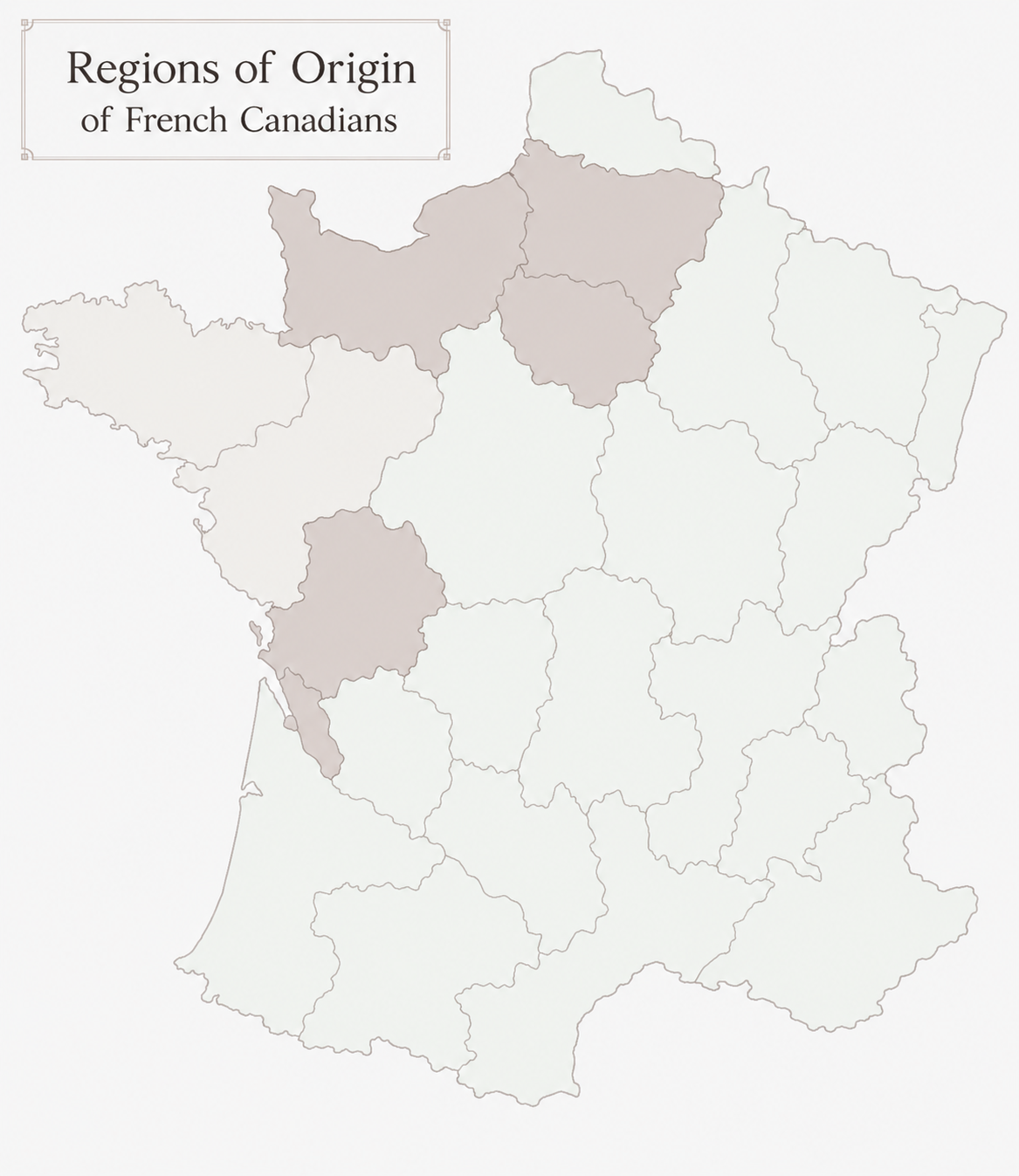
The four French regions that supplied the bulk of New France founders: Lower Normandy (Calvados, Manche, Orne, with the Perche zone particularly important), Picardy and Nord-Pas-de-Calais (the northern French coast and inland), Île-de-France (the Paris region, source of about half of the Filles du Roi), and Poitou-Charentes (especially the Loudunais, source of about 50 percent of Acadian founders, and the Aunis with La Rochelle as the main port of embarkation). Brittany and Pays de la Loire (shaded lighter) contributed sailors, fishermen, and a portion of the later Acadian resettlement. The remaining regions of France contributed only marginal numbers of founders to the New France stream.
3. The Huguenot question: largely excluded from New France
One of the persistent questions in French Canadian historiography is the role of French Protestants (Huguenots) in the colonization of New France. The answer is paradoxical. Huguenots financed and led the early Atlantic exploration: Samuel de Champlain himself, the founder of Quebec City, was raised in a Protestant family from Brouage in Saintonge and only formally converted to Catholicism in 1603. Pierre Dugua de Mons, who founded Port-Royal in 1604 and chose Champlain as his lieutenant, was an active Huguenot. The two most important port of departure for New France, La Rochelle and Dieppe, were both Protestant cities until the 1620s and remained centers of significant Protestant minorities thereafter.
Yet the official policy of the French Crown, from 1627 onwards, was to forbid Protestants from settling in New France. The Compagnie des Cent-Associes of 1627 explicitly restricted colonization to Catholics. The Edict of Nantes, which had granted limited religious freedom to Huguenots in France since 1598, did not apply to New France. After the revocation of the Edict of Nantes in 1685, when Louis XIV banned Protestantism in France entirely, Huguenot emigration was diverted to the Netherlands, England, Prussia, and the British American colonies (especially South Carolina and New York), not to Quebec. As a result, the Huguenot demographic contribution to French Canada was small and indirect. Some Huguenots converted to Catholicism in order to settle in New France; some came illegally or as soldiers and were tolerated locally; a small number of Huguenot ancestors appear in the BALSAC genealogy of modern Quebec.
The contrast with the Acadian case is sharp. Acadia was administratively more permissive in the early decades, and a substantial fraction of the Razilly and d'Aulnay recruits in the 1630s and 1640s were nominal Catholics but came from Loudunais and Aunis villages with significant Protestant populations. After the 1713 cession to Britain, the Acadians were officially Catholic but had been culturally isolated for two generations from the Catholic-Protestant tensions of metropolitan France. The Acadian gene pool therefore carries a small but real signal from formerly Protestant western French populations, particularly from La Rochelle and the Saintonge hinterland, where the Huguenot tradition was strongest.
4. Three streams, three destinations
The three demographic streams of New France produced three distinct colonial populations, each with its own subsequent history. The St. Lawrence valley population stayed in place after the British Conquest of 1760 and expanded through natural increase into modern French Canada. The Acadians were scattered by the Grand Derangement of 1755 to 1763 and reformed, against all odds, as the Cajuns of Louisiana, the Acadians of New Brunswick (the Maritimes returnees), and a smaller diaspora in Quebec (Gaspe Peninsula) and France (Belle-Ile-en-Mer). The Newfoundland and Saint-Pierre fishing population remained smaller and more seasonal but contributed substantially to specific regions of the Quebec coast (the North Shore, Iles-de-la-Madeleine).
The six migration flows that built French North America. Streams 1 (blue), 2 (green) and 3 (brown) carried founders directly from France to the three colonial anchors. Stream 4 (solid red) is the Grand Derangement and its Louisiana destination, the founding event of the Cajun population. Stream 5 (dashed red) is the partial Acadian return to New Brunswick (Madawaska, Cheticamp, Bouctouche) after 1763. Stream 6 (purple) is the late 19th century Franco-American emigration from Quebec to the New England textile mills, with peak intensity 1880 to 1920.
Settled by 8,500 founders from France between 1608 and 1760, with peak immigration in the 1660s during the Filles du Roi years. After 1760, the population expanded almost entirely through natural increase, with women routinely bearing 8 to 12 children. By 1850, the population reached 700,000; by 1950, 4 million; today, around 8.5 million in Quebec province plus a substantial diaspora in Ontario, Manitoba, New England, and elsewhere. The St. Lawrence stream is the demographic backbone of modern French Canada.
Settled by approximately 1,000 founders, mostly from the Loudunais (Poitou), Aunis, Saintonge, and Brittany. By 1755, the Acadian population had reached around 18,000. The Grand Derangement scattered them across the Atlantic world. About 6,000 to 7,000 were captured and deported; 2,000 escaped to the Miramichi region of present-day New Brunswick or to Quebec; 3,000 reached France. The remnant Maritime Acadians regrouped after 1764 in the Madawaska, Cheticamp, and other parts of New Brunswick and Cape Breton.
The first Acadian refugees reached Louisiana in 1764 via Santo Domingo. Spain, which had received the colony from France in 1762, welcomed them as Catholic loyalist farmers and granted them land in the prairies and bayous west of New Orleans (St. Martinville, Lafayette, Vermilionville). In 1785, seven Spanish ships brought 1,600 more Acadians directly from France. The Cajun population grew rapidly and absorbed smaller groups: French Creoles, German settlers along the Cote des Allemands, Spanish from the Canary Islands (the Islenos), and free people of color. By 2000, around 600,000 people in Louisiana identified as Cajun.
From the 1500s onwards, Norman, Breton and Basque cod fishermen operated seasonally on the Newfoundland banks. France maintained the colony of Plaisance (modern Placentia) until 1713, then retained only the "French Shore" (a fishing zone, not a settlement zone) and the islands of Saint-Pierre and Miquelon (kept by the Treaty of Paris of 1763). Some of these fishermen settled permanently in the Iles-de-la-Madeleine (after 1763) and along the Quebec North Shore (eastern part), contributing a distinct Norman-Breton-Basque component to those regional populations.
5. The Grand Derangement: the Acadian catastrophe
The deportation of the Acadians between 1755 and 1763 is one of the most thoroughly documented forced population displacements of the early modern Atlantic world. The triggering event was political: the Acadian refusal to swear an unconditional oath of allegiance to the British Crown. The Acadians had lived under British sovereignty since 1713 but had managed, for two generations, to maintain a position of practical neutrality between the British colonial administration and the French Crown. With the outbreak of the Seven Years' War in 1754 and the British fear of a fifth column in the strategically critical Bay of Fundy, the Nova Scotia Council under Governor Charles Lawrence decided in July 1755 to deport the entire Acadian population.
The military operation began at Fort Beausejour in August 1755 and at Grand-Pre and Pisiquit in September. Acadian men were summoned to the village churches and arrested, their farms burned, their livestock confiscated. Families were loaded onto British transport ships and dispersed across multiple destinations to prevent reunification. The historian Naomi Griffiths estimates that 7,000 Acadians were directly deported in the first wave (1755 to 1758), another 3,500 to 5,000 in the second wave (1758 to 1762, after the British capture of Louisbourg and Ile Saint-Jean), and that 3,000 to 5,000 more died from disease, drowning, starvation, or imprisonment during the events. The total demographic loss is estimated between 30 and 60 percent of the pre-1755 Acadian population.
About 7,000 Acadians from Grand-Pre, Pisiquit, Beaubassin, and the Annapolis Royal area are deported to the thirteen Anglo-American colonies: Massachusetts, Connecticut, New York, Pennsylvania, Maryland, Virginia (which refuses them and re-exports them to England), the Carolinas, and Georgia. Many die at sea; many are held in concentration camps for months. Some are sold as indentured laborers; some are imprisoned. Few are integrated into the local population.
After the British capture of Louisbourg in 1758, the Acadians who had taken refuge on Ile Saint-Jean (Prince Edward Island) and Ile Royale (Cape Breton) are also deported. About 3,500 are sent directly to France (mostly to Cherbourg, Saint-Malo, Nantes, and Belle-Ile-en-Mer). Others escape to Miramichi (New Brunswick), to the Gaspe Peninsula, to Madawaska, and to the St. Lawrence valley, where they form a recognizable Acadian minority within French Canada.
The roughly 3,000 Acadian deportees who reach France are largely refused integration. The French authorities try several resettlement schemes (in Poitou, in the Loire valley, at Belle-Ile-en-Mer) but most fail because the Acadians, used to the salt-marsh agriculture of the Bay of Fundy, cannot adapt to French rural life. By 1785, two thirds of these French Acadians depart for Louisiana, organized by a Spanish-funded expedition of seven ships from Nantes. They form the largest single Cajun founding wave.
The Spanish colonial governor Antonio de Ulloa welcomes the first Acadian refugees in 1764 and grants them land along Bayou Teche and the Mississippi alluvial prairie. By 1810, the Acadian population in Louisiana numbers 3,000 to 4,000. Endogamy is strict, French is preserved (in a distinct dialect that diverges from both Quebec French and continental French), and a recognizable Cajun cultural identity emerges by the early 19th century. The word "Cajun" itself is first attested in English around 1858, as an Anglophone deformation of "Cadien" (a shortening of "Acadien").
6. The genetics of modern Quebec: still essentially French
Four centuries of demographic isolation could have reshaped the French Canadian gene pool substantially. They did not. The population grew through natural increase from a restricted founder pool, with strong endogamy enforced by religious, linguistic, and geographic factors. The result is a population that is genetically still very close to its source regions in France, with the founder effect visible as increased homozygosity and elevated frequency of certain rare variants, but with no large-scale admixture from non-European sources.
For this article, we analyzed six anonymized Quebec samples (designated Quebec_sample_1 through Quebec_sample_6) on the Global25 PCA, using the Davidski Standard reference panel and comparing them to French regional populations. One additional Quebec sample available in the original dataset was excluded after inspection because the donor's genealogy indicated mixed (non-pure French Canadian) ancestry; the analyses below are based only on the six samples with documented full Quebec ancestry.
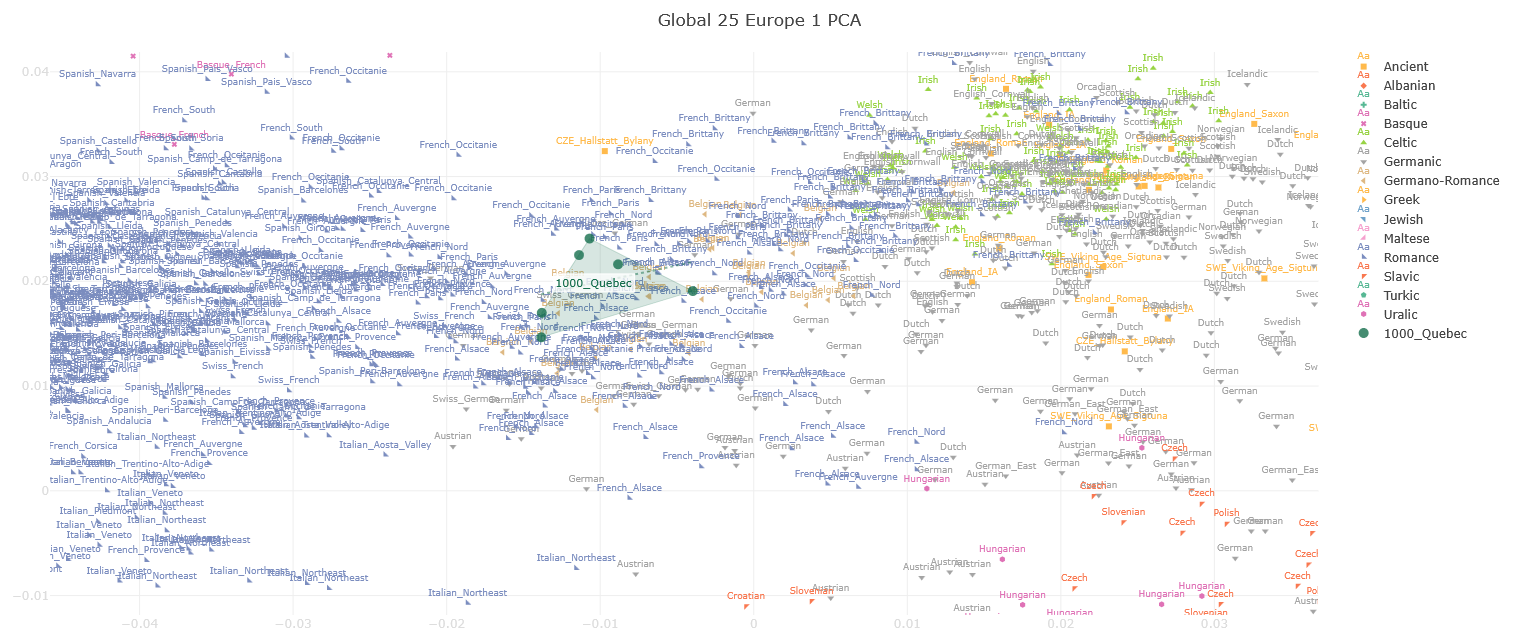
Global 25 Europe 1 PCA (Vahaduo). The dark green dots (1000_Quebec) plot the broader 1000 Quebec project cohort. They cluster tightly inside the French regional cloud, surrounded by French_Nord, French_Normandy, French_Paris, French_Alsace and French_Brittany labels, with French_Auvergne immediately below and French_Belgian-Dutch populations to the upper right. The Iberian populations sit to the left of the plot, the British and Irish to the upper right, the Italians to the lower left, and Central European Slavic and Germanic populations to the lower right. The Quebec polygon overlaps the heart of the northern and western French zone with no displacement toward British Isles, Iberian or any non-French cluster, confirming that the average Quebecer remains genetically inside the French cloud four centuries after the founding of the colony.
Distances from anonymized Quebec samples to French regional populations (G25 Euclidean)
Each row shows the closest French regional population to the corresponding Quebec sample, with the G25 distance and the next two closest references. Smaller distances mean closer genetic affinity. For context, the distance between two neighboring French regions (e.g. French_Normandy and French_Pas-de-Calais) is around 0.025, and the distance between French_Brittany and French_Provence is around 0.05.
| Sample | Closest match | Distance | Second match | Third match |
|---|---|---|---|---|
| Quebec_sample_1 | French (national) | 0.0284 | French_Nord (0.0288) | French_Occitanie (0.0292) |
| Quebec_sample_2 | French_Nord | 0.0230 | French_Alsace (0.0233) | French_Poitou-Charentes (0.0242) |
| Quebec_sample_3 | French_Poitou-Charentes | 0.0258 | French_Nord (0.0258) | French_Alsace (0.0259) |
| Quebec_sample_4 | French_Paris | 0.0273 | French_Pas-de-Calais (0.0299) | French (0.0307) |
| Quebec_sample_5 | French_Paris | 0.0172 | French_Nord (0.0192) | French (0.0198) |
| Quebec_sample_6 | French_Normandy | 0.0176 | French_Nord (0.0179) | French_Poitou-Charentes (0.0183) |
| Quebec average (n=6) | French_Nord | 0.0107 | French_Poitou-Charentes (0.0128) | French_Paris (0.0131) |
Three observations stand out. First, the closest matches concentrate on the northern and western French regional populations: French_Nord, French_Poitou-Charentes, French_Normandy, and French_Paris. This is exactly what would be predicted from the historical record of 8,500 founders drawn predominantly from Île-de-France, Normandy, Poitou-Charentes, and the Aunis-Saintonge area. Second, no sample matches a southern French population (French_Provence, French_Occitanie, French_Bigorre) as its closest reference, which is also consistent with the historical record: the south of France contributed almost nothing to the New France stream. Third, the Quebec average sits at a smaller G25 distance from French_Nord than two neighboring French regional populations sit from each other, meaning that the average Quebec individual is, autosomally, indistinguishable from a northern French.
The popular assumption
Four centuries of isolation, intermarriage with Indigenous peoples, and integration of Loyalists and Irish immigrants must have substantially reshaped the French Canadian gene pool by now. Modern Quebecers should be intermediate between French and something else, perhaps showing detectable British, Irish, or Native American components.
The genetic reality
On the Global25 PCA, every Quebec sample analyzed sits inside the French regional cloud, closer to a French region than to any non-French population. The Native American component, when present, averages around 1 percent at the population level (Bherer et al. 2011, Jomphe et al. 2012). Irish, Scottish, and English admixture is also visible only at low individual frequencies and does not shift the population mean detectably. The founder effect amplified specific rare alleles but did not import substantial non-French ancestry.
7. The genetics of the Cajuns: closer to Normandy and Brittany than to Paris
The Cajun population is genetically derived from a much narrower founder pool than the Quebec population: roughly 1,000 Acadian founders, filtered through the Grand Derangement, with a second filter applied by the Louisiana resettlement of 1764 to 1785. The result is a founder effect even stronger than the Quebec one, with high homozygosity and elevated frequency of specific founder mutations (such as the USH1C variant for Usher syndrome type I, which is shared between the Acadians of Louisiana, the Acadians of New Brunswick, and the Acadians of Gaspe).
We analyzed five anonymized Cajun samples (Cajun_sample_A through Cajun_sample_E) using the same Global25 methodology. Two of these samples come from individuals with documented 100 percent Cajun ancestry (all four grandparents from the same small Cajun town); the others have mixed Cajun and other French Canadian background.
Distances from anonymized Cajun samples to French regional populations (G25 Euclidean)
| Sample | Closest match | Distance | Second match | Third match |
|---|---|---|---|---|
| Cajun_sample_A | French_Alsace | 0.0140 | French_Nord (0.0163) | French (0.0163) |
| Cajun_sample_B | French_Brittany | 0.0096 | French_Normandy (0.0133) | French_Nord (0.0170) |
| Cajun_sample_C | French_Nord | 0.0132 | French_Normandy (0.0143) | French_Poitou-Charentes (0.0146) |
| Cajun_sample_D | French_Nord | 0.0113 | French_Poitou-Charentes (0.0124) | French_Alsace (0.0128) |
| Cajun_sample_E | French_Paris | 0.0363 | French_Pas-de-Calais (0.0364) | French (0.0367) |
| Cajun average (n=5) | French_Nord | 0.0118 | French_Poitou-Charentes (0.0129) | French_Normandy (0.0138) |
8. Native American ancestry in Quebec: small but real
One of the persistent questions in French Canadian genetics is the extent of Native American admixture. The French in New France were, on balance, much more willing to intermarry with Indigenous people than the English in the thirteen colonies. The fur trade, dominated by the coureurs des bois (French Canadian woodsmen) and the voyageurs, depended on alliances and marriages with Algonquian, Iroquoian, and Cree partners. The Metis population of the prairies, although mostly post-1815, traces a substantial part of its ancestry to French Canadian fur traders. So there was, demonstrably, a real demographic input from Indigenous populations into the broader French colonial gene pool of North America.
However, when this input is measured directly in the modern Quebec population, it turns out to be small. Bherer et al. 2011 in the American Journal of Physical Anthropology estimated the Native American component at around 1 percent on average across Quebec, with substantial variance between regional populations and between individuals. Jomphe, Lavoie, Moreau, and Labuda (2012) refined this estimate using both genealogical and genomic data and found that approximately 50 percent of contemporary French Canadians have at least one documented Native American ancestor in their genealogy, but that the autosomal contribution from this ancestor has been diluted by 8 to 10 generations of subsequent endogamy to a per-individual range of typically 0 to 5 percent, with a population mean closer to 1 percent.
9. The founder effect inside Quebec: SLSJ, Gaspe Acadians, and Gaspe Loyalists
While the average Quebecer is autosomally close to northern France, the modern Quebec population is not uniform. The Gagnon et al. 2024 study in the European Journal of Human Genetics, using the complete BALSAC genealogy of 665 subjects from eight regional and ethnocultural groups, showed that the Quebec population subdivides into five fine-scale subpopulations that emerged progressively from the 18th century onwards. Two of these subpopulations are particularly distinctive.
The Saguenay region was colonized starting in 1838 by families from neighboring Charlevoix, itself colonized in the late 17th century by a restricted number of founders. The SLSJ population grew 25-fold between 1861 and 1961 from a narrow base, creating one of the most studied founder effects in human genetics. SLSJ individuals share more short IBD segments than any other Quebec group, reflecting deep but distributed kinship. Specific rare variants are enriched 4-fold (spastic ataxia of Charlevoix-Saguenay) to 8-fold (Usher syndrome type I) compared to the general Quebec population (Gagnon et al. 2024 PLOS ONE).
Acadian refugees from the Grand Derangement settled in the Gaspe Peninsula starting in the second half of the 18th century. Linguistic and cultural barriers (their dialect was distinct from the Quebec French of the St. Lawrence valley) kept them endogamous for over a century. The GAC subgroup shows the highest inbreeding levels of any Quebec subpopulation and the strongest founder effect. Their pairs share more long IBD segments than any other Quebec group, indicating close, recent common ancestry. The USH1C founder mutation provides a direct genetic link between the Acadians of Gaspe and the Acadians of New Brunswick (Ebermann et al. 2007).
The broader Quebec population descended from the original 8,500 St. Lawrence founders has the lowest within-group relatedness of all Quebec subpopulations, reflecting more diverse founder ancestry. This cluster captures the demographic mainstream of French Canada: Montreal, Quebec City, Trois-Rivieres, and the surrounding seigneuries. Within this cluster, fine-scale geographic structure remains visible but is much subtler than in SLSJ or GAC.
The Gaspe Peninsula hosts not only Acadians but also three other distinct ethnocultural groups. The Gaspe Loyalists (descended from American Loyalists who fled after 1776) are genetically distinct from the other French Canadians on PC2 and PC3 of the regional PCA, reflecting British colonial origins. The Channel Islanders (mostly Jerseyais who came for the cod fishing industry in the early 19th century) are also distinct, with strong Norman-Breton-British affinities. The Gaspe French Canadians descend from the Lower St. Lawrence valley families that migrated downriver in the 1830s and 1840s.
10. NNLS modeling with a Mi'kmaq proxy
The geometric position of the Quebec and Cajun population means in Global25 PCA space can be modeled as a non-negative linear combination of source populations using NNLS. For this article we built the model using the ExploreYourDNA panel of French regional averages (which has substantially better sample sizes than the single-point Davidski coordinates: France_Brittany N=17, France_Lower_Normandy N=13, France_Nord-Pas-de-Calais N=13, France_Poitou-Charentes N=10, France_Upper_Normandy N=10, France_Pays_de_la_Loire N=8, and others). For the Indigenous American source we used Canada_400BP, a Canadian ancient DNA sample dated to approximately 1626 CE, which falls in the geographic and temporal window of contact between French settlers and the Mi'kmaq of Acadia (founded 1604), the Algonquin and Wendat of the St. Lawrence valley (Quebec founded 1608), and the other Northeastern Algonquian groups. Canada_400BP is the best available proxy for the Indigenous demographic input into French North America that does not introduce midpoint artifacts from Mesoamerican or Andean populations.
NNLS modeling of Quebec and Cajun population means with Mi'kmaq/Northeastern Indigenous proxy (Canada_400BP)
11. The Cajun cultural identity
While the genetic profile of the Cajuns has remained French, their cultural identity has developed into something distinct from both metropolitan French and from Quebec French. Cajun French, spoken by an estimated 150,000 to 200,000 people in Louisiana today, preserves many lexical and grammatical features of 17th and 18th century western French (Poitevin, Saintongeais) that have disappeared from modern continental French. The pronunciation has been influenced by neighboring English and by the Louisiana Creole French of the African American francophone population. The lexicon includes Indigenous, Spanish, and African loan words absent from Quebec French (banquette for sidewalk, lagniappe for bonus, gris-gris for charm).
Cajun music, with its central instruments of the diatonic accordion (introduced in the late 19th century by German settlers along the Cote des Allemands and adopted by Cajun musicians), the fiddle, the triangle, and later the guitar, has become one of the most recognized regional musical traditions of North America. The Cajun accordion (specifically the single-row diatonic accordion in the keys of C, D, or B-flat) defines the sound of the genre, accompanied by French-language lyrics that often deal with rural Louisiana life, love, lamentation, and the historical memory of the Grand Derangement. Closely related is Zydeco, the Creole francophone musical tradition that uses similar instruments but with stronger African American rhythmic input.
Cajun cuisine, which has crossed over into mainstream American food culture since the 1980s, combines French culinary techniques (roux, etouffee, court-bouillon) with Spanish, African, and Indigenous ingredients and methods (gumbo, jambalaya, file powder from sassafras leaves, the holy trinity of bell pepper, onion, and celery). The boudin sausage, the andouille, the tasso ham, and the crawfish boil are recognizable as French country cooking adapted to Louisiana ingredients and tastes. Boudin (the same word as in French, but pronounced "boo-dan" in Louisiana) is a pork-and-rice sausage that combines French charcuterie tradition with the Louisiana use of rice and Cajun spice mixes.
The Cajun identity has been politically and culturally reaffirmed since the 1970s. The CODOFIL (Council for the Development of French in Louisiana) was established in 1968 to promote French-language education in Louisiana public schools, with mixed success. Mardi Gras festivals in Cajun country (Mamou, Eunice, Church Point) differ markedly from the better-known New Orleans Mardi Gras and preserve specifically Cajun rural traditions (the Courir de Mardi Gras, a horseback ride through the countryside to collect ingredients for a communal gumbo). The recognition of Cajun ancestry as a U.S. Census category since 1990 has allowed roughly 600,000 Louisianans to claim it as their primary ethnic identification.
12. The North Shore, Iles-de-la-Madeleine, and the Atlantic fishermen
Beyond the Quebec and Acadian streams, a third French Atlantic stream deserves attention: the seasonal cod fishery of Newfoundland and the Gulf of Saint Lawrence, dominated since the 1500s by Norman, Breton, and Basque fishermen. Although this stream did not produce a continuous large settlement, it left two distinct demographic legacies on the modern Quebec map.
The first is the Iles-de-la-Madeleine (Magdalen Islands), an archipelago in the southern Gulf of Saint Lawrence. The islands were settled permanently after 1763 by Acadian refugees from the Grand Derangement, supplemented by Breton and Norman fishermen who had been using the islands as a seasonal base for over two centuries. The modern Madelinot population retains a recognizable Acadian identity but with stronger Norman-Breton autosomal input than the mainland New Brunswick Acadians.
The second is the eastern North Shore of Quebec, the long stretch of coastline north of the Saint Lawrence estuary running from Sept-Iles to Blanc-Sablon. The Gagnon et al. 2024 European Journal of Human Genetics study notes that the eastern North Shore was settled by "fishermen from Iles-de-la-Madeleine and Gaspe", not by St. Lawrence French Canadians, and that this gives the eastern North Shore population a distinct genetic profile, closer to the Acadian and Magdalen Islands populations than to the mainland Quebec stream. The North Shore subgroup shares more long IBD segments than the SLSJ subgroup, reflecting more recent common ancestors, but fewer short segments, reflecting a narrower founder base.
Saint-Pierre-et-Miquelon, kept by France in the Treaty of Paris of 1763 and again in 1814, remains the only French overseas territory in North America. Its population of around 6,000 traces ancestry to Breton, Norman, and Basque fishermen, with smaller Acadian and Madelinot input. The genetic profile of Saint-Pierrais today is closer to modern Breton and Norman populations than to mainland French Canadians, reflecting the continuous demographic input from western France during the 19th and early 20th centuries when the colony served as the base for the French Atlantic cod fleet.
13. The Scottish soldiers and the Irish famine orphans: post-Conquest admixture into French Canada
The British Conquest of 1760 ended the demographic isolation of New France. From 1760 onwards, a series of British, Scottish, and Irish demographic inputs reached the St. Lawrence valley and the Maritimes, several of which mixed into the French Canadian and Acadian gene pools through marriage and adoption. The two most significant of these inputs are the Highland Scottish soldiers of the 1760s and the Irish famine orphans of 1847. Both are visible in modern French Canadian autosomal data as small but consistent British Isles signals layered on top of the original French founder profile.
The 78th Fraser Highlanders, raised by Simon Fraser of Lovat in 1757, fought at the Plains of Abraham in 1759 under General Wolfe. The regiment was disbanded in Quebec in 1763. Roughly 150 to 250 Highland soldiers chose to stay rather than return to Scotland, in part because many were Catholic Highlanders for whom assimilation into the local Catholic seigneurial society was easier than for Lowland Protestants. They received land grants in Murray Bay (Malbaie), Mount Murray, and the Lower Saint Lawrence, swore allegiance to the British Crown, and married French Canadian women. Their Scottish surnames (Fraser, Macnider, McNicoll, Blackburn, McCartney, Cameron, Macleod, McLean) persist in Charlevoix, Bas-Saint-Laurent, and Gaspe families to this day. A second Highland wave arrived after 1810 with the Highland Clearances: roughly 25,000 Scottish Gaelic-speaking Catholic Highlanders settled in Cape Breton, Antigonish County, and Inverness County (Nova Scotia) between 1810 and 1840. Where these settlements bordered Acadian villages, notably around Cheticamp and the Pictou-Antigonish frontier, modest Highland-Acadian intermarriage occurred in mixed parishes.
The Great Irish Famine of 1845 to 1852 sent hundreds of thousands of Irish refugees across the Atlantic. In 1847, the "Black Year" of the famine, approximately 100,000 Irish immigrants arrived at the Grosse-Ile quarantine station downriver from Quebec City. Typhus killed an estimated 5,000 of them on the island itself and several thousand more on the so-called coffin ships and in Quebec City hospitals. The catastrophe left thousands of children orphaned. Bishop Pierre-Flavien Turgeon of Quebec and Bishop Ignace Bourget of Montreal issued formal appeals to French Canadian parishioners to adopt the Irish orphans, with the explicit condition (often respected) that the children retain their Irish surnames. Documented adoptions from 1847 to 1849 alone number around 1,300 to 1,500 children, with several thousand more informal placements through extended families and religious orders. The surnames Murphy, O'Brien, Ryan, Walsh, Kelly, Burke, Sullivan, Hurley, Hayes, Madden, and Donovan therefore appear today in Quebec French-speaking families whose autosomal profile is otherwise indistinguishable from their Quebec neighbors of pure French ancestry, except for an Irish autosomal signal of typically 25 to 50 percent in first-generation adoptees, diluted to 3 to 12 percent in their descendants after five generations of endogamy with French Canadian partners.
Beyond the 1847 orphan cohort, Catholic Irish immigration to Quebec was substantial throughout the 19th century. The 1851 Canadian census recorded roughly 50,000 Irish-born residents in Lower Canada (modern Quebec), a large majority of them Catholic and therefore religiously compatible with French Canadian society. Irish-French marriages, while less common than within-group marriages, accumulated steadily in the urban parishes of Quebec City (Saint-Roch, Saint-Sauveur, Saint-Patrick) and Montreal (Griffintown, Pointe-Saint-Charles, Saint-Henri), as well as in the Outaouais (Aylmer, Buckingham, Gatineau) and the Ottawa Valley lumber camps where Irish and French Canadian workers labored side by side. Surnames like Hurteau (Hurteau, originally probably a phonetic adaptation), Aquin (with some lineages tracing to an Irish ancestor named Hawkins), Riendeau (in some cases from Reardon), and several others document the Irish demographic input through onomastic Francization.
For the Acadians, the equivalent admixture pattern is different. The Acadian deportation of 1755 to 1763 occurred before the Highland Scottish and Irish famine waves reached the Maritimes, and the post-1764 Acadian returnees regrouped in dedicated Acadian villages (Caraquet, Bouctouche, Memramcook, Cheticamp) that remained ethnoreligiously endogamous for several generations. The principal exception is Cheticamp on Cape Breton Island, where the Acadian population coexisted from the 1810s onward with the neighboring Highland Catholic Scots of Inverness County. Modern Cheticamp Acadian families show a slightly elevated Scottish autosomal signal compared to New Brunswick Acadians, consistent with this localized admixture. The Cajuns of Louisiana experienced negligible Irish or Scottish demographic input: the Cajun gene pool was effectively closed by the 1820s once the major Acadian arrival waves ended, and the small Irish immigration into Louisiana of the 1830s to 1860s went mostly to New Orleans rather than to the Acadian parishes.
In autosomal Global25 modeling, this post-Conquest British Isles input is visible as a small Irish or Scottish component in NNLS fits for many modern Quebec individuals, typically in the 0 to 10 percent range, occasionally reaching 20 to 40 percent in specific lineages descending from a documented Irish or Scottish ancestor (a Fraser Highlander progenitor of an 18th century family, or an Irish famine orphan ancestor of a 19th century family). When a Quebecer's NNLS output shows a non-trivial Irish or Scottish component on top of an otherwise French profile, the 19th century BALSAC genealogy usually identifies the ancestor within four to six generations. The Anderson-Trocme et al. 2023 Science study of more than 20,000 Quebec genomes explicitly identifies Irish-derived ancestry in a substantial minority of modern Quebecers, with the strongest signals concentrated in regions of historical Irish settlement (Quebec City, Montreal, the Pontiac and Outaouais regions, the Eastern Townships).
14. The Franco-American emigration: 900,000 Quebecers to New England
Between 1840 and 1930, a major emigration wave took Quebecers south to the textile mills of New England. The economic push factors included rural overpopulation in the older Quebec seigneuries (where partible inheritance had subdivided farms below the level of viability after 200 years of high birth rates) and several crop failures in the 1840s and 1850s. The pull factor was the rapid industrial expansion of New England, which needed cheap labor for its textile, shoe, and paper mills. By 1900, roughly 600,000 Quebec-born people lived in New England; by the peak in 1930, the total Franco-American population (Quebec-born plus their American-born descendants) reached around 900,000.
The Franco-Americans concentrated in specific industrial cities: Lowell, Lawrence, and Fall River in Massachusetts; Manchester and Nashua in New Hampshire; Lewiston and Biddeford in Maine; Woonsocket and Central Falls in Rhode Island. They formed Little Canadas (Petits Canadas), French-speaking Catholic neighborhoods with their own parishes, parochial schools, mutual-aid societies, and newspapers. The Catholic Church played a central role in maintaining French language and identity, with bilingual parishes (the Eglise nationale) often in conflict with the Irish-dominated American Catholic hierarchy.
The French language declined sharply in New England between 1930 and 1980, primarily through the disappearance of bilingual parochial schools and the assimilation pressure of World War II and the post-war economic boom. By 2000, the U.S. Census still identified French and French Canadian as the largest reported ancestry in 50 counties of the United States, mostly in northern New England (especially Maine, where 5 of 16 counties had French Canadian as their plurality ancestry, the highest concentration outside Louisiana). The cultural revival since the 1970s has been driven by university programs (Universite du Maine a Fort-Kent, Universite du Vermont), genealogical interest, and the parallel Quebec sovereigntist movement, which has rekindled awareness of the Franco-American historical legacy.
15. Three transversal lessons
The Franco-American genetic story illustrates three general principles of population history that the modern paleogenetic literature has articulated in different contexts.
First, founder effects preserve source-region ancestry. The 8,500 French settlers of Quebec and the 1,000 Acadian founders did not undergo substantial admixture with the surrounding non-European populations after their arrival, despite four centuries of opportunity. Religion, language, geography, and political organization all conspired to keep the founder gene pool isolated. The modern Quebec and Cajun populations are therefore much closer, autosomally, to their 17th and 18th century French source regions than would be expected from the geographic distance and time depth alone. This is the same principle that explains why modern Mizrahi Jews are still closer to the Iron Age Levant than to their Mesopotamian or Persian hosts, and why modern Sicilians still carry detectable Magna Graecia signal 2,500 years after the founding of Syracuse. Endogamy preserves ancestry.
Second, demographic expansion from a narrow base creates founder-effect substructure. The Saguenay-Lac-Saint-Jean population grew 25-fold between 1861 and 1961 from a few hundred founding families recruited from neighboring Charlevoix. The result is one of the most studied founder effects in human genetics, with specific rare variants reaching 4-fold to 8-fold higher frequencies than in the broader Quebec population. The same applies to the Acadians of Gaspe, the Cajuns of Louisiana, and to a lesser extent the Madelinots of the Iles-de-la-Madeleine. Each of these populations descends from a restricted set of founders followed by demographic isolation and rapid expansion. The pattern reproduces, at smaller scale, what is seen in the Ashkenazi Jews (350 founders, expansion from medieval Rhineland), the Finns (small Neolithic and Bronze Age founders, expansion in the post-glacial period), and the Hutterites and Amish (~400 founders, rapid demographic expansion under endogamy).
Third, political borders are slower than genealogical drift but faster than genetic flow. The political border between French Canada and English Canada was drawn in 1760 by the British Conquest, and the political border between French Acadia and British Nova Scotia in 1713. Two and a half centuries later, the modern French Canadian and modern Acadian populations remain culturally and politically distinct from their Anglophone neighbors. The genetic boundary, however, is even sharper than the political one: French Canadian, Acadian, and Cajun populations have not significantly admixed with the surrounding English, Irish, Scottish, or American populations beyond ordinary individual exceptions. This is the opposite extreme from the Corsican case (politically French since 1768, autosomally Italian) or the British case (politically united since 1707, genetically still subdivided between Anglo-Saxon and Celtic substrate). In French North America, the political, linguistic, religious, and genetic boundaries have remained almost perfectly aligned.
16. G25 coordinates (Global25 scaled)
The following coordinates correspond to the populations and anonymized samples discussed in this article. The seven Quebec samples and five Cajun samples are anonymized public-domain coordinates from contributors to the ExploreYourDNA community. Copy them into Vahaduo, the Davidski Standard G25 Calculator (Calculator 2 on ExploreYourDNA), or the Modern World Regions Mythbuster (Calculator 173) for your own modeling.
Quebec_sample_1,0.127482,0.142174,0.052797,0.024548,0.041238,0.013387,-0.001645,0.001154,0.018203,0.018041,-0.004872,0.000749,-0.014569,-0.002615,0.013301,-0.004243,-0.019036,0.007221,0.009553,-0.005253,0,-0.005317,-0.006409,-0.004579,0.003233
Quebec_sample_2,0.127482,0.136081,0.0445,0.020995,0.034468,0.009203,0.00188,0.002769,0.01084,0.016766,-0.001137,0,-0.013677,-0.004129,0.014115,-0.003978,-0.014473,0.000507,0.000503,-0.004002,-0.003619,0.0115,-0.006162,0.00964,0.000718
Quebec_sample_3,0.12634365,0.142174119,0.052042653,0.01679608,0.043392736,0.007251157,-0.000470021,0.002307596,0.012680478,0.014032181,-0.011854355,0.004196265,-0.005351785,-0.008670228,0.013300589,-0.009281271,-0.01095226,-0.003040526,-0.002388263,-0.007878779,-0.003493835,0.001731138,-0.004806661,0.005904449,0.006586236
Quebec_sample_4,0.127482,0.137096,0.046763,0.028747,0.040007,0.00251,0.003995,0.006923,0.008999,0.020957,-0.002761,0.003747,-0.012636,-0.017616,0.017779,0.01538,0.017863,0.001014,0.000377,0.001876,0.001248,0.004081,-0.002342,0.00976,0.002515
Quebec_sample_5,0.121791,0.137096,0.053551,0.024548,0.041854,0.008646,-0.000235,0.001385,0.008999,0.021686,-0.005846,0.002398,-0.016947,-0.009496,0.015879,0.005436,-0.000913,-0.00038,0.005028,0.002251,-0.001872,0.00507,-0.002342,0.010122,0.007305
Quebec_sample_6,0.134311,0.139128,0.047517,0.031977,0.036622,0.012829,-0.00235,0.002769,0.006954,0.017859,-0.001137,0.001349,-0.009068,-0.013212,0.011129,0.008751,-0.001695,0.000127,0.005028,0.003252,0.006489,0.001978,-0.00037,0.001446,0.000838
Cajun_sample_A,0.127907,0.136810,0.048278,0.018096,0.038363,0.006940,0.000952,0.001147,0.010746,0.017336,-0.003757,0.005541,-0.012298,-0.002680,0.004248,0.002105,0.000096,0.000537,0.003230,-0.002124,0.000204,-0.000072,0.000398,0.004929,-0.000553
Cajun_sample_B,0.128992,0.134808,0.057201,0.035828,0.040889,0.012479,0.001172,0.003136,0.007876,0.009930,-0.004714,0.005330,-0.013687,-0.008838,0.017959,0.003400,-0.006770,0.001060,0.000417,0.002151,0.004823,0.000430,-0.000681,0.006271,0.000869
Cajun_sample_C,0.128926,0.134906,0.055467,0.027736,0.041985,0.008079,-0.002629,-0.001771,0.011326,0.016459,-0.003560,0.005853,-0.012978,-0.010042,0.010267,0.001761,-0.004979,0.001755,0.002582,-0.001813,0.001208,0.002148,-0.000878,0.006986,-0.000541
Cajun_sample_D,0.126975,0.133709,0.048072,0.027184,0.036082,0.010977,-0.000504,-0.000113,0.008457,0.013529,-0.003935,0.005616,-0.012531,-0.006574,0.009604,0.000563,-0.003782,0.000625,0.001718,-0.000843,0.001787,0.001141,0.000065,0.006830,-0.000362
Cajun_sample_E,0.136588,0.126941,0.046009,0.017119,0.040315,0.013387,0.003055,-0.002769,0.012885,0.018770,0.003085,0.001948,-0.017691,-0.017478,0.003393,0.014585,0.014342,-0.000633,0.005908,0.010255,0.001622,-0.002720,0.000493,0.009037,-0.000958
French,0.129086,0.142174,0.049857,0.021157,0.042162,0.005577,0.000587,0.003923,0.012066,0.022416,-0.00471,0.006144,-0.013479,-0.009496,0.011944,0.004243,-0.003912,0.000887,0.000628,-0.000625,0.004118,0.001113,-0.002342,0.001928,-0.000539
French_Poitou-Charentes,0.130024,0.140644,0.050431,0.024548,0.038423,0.008911,0.002115,0.003923,0.006954,0.011469,-0.005846,0.005995,-0.011382,-0.00963,0.011536,0.003448,-0.005215,0.001774,0.001257,0.000625,0.004492,0.001978,-0.001602,0.007471,-0.000419
French_Normandy,0.131466,0.139128,0.0535,0.029102,0.04231,0.012999,0.003586,0.001577,0.008373,0.011104,-0.005329,0.004146,-0.009741,-0.008594,0.013209,0.004552,-0.003259,0.000823,0.001131,-0.001876,0.005364,0.002411,-0.000123,0.005784,-0.001725
French_Brittany,0.131466,0.13834,0.05785,0.039285,0.039169,0.015813,0.003155,0.004211,0.008186,0.00949,-0.005131,0.00559,-0.014368,-0.013102,0.018343,0.004399,-0.007302,0.00128,-0.000462,0.001773,0.004467,0.001787,-0.001254,0.010547,0.000659
French_Nord,0.128275,0.140543,0.051357,0.025605,0.038273,0.008891,0.001097,0.00442,0.008373,0.012016,-0.003484,0.004033,-0.010861,-0.008182,0.011199,0.002543,-0.004607,0.002227,0.004095,0.001031,0.002133,0.001525,-0.001572,0.007471,0.000014
French_Paris,0.127171,0.141436,0.050431,0.02399,0.040903,0.009305,0.002799,0.005454,0.011602,0.018174,-0.007706,0.006812,-0.012906,-0.010384,0.01377,0.006063,-0.001825,0.004664,0.002708,-0.000978,0.002201,0.003575,-0.001232,0.011141,-0.001905
French_Seine-Maritime,0.136019,0.137096,0.045254,0.029555,0.039084,0.016733,0.00423,-0.000692,0.003988,0.006014,-0.003735,0.007493,-0.007582,-0.001651,0.014251,0.003514,-0.007953,-0.002344,0.000943,-0.005002,0.003931,0.005503,0.000863,0.004278,-0.004491
French_Pas-de-Calais,0.127861,0.140481,0.054305,0.026809,0.042162,0.012736,0.004152,0.001308,0.008522,0.012453,-0.008011,0.002198,-0.01001,-0.012019,0.013663,0.008132,-0.000478,0.001816,-0.003645,0.004252,0.009982,0.001443,-0.002547,0.005904,-0.001437
French_Alsace,0.127311,0.140372,0.050317,0.022432,0.038423,0.008911,0.00292,0.004875,0.006852,0.010679,-0.003134,0.004578,-0.009444,-0.00417,0.008561,0.003066,-0.004893,0.002439,0.003243,-0.000716,0.002764,0.001156,-0.001322,0.007137,-0.000314
French_Auvergne,0.125416,0.144656,0.04742,0.012992,0.043472,0.003997,-0.000339,0.002513,0.015407,0.022172,-0.002466,0.007355,-0.013969,-0.009669,0.008299,0.001483,-0.000787,0.001497,0.003073,-0.000213,0.001858,0.003737,-0.002282,0.001816,-0.000089
French_Occitanie,0.127039,0.144883,0.048879,0.017908,0.043376,0.003416,0.000522,0.003891,0.014856,0.023589,-0.003288,0.006582,-0.015044,-0.009458,0.010737,0.002567,-0.003709,0.002484,0.001425,0.000045,0.003671,0.002446,-0.00255,0.001767,0.000422
French_Provence,0.121925,0.143847,0.036891,0.005358,0.036858,0.00233,0.002267,0.003638,0.010058,0.020453,-0.003869,0.007211,-0.012138,-0.010961,0.005956,0.003174,0.001097,0.002809,0.001775,-0.001515,0.001541,0.002735,0.000355,0.005444,0.000035
Basque_French,0.128051,0.152025,0.055173,0.012823,0.056411,0.00251,-0.00141,0.003323,0.030597,0.041204,-0.009272,0.010341,-0.020976,-0.014024,0.013219,-0.001936,-0.011917,0.003028,-0.000716,-0.004415,0.010157,0.002485,-0.00864,-0.00917,0.000072
Spanish_Cataluna,0.114582,0.146236,0.045883,0.002369,0.047188,0,-0.002037,0.002384,0.022361,0.030494,-0.001895,0.008592,-0.016006,-0.010643,0.008867,0.001591,-0.000652,-0.001647,-0.001131,-0.000959,0.006197,-0.005729,-0.003903,-0.001928,0.000958
Canada_400BP,0.052359,-0.319892,0.120679,0.091409,-0.10125,0.004183,-0.208689,-0.249682,-0.00225,-0.026789,-0.000974,-0.002548,-0.003717,0.018441,-0.000407,0.021612,0.008996,0.012289,0.00264,-0.00988,-0.006364,-0.01014,-0.009244,0.005422,0.009819
17. Conclusion
The French presence in North America began with two small founding pulses: 8,500 settlers in the St. Lawrence valley between 1608 and 1760, and around 1,000 founders in Acadia between 1604 and 1755. Four centuries later, more than 11 million descendants of these founders live in Quebec, the Acadian Maritimes, Louisiana, New England, and elsewhere. Their cultural identity has diversified dramatically: French Canadians of Quebec, Acadians of New Brunswick, Cajuns of Louisiana, Madelinots of the Iles-de-la-Madeleine, Saint-Pierrais of the last French overseas territory in North America, Franco-Americans of Maine and Vermont. Their political fortunes have been wildly different, from the conquered but persistent French Canadians of the St. Lawrence to the scattered and reborn Acadians of the diaspora to the assimilated Franco-Americans of New England.
Their genetic profile, however, has remained remarkably uniform. On the Global25 PCA, the average modern Quebecer sits at distance 0.0107 from French_Nord, and the average Cajun at 0.0155 from France_Pays_de_la_Loire. These are smaller than the distance between two neighboring French regions. The same northern and western French source regions (Normandy, Poitou-Charentes, Île-de-France, Picardy, Brittany) that the historical record identifies as the principal contributors to the New France stream are still the closest matches in autosomal space today. The founder effect is visible only as elevated frequency of specific rare alleles within the population (USH1C in Acadians and Cajuns, the Charlevoix-Saguenay variants in SLSJ, several others) and as fine-scale structure between subpopulations (SLSJ, Gaspe Acadians, Gaspe Loyalists, Madelinots, North Shore eastern fishermen, Charlevoix descendants of Highland soldiers). The post-Conquest admixture from Highland Scottish soldiers (1760s) and Irish famine orphans (1847) adds a small but detectable British Isles signal to many French Canadian families, and a small Mi'kmaq signal sits in the Cajun gene pool from the 17th and 18th century Acadian-Mi'kmaq marriages. None of these inputs has displaced the dominant French founder profile.
What the genetic story confirms is the resilience of the founding pulse. Eight and a half thousand French settlers, dropped in a frozen valley in 1608, multiplied to eight million descendants. One thousand Acadian founders, deported, scattered, and reborn in Louisiana, are still autosomally Norman and Poitevin today. The Atlantic crossing, the harsh winters, the British Conquest, the Grand Derangement, the Cajun cultural reconstruction, the New England exodus, the linguistic assimilation, none of these events have erased the original signal. The Cajun bayou, the Quebec habitant, and the Acadian fisherman of the Bay of Fundy all carry, in their autosomal DNA, the same restricted slice of 17th century western France that crossed the ocean on the ships of Champlain, Razilly, d'Aulnay, and the Filles du Roi.
18. References
- Anderson-Trocme, L., Nelson, D., Zabad, S., Diaz-Papkovich, A., Baya, N., Touvier, M., Jeffery, B., Dina, C., Vezina, H., Kelleher, J., Gravel, S. (2023). On the genes, genealogies, and geographies of Quebec. Science, 380(6647), 849-855. DOI: 10.1126/science.add5300 BALSAC Quebec
- Gagnon, L., Moreau, C., Laprise, C., Vezina, H., Girard, S. L. (2024). Deciphering the genetic structure of the Quebec founder population using genealogies. European Journal of Human Genetics, 32(1), 91-97. DOI: 10.1038/s41431-023-01356-2 Genealogy SLSJ Gaspe Acadians
- Gagnon, L., Moreau, C., Laprise, C., Girard, S. L. (2024). Fine-scale genetic structure and rare variant frequencies. PLOS ONE, 19(11), e0313133. DOI: 10.1371/journal.pone.0313133 USH1C Rare variants
- Roy-Gagnon, M. H., Moreau, C., Bherer, C., St-Onge, P., Sinnett, D., Laprise, C., Vezina, H., Labuda, D. (2011). Genomic and genealogical investigation of the French Canadian founder population structure. Human Genetics, 129(5), 521-531. DOI: 10.1007/s00439-010-0945-x Quebec founder structure
- Bherer, C., Labuda, D., Roy-Gagnon, M. H., Houde, L., Tremblay, M., Vezina, H. (2011). Admixed ancestry and stratification of Quebec regional populations. American Journal of Physical Anthropology, 144(3), 432-441. DOI: 10.1002/ajpa.21424 Native American admixture
- Jomphe, M., Lavoie, E. M., Moreau, C., Labuda, D. (2012). L'apport des donnees genetiques a la mesure genealogique des origines amerindiennes des Canadiens francais. Cahiers Quebecois de Demographie, 41, 87-105. Indigenous admixture
- Moreau, C., Vezina, H., Yotova, V., Hamon, R., Knijff, P. D., Sinnett, D., Labuda, D. (2009). Genetic heterogeneity in regional populations of Quebec, parental lineages in the Gaspe Peninsula. American Journal of Physical Anthropology, 139(4), 512-522. DOI: 10.1002/ajpa.21012 Gaspe
- Ebermann, I., Lopez, I., Bitner-Glindzicz, M., Brown, C., Koenekoop, R. K., Bolz, H. J. (2007). Deafblindness in French Canadians from Quebec: a predominant founder mutation in the USH1C gene provides the first genetic link with the Acadian population. Genome Biology, 8(4), R47. DOI: 10.1186/gb-2007-8-4-r47 USH1C founder Acadian-Quebec link
- Robichaud, P. P., Allain, E. P., Belbraouet, S., Bherer, C., Mamelona, J., Harquail, J., et al. (2022). Pathogenic variants carrier screening in New Brunswick: Acadians reveal high carrier frequency for multiple genetic disorders. BMC Medical Genomics, 15(1), 98. DOI: 10.1186/s12920-022-01249-1 New Brunswick Acadians
- Gauvin, H., Moreau, C., Lefebvre, J. F., Laprise, C., Vezina, H., Labuda, D., Roy-Gagnon, M. H. (2014). Genome-wide patterns of identity-by-descent sharing in the French Canadian founder population. European Journal of Human Genetics, 22(6), 814-821. DOI: 10.1038/ejhg.2013.227 IBD
- Scriver, C. R. (2001). Human Genetics: Lessons from Quebec Populations. Annual Review of Genomics and Human Genetics, 2, 69-101. DOI: 10.1146/annurev.genom.2.1.69 Founder effect
- Laberge, A. M., Michaud, J., Richter, A., Lemyre, E., Lambert, M., Brais, B., Mitchell, G. A. (2005). Population history and its impact on medical genetics in Quebec. Clinical Genetics, 68(4), 287-301. DOI: 10.1111/j.1399-0004.2005.00497.x Medical genetics Quebec
- Charbonneau, H., Desjardins, B., Legare, J., Denis, H. (2000). The population of the St-Lawrence Valley, 1608-1760. In: A Population History of North America. Cambridge University Press, pp. 99-142. Historical demography
- Grace, R. J. (1993). The Irish in Quebec: An Introduction to the Historiography. Institut quebecois de recherche sur la culture. Irish immigration Quebec
- Marianna O'Gallagher (1984). Grosse Ile: Gateway to Canada 1832-1937. Carraig Books. Documents the Grosse-Ile quarantine station, the 1847 typhus catastrophe, and the adoption of Irish famine orphans by French Canadian families. Irish orphans Grosse-Ile
- Bumsted, J. M. (1982). The People's Clearance: Highland Emigration to British North America 1770-1815. Edinburgh University Press / University of Manitoba Press. Documents the Highland Scottish emigration to Cape Breton, Antigonish County, and the surrounding regions where Highland Scots Catholics settled adjacent to Acadian communities. Highland Scots Cape Breton
- Harper, M. (2003). Adventurers and Exiles: The Great Scottish Exodus. Profile Books. Scottish emigration Canada
- Charbonneau, H., Robert, N. (1987). The French origins of the Canadian population, 1608-1759. In: Historical Atlas of Canada, Volume I. University of Toronto Press, plate 45. Historical demography
- Desjardins, M., Frenette, Y., Belanger, J. (1999). Histoire de la Gaspesie. Editions de l'IQRC, Sainte-Foy, Quebec. 797 p. Gaspe history
- Pouyez, C., Lavoie, Y. (1983). Les Saguenayens. Introduction a l'histoire des populations du Saguenay. Presses de l'Universite du Quebec. 386 p. SLSJ history
- Griffiths, N. E. S. (2005). From Migrant to Acadian: A North American Border People, 1604-1755. McGill-Queen's University Press. Acadian history
- Brasseaux, C. A. (1987). The Founding of New Acadia: The Beginnings of Acadian Life in Louisiana, 1765-1803. Louisiana State University Press. Cajun foundation
- Davidski, A. (ongoing). Global25 PCA modern population averages, scaled coordinates. Eurogenes Blog. Reference panel used for all G25 distances and NNLS models in this article. eurogenes.blogspot.com G25 panel
- BALSAC (ongoing). BALSAC parish-record genealogical database, Universite du Quebec a Chicoutimi. balsac.uqac.ca Genealogy