

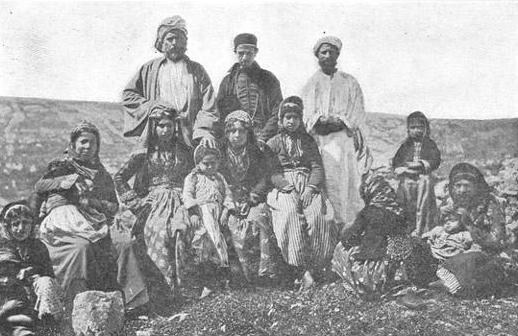
The Samaritans are the most extreme genetic isolate in the Levant, and one of the most extreme in the world. A community of approximately 800 to 900 people, descended from a founding population that collapsed to roughly 140 individuals in the early twentieth century, they have practiced absolute endogamy for far longer than the Druze and with a far smaller effective population. The genetic consequence is twofold. On the one hand, the Samaritans preserve the Bronze Age population of the southern Levant, the land of Canaan and Israel proper, in a form even more localised than the Druze preserve the northern Levant. On the Global25 PCA, the average Samaritan sits at a distance of just 0.0201 from Israel_Ashkelon_LBA, a Late Bronze Age Canaanite city population, the single closest ancient sample to any living group documented for the southern Levant. They carry the highest Natufian fraction of any living population on Earth, the autochthonous signature of the pre-agricultural Levant. On the other hand, the very smallness of the community has produced genuine genetic drift, which means that where the Druze serve as a robust population-scale proxy for the Levantine root of the Jewish diasporas, the Samaritans, for all their antiquity, do not. This article documents the Samaritan profile in detail, places it against its Bronze Age Canaanite predecessors, and then sets it directly against the Druze. The result is a clean dual portrait of the Levant: the Samaritans are the southern, Israelite-Canaanite isolate, anchored at Ashkelon and the highlands of Israel, while the Druze are the northern, Aramaean-Phoenician isolate, anchored at the Phoenician coast and Alalakh. The two surviving religious isolates of the Levant preserve opposite ends of the same Bronze Age cline, separated on Global25 by 0.0398, more than four times the internal distance within the Druze community itself.
Key Points
- The Samaritans (Hebrew: Shomronim, "Keepers of the Torah") are a religious community of approximately 800 to 900 people, split between Kiryat Luza on Mount Gerizim above Nablus, and Holon near Tel Aviv. They claim descent from the Israelite tribes of Ephraim and Manasseh, with a priestly line tracing to Levi, and they preserve their own version of the Torah, the Samaritan Pentateuch, while rejecting the rest of the Hebrew Bible.
- The Samaritans are the most extreme endogamous bottleneck population in the Levant. In the early twentieth century the community fell to roughly 140 individuals. Every living Samaritan descends from this tiny founder pool, and the present community is built on four extended patrilineal families. The effective population size is on the order of 1,800 times smaller than that of the Druze.
- The single closest ancient sample to the average Samaritan on Global25 is Israel_Ashkelon_LBA at a distance of 0.0201, a Late Bronze Age Canaanite population. The next closest are Lebanon_MBA (0.0234), Israel_MLBA (0.0236), and Jordan_LBA_IA (0.0238). Every one of the top twenty closest ancient populations is a southern or central Levantine Bronze Age or Iron Age group. The Samaritans are the cleanest living approximation to the Bronze Age population of Canaan and the land of Israel.
- The distal NNLS model returns for the Samaritan average: 40.1 percent Anatolia_N, 28.0 percent Natufian, 21.6 percent Iran_N, 10.3 percent CHG. The Natufian fraction of 28 percent is the highest of any living population, reflecting the deep autochthonous Levantine substrate. The Caucasian hunter-gatherer fraction of 10 percent is correspondingly the lowest among Levantine groups.
- The proximal NNLS model, using southern Levantine Bronze Age sources, returns the Samaritan average as 57.3 percent Israel_Ashkelon_LBA plus 42.7 percent Israel_MLBA, with zero Iranian plateau input and an excellent fit of 0.0161. The Samaritans flatly reject any Iranian or Caucasian-rich proximal source. They are a frozen southern Levantine Bronze Age population.
- The Samaritans and the Druze are not the same isolate. They sit 0.0398 apart on Global25, more than four times the 0.0093 internal distance between the two Druze sub-populations. The Samaritans are the southern Levantine (Israelite-Canaanite) isolate; the Druze are the northern Levantine (Aramaean-Phoenician) isolate. They preserve opposite ends of the same Bronze Age cline.
- The defining genetic difference is the Caucasian-Iranian component. The Druze carry roughly 15 percent CHG and require about 26 percent Iranian plateau input in proximal modelling. The Samaritans carry only 10 percent CHG and require zero Iranian input. The northern Levant absorbed the Caucasian-Iranian stream from the Middle Bronze Age onward; the southern Levant retained more of the original Natufian-Anatolian base.
- Despite their antiquity, the Samaritans are a worse proxy for the Jewish diasporas than the Druze. When each diaspora is modelled as Levantine proxy plus Italy_IA_Republic, the Druze give tighter NNLS fits for Iraqi (0.029 versus 0.046), Iranian (0.037 versus 0.059), Kurdish (0.031 versus 0.051), Syrian (0.018 versus 0.031), and Ashkenazi Jews (0.021 versus 0.028). The eastern Jewish diasporas carry the northern-Levantine Caucasian-Iranian component that the Druze preserve and the Samaritans lack.
- The worse Samaritan distal fit (0.040 versus 0.028 for the Druze) and the anomalous zeroing of the Iranian source are the empirical fingerprint of genuine genetic drift from the extreme founder effect. This is why, of the two living Levantine isolates, the Druze are the more reliable population-scale proxy, and the Samaritans are best understood as a high-precision but drift-distorted snapshot of one specific corner of the Bronze Age Levant.
- Y-chromosome studies (Shen et al. 2004, Oefner et al. 2013) found that Samaritan male lineages cluster with Jewish populations and with the Cohen modal haplotype, supporting a shared ancient Israelite paternal origin. The autosomal Global25 signal documented here is fully consistent: a southern Levantine Bronze Age core, frozen by a thousand years of religious endogamy and sharpened by a twentieth-century bottleneck.
1. Who are the Samaritans?
The Samaritans are a religious community that calls itself the Shomronim, a Hebrew word usually rendered as "Keepers" or "Guardians" of the Torah, and which also evokes the region of Samaria (Shomron) in the central highlands of the historical land of Israel. They are not, in their own self-understanding, a branch of Judaism. They are, by their own account, the remnant of the northern Israelite tribes, specifically Ephraim and Manasseh (the two sons of Joseph), together with a priestly lineage descended from Levi through Aaron. In the Samaritan account, it was the southern Judeans who departed from the original Israelite religion when they centred worship on Jerusalem, while the Samaritans preserved the older and correct practice on Mount Gerizim, the mountain above the modern city of Nablus that the Samaritan Pentateuch identifies as the chosen place of God.
The Samaritan religion is built on the Samaritan Pentateuch, a version of the Five Books of Moses written in the Samaritan script (a direct descendant of the Paleo-Hebrew alphabet, distinct from the square Aramaic script adopted by Jews after the Babylonian exile). The Samaritan canon contains only the Torah. The Prophets, the Writings, the Talmud, and the entire later apparatus of rabbinic Judaism are absent. Samaritan worship centres on Mount Gerizim, where the community gathers for the Passover sacrifice each spring, slaughtering sheep on the mountain in a rite that has not changed in form for over two thousand years and that no other community on Earth still practices. The Samaritan high priesthood, claimed as a continuous Aaronide line, is the oldest continuously functioning religious office in the Abrahamic world.
Today the community numbers approximately 800 to 900 individuals, living in two locations. The larger group lives in Kiryat Luza, a village on the slope of Mount Gerizim, within the Palestinian-administered area near Nablus. The second group lives in Holon, a suburb of Tel Aviv inside Israel. Members move between the two, and the community functions as a single endogamous unit. Samaritans hold both Israeli and Palestinian documents, occupy a uniquely neutral position between the two national communities, and speak Arabic and Modern Hebrew in daily life while preserving Samaritan Hebrew and Samaritan Aramaic as liturgical languages.
2. The most extreme founder effect in the Levant
To understand the Samaritan genome, one must understand the demographic catastrophe that very nearly ended the community. In late antiquity the Samaritans were a substantial population, numbering perhaps several hundred thousand, spread across Samaria and the coastal plain. A series of revolts against Byzantine rule in the fifth and sixth centuries CE was crushed with enormous loss of life, and the community entered a long decline accelerated by forced conversion, persecution, and economic marginalisation under successive Byzantine, Islamic, Crusader, and Ottoman rulers. By the early twentieth century the entire worldwide Samaritan population had fallen to roughly 140 individuals, concentrated in Nablus. The community stood at the edge of extinction.
From that founder pool of around 140 people, the modern community has slowly recovered to its present 800 to 900, through high birth rates within an extremely restricted marriage pool. Nearly every living Samaritan can trace descent to one of four patrilineal families. The genetic consequence is the most extreme runs-of-homozygosity profile and the highest documented consanguinity of any Levantine population, exceeding even that of the Druze and the Ashkenazi Jews. The community faces a well-known catalogue of recessive disorders, and in recent decades the priesthood has cautiously permitted a small number of marriages to outside women (converts who adopt the religion fully), specifically to widen the gene pool and reduce the burden of inherited disease. This is the one crack in an otherwise absolute endogamy, and it is recent enough not to affect the ancestral signal documented here.
The Assyrian conquest of the kingdom of Israel deports part of the northern Israelite population. In the Samaritan account, the core of the population remained on the land and preserved the original religion. In the rival Judean account (2 Kings), the region was resettled with foreign peoples. The genetic data documented here supports substantial Israelite continuity: the Samaritans are autosomally a southern Levantine Iron Age population, not an imported one.
A Samaritan temple is built on Mount Gerizim during the Persian period, formalising the religious split between Samaritans and Judeans. The two communities, already diverging, now have separate cultic centres: Gerizim for the Samaritans, Jerusalem for the Judeans. Both descend from the same Iron Age Israelite population, which is why both remain genetically Levantine to the present day.
The Hasmonean ruler John Hyrcanus destroys the Samaritan temple on Mount Gerizim, deepening the enmity between the two communities. The Samaritans continue to worship on the mountain itself, which they still do today, the only sacrificial worship surviving from the ancient Israelite world.
A series of revolts against Byzantine rule, the largest under Julianus ben Sabar (529 CE), are crushed with catastrophic loss of life. Tens of thousands of Samaritans are killed, enslaved, or forced to convert. The community never recovers its former size. This is the demographic turning point from which the modern bottleneck ultimately descends.
Under Islamic, Crusader, and Ottoman rule the Samaritan community contracts steadily through conversion, taxation, and isolation. By the Ottoman period the Samaritans survive only in Nablus, a small and impoverished community defined entirely by its religion and its mountain.
The community reaches its nadir at roughly 140 individuals. From this founder pool it slowly recovers, splitting into the Nablus (Kiryat Luza) and Holon communities in the twentieth century. The present population of around 800 to 900 carries the genetic signature of that extreme bottleneck: maximal homozygosity, maximal consanguinity, and a frozen, drift-sharpened southern Levantine Bronze Age profile.
3. The Samaritans on Global25: a southern Levantine Bronze Age continuum
When all ancient populations in the Davidski Global25 panel are ranked by Euclidean distance from the average Samaritan coordinates, the result is unambiguous and geographically tight. The twenty closest ancient samples are exclusively southern and central Levantine Bronze Age and Iron Age populations, with the Canaanite cities of the coast and the highlands at the very top. The single closest is Israel_Ashkelon_LBA, the Late Bronze Age population of the great Canaanite port city of Ashkelon, at a distance of just 0.0201. This is the closest match between a living population and a southern Levantine ancient sample anywhere in the panel, and it is closer than the Druze match to their own nearest Phoenician predecessor.
| Rank | Ancient sample | G25 distance to Samaritan average | Approximate date | Context |
|---|---|---|---|---|
| 1 | Israel_Ashkelon_LBA | 0.0201 | ~1600 to 1200 BCE | Late Bronze Age Canaanite Ashkelon, southern coast |
| 2 | Lebanon_MBA.SG | 0.0234 | ~2000 to 1550 BCE | Middle Bronze Age Sidon, Canaanite coast |
| 3 | Israel_MLBA | 0.0236 | ~2000 to 1200 BCE | Middle to Late Bronze Age southern Levant |
| 4 | Jordan_LBA_IA | 0.0238 | ~1500 to 800 BCE | Late Bronze and Iron Age Transjordan |
| 5 | Lebanon_EjJaouze_Phoenician.SG | 0.0250 | ~800 to 300 BCE | Iron Age Phoenician highland site |
| 6 | Lebanon_IA3.SG | 0.0266 | ~600 to 300 BCE | Late Iron Age Lebanese |
| 7 | Syria_Ebla_EMBA | 0.0289 | ~2500 to 1500 BCE | Early to Middle Bronze Age Ebla, northern Syria |
| 8 | Lebanon_Chhim_Phoenician.SG | 0.0291 | ~800 to 300 BCE | Iron Age Phoenician site, southern Lebanon |
| 9 | Israel_IA_o | 0.0293 | ~1200 to 600 BCE | Iron Age southern Levant, outlier |
| 10 | Israel_IA | 0.0293 | ~1200 to 600 BCE | Iron Age southern Levant (Israelite period) |
| 11 | Jordan_LBA | 0.0297 | ~1550 to 1200 BCE | Late Bronze Age Transjordan |
| 12 | Lebanon_Roman.SG | 0.0303 | ~50 BCE to 400 CE | Roman-era Lebanese |
| 13 | Turkey_MBA | 0.0306 | ~2000 to 1500 BCE | Middle Bronze Age Anatolia |
| 14 | Israel_Ashkelon_IA2 | 0.0312 | ~1000 to 600 BCE | Iron Age II Ashkelon |
| 15 | Turkey_Alalakh_MLBA | 0.0317 | ~2000 to 1200 BCE | Northern Levantine Bronze Age, Mukish kingdom |
| 16 | Lebanon_Medieval.SG | 0.0318 | ~600 to 1500 CE | Medieval Lebanese |
| 17 | Lebanon_IA2.SG | 0.0332 | ~900 to 600 BCE | Iron Age II Lebanese |
| 18 | Turkey_TellAtchana_MLBA | 0.0333 | ~2000 to 1200 BCE | Alalakh, alternate sample |
Where the Druze nearest neighbours run up the Phoenician coast and into the northern Levant and Anatolia (Ej Jaouze, Chhim, Alalakh, Roman and Byzantine Anatolia), the Samaritan nearest neighbours cluster on the southern coast and the highlands of Israel and Transjordan (Ashkelon, Israel_MLBA, Jordan_LBA, Israel_IA). The two living isolates are pulling their ancestry from two adjacent but distinct corners of the same Bronze Age world. The Samaritans are the population of Canaan and Israel proper; the Druze are the population of Phoenicia and Aram.
4. The Bronze Age Canaan to Samaritan continuity, visualised
The southern Levantine continuity. The four ancestral components combine in the Bronze Age Canaanite populations of Ashkelon, Sidon, and the highlands of Israel around 1500 BCE. That profile, unusually rich in Natufian and unusually poor in Caucasian hunter-gatherer ancestry, is transmitted through the Iron Age Israelite populations of Samaria and the coast, and is preserved in the modern Samaritans in a form sharpened by the twentieth-century bottleneck. The Druze, treated in the companion article, descend from the parallel but distinct northern Levantine line.
5. The distal NNLS model: the highest Natufian fraction of any living population
Decomposed into the four canonical southwest Asian sources (Anatolia_N represented by Turkey_Barcin_LN, Iran_N by Iran_GanjDareh_N, CHG by Georgia_Kotias, and Natufian by Israel_Natufian), the Samaritan average is 40.1 percent Anatolian Neolithic, 28.0 percent Natufian, 21.6 percent Iranian Neolithic, and 10.3 percent Caucasian hunter-gatherer. The defining feature is the Natufian fraction of 28 percent, the highest of any living population on Earth, paired with the lowest Caucasian hunter-gatherer fraction of any Levantine group. The Druze average is shown for direct comparison.
Distal NNLS: Anatolia_N / Natufian / Iran_N / CHG for the Samaritans and the Druze
6. The proximal NNLS model: 57 percent Ashkelon, 43 percent Israel Bronze Age, zero Iranian
When the Samaritans are modelled against southern Levantine Bronze Age sources directly (Israel_Ashkelon_LBA and Israel_MLBA), with the Iranian plateau population Iran_DinkhaTepe_BA also offered to the algorithm, the result is decisive. The Samaritan average resolves to 57.3 percent Israel_Ashkelon_LBA plus 42.7 percent Israel_MLBA, with the Iranian source assigned exactly zero weight, at an excellent fit of 0.0161. The Druze run through the same three sources is shown beneath for contrast: the Druze cannot be modelled without the Iranian source, which takes 26.5 percent of their ancestry.
Proximal NNLS: Israel_Ashkelon_LBA / Israel_MLBA / Iran_DinkhaTepe_BA
7. The Druze and the Samaritans: the two Levantine isolates compared
The Levant today preserves two living religious isolates of pre-Arab ancestry: the Druze (treated in the companion article) and the Samaritans. They are often grouped together as "the surviving Levantine isolates", and in a broad sense they are alike: both are endogamous, both predate the Arab conquest, both preserve a Bronze Age genome that the surrounding modern populations have lost through later admixture. But genetically they are not the same population, and the difference is structured and informative. They sit 0.0398 apart on Global25, more than four times the 0.0093 internal distance between the Israeli and Lebanese Druze. They are two distinct snapshots of two distinct corners of the Bronze Age Levant.
| Feature | Samaritans | Druze |
|---|---|---|
| Closest ancient sample | Israel_Ashkelon_LBA (0.0201) | Lebanon_EjJaouze_Phoenician (0.0235) |
| Geographic anchor | Southern Levant: Canaan, Israel, Samaria | Northern Levant: Phoenicia, Aram, Alalakh |
| Historical identity | Israelite-Canaanite (Ephraim, Manasseh) | Aramaean-Phoenician-Canaanite |
| Natufian (distal) | 28.0 percent (highest alive) | 17.6 percent |
| CHG (distal) | 10.3 percent (lowest Levantine) | 14.7 percent |
| Iranian plateau (proximal) | 0 percent | 26.5 percent |
| Religious closure | Ancient, gradual (schism by ~400 BCE) | Abrupt, 1043 CE |
| Founder bottleneck | Extreme: ~140 people, ~1917 | Moderate: 11th century closure |
| Present population | ~800 to 900 | ~1.5 million |
| Distal NNLS fit | 0.040 (drift-affected) | 0.028 |
8. The Samaritans as a proxy for the Jewish diasporas: why the Druze are better
In the companion article we used the Druze as a clean proxy for the Levantine root of the worldwide Jewish diasporas, modelling each diaspora as a binary mixture of Druze (Levantine root) and Italy_IA_Republic (a pre-Roman European proxy). It is natural to ask whether the Samaritans, who are even older as an isolate and who match the Bronze Age southern Levant even more tightly, might be a better proxy still. The answer, perhaps counterintuitively, is no. Across almost every diaspora, the Druze give a better fit.
Jewish diasporas modelled as Samaritan (Levantine root) + Italy_IA_Republic
| Diaspora | Druze proxy: percent Levant (fit) | Samaritan proxy: percent Levant (fit) | Better proxy |
|---|---|---|---|
| Iraqi_Jew | 100 percent (0.029) | 100 percent (0.046) | Druze |
| Iranian_Jew | 100 percent (0.037) | 99.8 percent (0.059) | Druze |
| Kurdish_Jew | 100 percent (0.031) | 100 percent (0.051) | Druze |
| Syrian_Jew | 89 percent (0.018) | 79 percent (0.031) | Druze |
| Ashkenazi | 58 percent (0.021) | 50 percent (0.028) | Druze |
| Italian_Jew | 68 percent (0.018) | 60 percent (0.018) | tie |
| Moroccan_Jew | 73 percent (0.042) | 66 percent (0.037) | Samaritan |
| Yemenite_Jew | 100 percent (0.108) | 100 percent (0.080) | Samaritan |
The pattern is coherent. The eastern, Mizrahi diasporas (Iraqi, Iranian, Kurdish, Syrian) and the European-admixed Ashkenazim all fit the Druze better, because the historical Jewish populations carry the northern-Levantine Caucasian-Iranian component that the Druze preserve and the Samaritans almost entirely lack. The only diasporas where the Samaritan proxy wins are Moroccan and Yemenite Jews, the two communities with the most southern-Levantine, Natufian-rich, and African-adjacent ancestry, which the Samaritan's elevated Natufian happens to capture better. Even there, the Yemenite fits are poor for both proxies (0.080 and 0.108), because neither proxy models the substantial Sub-Saharan African and Arabian Peninsular component of the Yemenite Jewish gene pool.
9. The Samaritan Global25 coordinate
For readers who wish to reproduce the analysis in Vahaduo or any Global25 tool, the scaled average Samaritan coordinate used throughout this article is given below.
10. Myth versus reality
Myth
- The Samaritans are descendants of foreign peoples resettled in Samaria by the Assyrians, with no real Israelite ancestry.
- Samaritans and Jews are genetically unrelated communities that simply share a region.
- Because they are so ancient and so isolated, the Samaritans must be the single best living proxy for ancient Israelite and Jewish ancestry.
- The Druze and the Samaritans are essentially the same kind of Levantine population.
Reality
- The Samaritans are autosomally a southern Levantine Bronze and Iron Age population, matching Canaanite Ashkelon at 0.0201. The Israelite substrate is genetically real.
- Samaritan Y-lineages cluster with Jewish populations and the Cohen modal haplotype (Shen et al. 2004, Oefner et al. 2013). The two communities share a common ancient Israelite paternal origin.
- They are the best proxy for one specific corner of the Bronze Age southern Levant, but their extreme founder effect has drifted them off-centre, making the Druze the more robust proxy for the Jewish diasporas as a family.
- They sit 0.0398 apart, four times the internal Druze distance. The Samaritans are the southern isolate, the Druze the northern one.
11. Conclusion
The Samaritans are at once the most precise and the most fragile genetic record in the Levant. A community that fell to roughly 140 people a century ago, they nonetheless preserve, in nearly undiluted form, the Bronze Age population of Canaan and the land of Israel: the highest Natufian fraction of any living group, a perfect southern Levantine proximal fit at Ashkelon and Israel_MLBA, and zero of the Caucasian-Iranian input that defines their northern cousins. Set against the Druze, they complete the picture. The Druze are the northern Levant frozen in 1043; the Samaritans are the southern Levant frozen by a far older and far crueller history. Between them, the two surviving Levantine religious isolates reconstruct both endpoints of the Bronze Age cline that ran from Alalakh and the Phoenician coast in the north to Ashkelon and the highlands of Israel in the south. The Jewish diasporas, the Lebanese, the Syrians, and the Palestinians all descend from points along that same cline, overlaid to varying degrees by later admixture. The Samaritans, more than any other living people, show us what its southern end looked like before any of that overlay arrived.
References
- Shen, P., Lavi, T., Kivisild, T., et al. (2004). Reconstruction of patrilineages and matrilineages of Samaritans and other Israeli populations from Y-chromosome and mitochondrial DNA sequence variation. Human Mutation, 24(3), 248 to 260. DOI: 10.1002/humu.20077 Y-DNA, mtDNA
- Oefner, P. J., Hoelzl, G., Shen, P., et al. (2013). Genetics and the history of the Samaritans: Y-chromosomal microsatellites and genetic affinity between Samaritans and Cohanim. Human Biology, 85(6), 825 to 858. DOI: 10.3378/027.085.0601 Y-DNA
- Agranat-Tamir, L., Waldman, S., Martin, M. A. S., et al. (2020). The Genomic History of the Bronze Age Southern Levant. Cell, 181(5), 1146 to 1157. DOI: 10.1016/j.cell.2020.04.024 Bronze Age Levant
- Feldman, M., Master, D. M., Bianco, R. A., et al. (2019). Ancient DNA sheds light on the genetic origins of early Iron Age Philistines. Science Advances, 5(7), eaax0061. DOI: 10.1126/sciadv.aax0061 Ashkelon
- Haber, M., Doumet-Serhal, C., Scheib, C., et al. (2017). Continuity and Admixture in the Last Five Millennia of Levantine History from Ancient Canaanite and Present-Day Lebanese Genome Sequences. American Journal of Human Genetics, 101(2), 274 to 282. DOI: 10.1016/j.ajhg.2017.06.013 Levantine continuity
- Bonné-Tamir, B., et al. (2003). Maternal and paternal lineages of the Samaritan isolate: mutation rates and time to most recent common male ancestor. Annals of Human Genetics, 67(2), 153 to 164. DOI: 10.1046/j.1469-1809.2003.00024.x Samaritan founder
- Davidski (Eurogenes). Global25 scaled coordinates and the Vahaduo Global25 tools. NNLS modelling performed for this article in Python (scipy). G25 method