

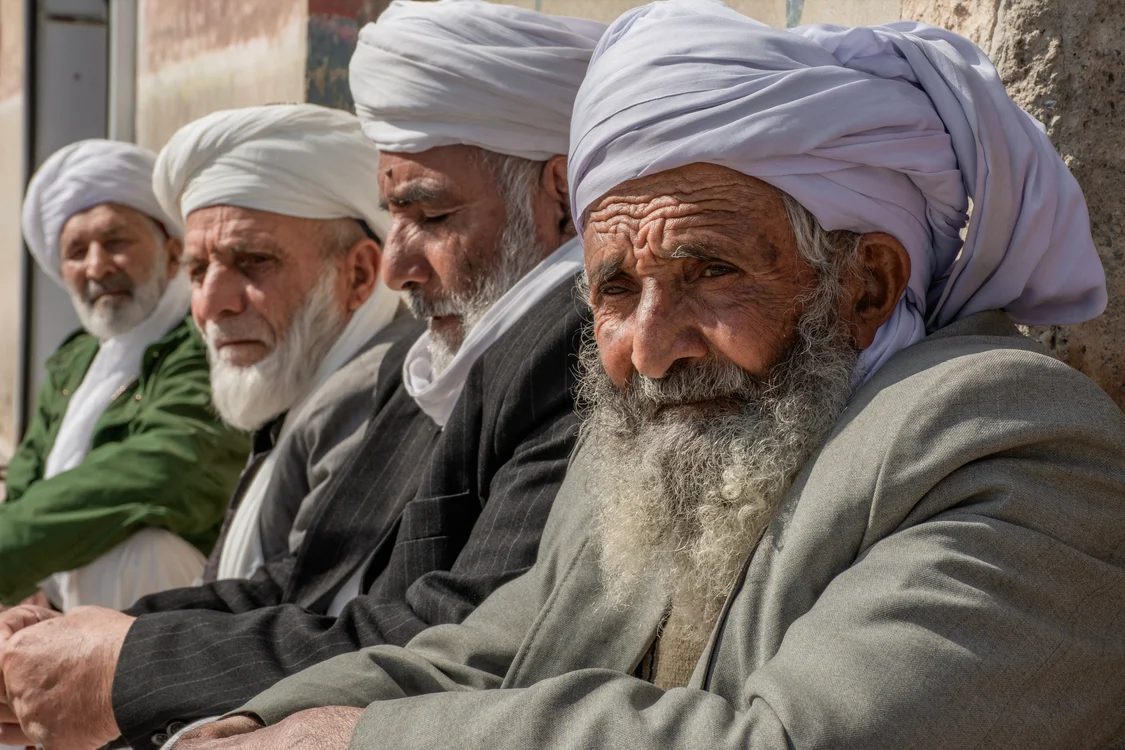
The Druze are the cleanest living mirror we have of the medieval Levant, and through it, of the Bronze Age and Iron Age populations that built the Phoenician city-states, the kingdoms of Israel and Judah, the Aramaean polities, and the Canaanite world that preceded them all. A religious community formally closed to new conversions in 1043 CE, after a brief 26-year window of public preaching under the Fatimid Caliph al-Hakim bi-Amr Allah and his theologians Hamza ibn Ali and al-Muqtana Baha'eddin, the Druze have practiced absolute endogamy for nearly a thousand years. No conversion in, no conversion out, marriage outside the community resulting in the loss of Druze status for the individual and all descendants. Today, approximately 1.5 million Druze live in Syria, Lebanon, Israel, and Jordan, with a small diaspora in the Americas. On the Global25 PCA, the average Druze sits at a distance of 0.024 from Iron Age Phoenician samples, 0.028 from Bronze Age northern Levantines, and 0.029 from Roman and Byzantine Lebanese. The Druze are, autosomally, what Levantines looked like before the Arab conquest of 636 CE, before the Crusades, before the Ottoman empire, before any of the demographic transformations that reshaped the rest of the Eastern Mediterranean. They are the closest living approximation we have to the genome of the ancient Israelites, the Phoenicians, the Canaanites, and the Aramaeans. This article documents that continuity in detail, then uses the Druze profile as a clean proxy for the Levantine root of all major Jewish diasporas. The result is a striking gradient: Iraqi Jews model as 94 percent Druze, Moroccan Jews 79 percent, Sephardim 74 percent, Italian Jews 67 percent, Ashkenazim 45 percent. The percentages precisely track the historically documented intensity of European admixture in each community, confirming with NNLS modelling what the textual record has long suggested: the Jewish diasporas and the Druze share a common Levantine ancestor from before the Roman period, and the Druze are the better-preserved branch of that shared trunk.
Key Points
- The Druze religion was founded between 1017 and 1043 CE under the Fatimid Caliph al-Hakim bi-Amr Allah. The community formally closed to new conversions in 1043 CE and has practiced absolute endogamy ever since, for nearly 1,000 years. The genetic consequence of this closure is one of the cleanest religious isolates documented in human population genetics.
- The 12 closest ancient samples to the average Druze on Global25 are all Levantine Iron Age, Bronze Age, Roman, or Byzantine populations. The closest is Lebanon_EjJaouze_Phoenician at G25 distance 0.0236, followed by Lebanon_Chhim_Phoenician (0.0241), Turkey_RomanByzantine (0.0243), Iran_DinkhaTepe_BA_IA (0.0263), Turkey_Alalakh_MLBA (0.0275), Lebanon_Medieval (0.0285), Lebanon_Roman (0.0293), Lebanon_IA3 (0.0317), and Syria_Ebla_EMBA (0.0332).
- Druze_Israel and Druze_Lebanon sit at a G25 distance of 0.0086 from each other, comparable to the internal distance within a tightly endogamous regional population. Despite a century of political separation between the Israeli Galilee and Mount Lebanon Druze communities, the two subpopulations have not drifted apart in any detectable way.
- The classical distal NNLS model returns for the Druze average: 44.4 percent Anatolia_N, 22.0 percent Iran_N (Zagros Neolithic), 18.3 percent Natufian (Levantine hunter-gatherer), 15.3 percent CHG (Caucasian hunter-gatherer). This is the canonical Bronze Age Levantine ancestry profile (Haber et al. 2017, Agranat-Tamir et al. 2020), with the Caucasian-Iranian fraction characteristic of Levantine populations from the Middle Bronze Age onward.
- The proximal NNLS model returns 72 percent Turkey_Alalakh_MLBA (northern Levantine Middle-Late Bronze Age, the kingdom of Mukish around Aleppo) and 28 percent Iran_DinkhaTepe_BA, with an excellent fit of 0.016. The Druze are essentially a frozen northern-Levantine Bronze Age population.
- Runs of homozygosity (ROH) in modern Druze are comparable to or higher than Ashkenazi Jews (Carmi et al. 2014, Vahaba et al. 2020). The community is a recognised medical genetics isolate, with elevated frequencies of familial Mediterranean fever, congenital nephrotic syndrome of the Finnish type variant, and over a dozen other founder mutations specific to the community (Marshall et al. 2016, Vahaba et al. 2020).
- When each Jewish diaspora is modelled as a binary mixture of Druze (the Levantine root proxy) and Italy_IA_Republic (a clean pre-Roman Italian European proxy), the resulting gradient is: Iraqi Jews 94 percent Druze, Moroccan Jews 79 percent, Sephardim 74 percent, Italian Jews 67 percent, Ashkenazim 45 percent. The gradient precisely tracks the historically documented intensity of European admixture in each community.
- The Druze are an excellent proxy for the Levantine root of Jewish populations because they are chronologically and geographically appropriate. They crystallised as an isolate in the 11th century CE, exactly contemporary with the consolidation of the European Jewish diasporas, and they preserve a pre-Arab Levantine signal that includes the Caucasian-Iranian component characteristic of the Levant from the Middle Bronze Age onward.
- Iraqi Jews sit at G25 distance 0.0207 from the Druze average, closer to the Druze than the Druze are to their own Iron Age Phoenician predecessors (0.0236). This is one of the most striking single-statistic demonstrations of the shared Levantine continuity that underlies both communities.
- The Druze gene pool retains essentially zero detectable Arab Peninsular ancestry (Bedouin and Saudi populations sit at G25 distances greater than 0.08 from the Druze average), and very little Sub-Saharan African or Berber input, despite 1,300 years of Islamic Caliphate and Ottoman rule over the Levant. The Arabisation that overlaid the Levant was almost entirely linguistic and cultural, not demographic, and the Druze preserve the pre-Arab demographic substrate in nearly pristine form.
- The cultural identification of modern Druze as Arabs reflects their adoption of the Arabic language, not their genetic ancestry. Genetically the Druze are continuous descendants of the pre-Arab Bronze Age and Iron Age Levantine populations: the Israelites, the Phoenicians, the Aramaeans, and the Canaanites. The Arab linguistic veneer arrived after 636 CE; the genome predates it by 3,000 years.
- Compared to the Samaritans, the other surviving Levantine religious isolate (only about 850 individuals worldwide, extreme founder effect), the Druze provide a more demographically robust proxy for Levantine ancestry at population scale because their effective population size is approximately 1,800 times larger, which keeps the random genetic drift to a level that does not distort allele frequency comparisons with other populations.
1. Who are the Druze?
The Druze are a religious community of approximately 1.5 million people concentrated in the Levant, with about 700,000 in Syria (mainly in the Jabal al-Druze region of As-Suwayda and on the slopes of Mount Hermon), 280,000 in Lebanon (in the Chouf district, Aley, the Wadi al-Taym, and the Matn), 150,000 in Israel (in the Galilee, on Mount Carmel, and in the Golan Heights), 25,000 in Jordan, and a diaspora of approximately 100,000 in Venezuela, the United States, Canada, Australia, and West Africa. They speak Arabic in a regional Levantine dialect indistinguishable from that of their non-Druze neighbours, identify culturally as part of the broader Arab world, and yet maintain a religious and social distinctiveness so absolute that no member of the community has been added through conversion in nearly a thousand years, and no member has been allowed to retain Druze status after marriage to an outsider.
The religion they profess is called by themselves al-Tawhid (the Unity), and by outsiders al-Mowahhidoun (the Unitarians) or simply Druze, the latter being a name they generally accept while preferring the former. The doctrine is unitarian, monotheistic, esoteric, and reserved: only a minority of the community, the Uqqal (the initiated, perhaps 10 to 20 percent of the total), have access to the full theological texts and rituals. The Juhhal (the uninitiated, the majority) live by the moral precepts of the religion without access to its inner content. The faith integrates elements of Ismaili Shia Islam from which it emerged, Neoplatonism, Pythagorean and Hermetic philosophy, and Iranian and Indian beliefs (notably the doctrine of the transmigration of souls, tanasukh, which posits that at death every Druze soul immediately enters the body of a newborn Druze). The religious texts are collectively called the Rasa'il al-Hikma (the Epistles of Wisdom), comprising 111 letters compiled in the 11th century by the founders and never since added to.
The community is famously discreet about its faith. Outside observers were largely unable to access Druze theology until the publication, by Christian missionaries and Orientalist scholars in the 19th century, of leaked or stolen copies of the Epistles. To this day, the religion is not proselytised. There is no missionary activity, no public preaching, no theological argument with outsiders. A non-Druze cannot become Druze, period. A Druze who marries a non-Druze loses Druze status, and so do all of their descendants, regardless of whether they remain culturally Arab. This absolute boundary, maintained continuously since 1043 CE, is what produces the Druze genetic profile.
2. The religious genesis and the 1043 closure
The history of the Druze religion is, paradoxically, very short. It begins in 1017 CE in Fatimid Cairo, under the sixth Fatimid Caliph al-Hakim bi-Amr Allah. The Fatimids were Ismaili Shia rulers who had conquered Egypt in 969 CE and made Cairo their capital. Al-Hakim, who reigned from 996 to 1021, was an eccentric and controversial figure: ascetic, autocratic, given to nocturnal walks through Cairo, prone to bizarre decrees (banning chess, banning women from leaving their homes, ordering the destruction of the Church of the Holy Sepulchre in Jerusalem in 1009). In the later years of his reign, a small group of Ismaili theologians, including the Persian al-Darazi (from whom the name "Druze" likely derives, though somewhat ironically since he was later declared a heretic by the community itself), Hamza ibn Ali, and al-Muqtana Baha'eddin, began to preach a new doctrine in which al-Hakim was identified as a manifestation of the divine Unity, and a complete theology was developed around this central tenet. In 1021, al-Hakim disappeared mysteriously during one of his nocturnal walks in the hills outside Cairo, never to be seen again. The Druze interpretation is that he went into occultation (ghayba), and will return at the end of time.
After al-Hakim's disappearance, the new doctrine was persecuted by his successor and went underground. Hamza ibn Ali and al-Muqtana Baha'eddin moved their activity to the Wadi al-Taym in the southern Anti-Lebanon mountains, where they continued to preach in secret and to consolidate the doctrine in writing. Between 1026 and 1043, the foundational Epistles of Wisdom were composed, with their final canonical form being established in 1042. In 1043 CE, al-Muqtana Baha'eddin issued the formal decree closing the Druze community to all new conversions. The "Bab al-Tawhid" (the Door of Unity) was declared sealed. From that point onward, the community was to be self-sustaining through endogamy, with the doctrine transmitted only within established Druze families. This decree, almost a thousand years old, has been observed without exception to the present day.
The sixth Fatimid Caliph rules Egypt from Cairo. His court attracts Ismaili theologians, philosophers, and missionaries from across the Islamic world. The intellectual environment is unusually open: Greek philosophy is studied, Christian and Jewish scholars are admitted to court. Around 1017, a small circle of theologians begins to develop a new doctrine that identifies al-Hakim as a divine manifestation. The doctrine is initially preached publicly in Cairo, generating both followers and intense opposition from mainstream Sunni and Shia clergy.
Hamza ibn Ali, al-Darazi, and other early theologians preach publicly in Cairo. Converts are made among the educated classes of Egypt, Syria, and Lebanon. Tensions rise sharply; in 1019, riots break out in Cairo between supporters and opponents of the new doctrine. Al-Darazi is reportedly killed in this period (the date and circumstances are disputed) and is subsequently disavowed by Hamza, who declares him a heretic for having misunderstood the doctrine.
On a February night in 1021, al-Hakim leaves Cairo on horseback for one of his customary excursions to the Mokattam Hills and never returns. His donkey is found, his bloodstained clothes are found, but his body is not recovered. The Fatimid succession passes to his son al-Zahir, who initiates a violent persecution of the new doctrine's adherents. Hamza ibn Ali goes into hiding; many followers are killed or flee. The doctrine becomes esoteric and is transmitted in secret.
Hamza ibn Ali and al-Muqtana Baha'eddin establish themselves in the Wadi al-Taym in southern Lebanon, in the foothills of Mount Hermon. They consolidate the doctrine in writing, composing the 111 Epistles of Wisdom. The faith spreads slowly through the Lebanese, southern Syrian, and northern Palestinian mountains, where it finds receptive populations among the rural Aramaean and post-Phoenician communities of the region.
Al-Muqtana Baha'eddin issues the final epistle, formally closing the community to all new conversions. The Bab al-Tawhid (Door of Unity) is sealed. The doctrine is now fully transmitted only within established Druze families, by hereditary lineage and through the Uqqal initiated. This decree has been observed continuously, without exception, to the present day. It is one of the longest unbroken endogamy regimes documented in human history.
The Druze of Mount Lebanon and the Wadi al-Taym maintain a fragile autonomy through the upheavals of the Crusader period (1099 to 1291), the Mongol invasions (1260, 1299, 1300), and the Mamluk sultanate (1250 to 1517). They develop strong feudal structures around major chieftain families (the Tanukh, then later the Maan and the Jumblatt). Druze warriors gain a reputation for mountain combat and supply contingents to various regional powers. Marriages remain strictly within the community.
Under Ottoman suzerainty, the Druze of Mount Lebanon retain substantial autonomy. The Maan dynasty (until 1697), and then the Shihab dynasty (which had partially converted to Maronite Christianity by the late 18th century), rule over a mixed Druze-Maronite Mount Lebanon. The Druze of the Jabal al-Druze in southern Syria emerge as a distinct community after migrations from Mount Lebanon in the 17th to 19th centuries. Endogamy is maintained throughout.
A communal conflict between Druze and Maronite Christians in Mount Lebanon, partly driven by Ottoman manipulation and partly by genuine sectarian and economic tensions, results in the massacre of thousands of Maronites in the Chouf and the Druze-led sacking of Damascus. French and European intervention ends the war and reorganises Mount Lebanon as a quasi-autonomous Ottoman district (the Mutasarrifate) under a Christian governor. The Druze position is weakened but the community remains intact.
Under Sultan al-Atrash, the Druze of the Jabal al-Druze in southern Syria launch a revolt against the French Mandate, which had been imposed on Syria after the dissolution of the Ottoman empire. The revolt spreads to other Syrian regions and constitutes the largest anti-colonial uprising in the interwar Levant. It is eventually crushed by French air and ground forces, but it cements the Druze reputation for martial autonomy and shapes Syrian nationalism in the decades that follow.
After 1948, the Druze of the Galilee and Mount Carmel become Israeli citizens. By a 1957 agreement with the Israeli state, Druze men are subject to military conscription in the Israel Defense Forces, the only Arabic-speaking community for which this is the case. The Syrian Druze remain in As-Suwayda and have largely supported the Assad government during the 2011 civil war. The Lebanese Druze, led by the Jumblatt family since the 17th century, play a central political role in the Lebanese system. Despite political separation across three modern states, the worldwide Druze community remains genetically homogeneous.
3. The Druze on Global25: a Phoenician-Levantine continuum
The position of the Druze in the global panel of modern and ancient populations is striking. When we rank all ancient samples in the standard Davidski G25 panel (1,916 populations) by Euclidean distance from the average Druze coordinates (computed as the mean of Druze_Israel and Druze_Lebanon), the top 20 closest samples are exclusively Levantine, Anatolian, and adjacent populations from the Bronze Age through the early Islamic period. There is no ancient population from any other geographic region in the top 20. The Druze cluster forms a continuous chain with the Iron Age Phoenicians of the Lebanese coast, the Roman and Byzantine Lebanese, the Medieval Lebanese, the Bronze Age northern Levantines of Alalakh and Ebla, and the Iron Age Iranian plateau communities of Dinkha Tepe.
| Rank | Ancient sample | G25 distance to Druze average | Approximate date | Context |
|---|---|---|---|---|
| 1 | Lebanon_EjJaouze_Phoenician.SG | 0.0236 | ~800 to 300 BCE | Iron Age Phoenician site in the Lebanese mountains |
| 2 | Lebanon_Chhim_Phoenician.SG | 0.0241 | ~800 to 300 BCE | Iron Age Phoenician site, southern Lebanon |
| 3 | Turkey_RomanByzantine | 0.0243 | ~50 BCE to 600 CE | Roman-Byzantine Anatolia |
| 4 | Macedonia_Classical_Hellenistic_o | 0.0262 | ~400 to 50 BCE | Hellenistic-era Levantine-shifted Macedonian outlier |
| 5 | Iran_DinkhaTepe_BA_IA | 0.0263 | ~1500 to 800 BCE | Bronze and Iron Age northwestern Iran, Lake Urmia basin |
| 6 | Turkey_SoutheastByzantine | 0.0268 | ~400 to 1100 CE | Byzantine southeastern Anatolia |
| 7 | Italy_Imperial_oLevant | 0.0269 | ~50 BCE to 400 CE | Roman Imperial Italy, Levantine-origin outlier |
| 8 | Turkey_Alalakh_MLBA | 0.0275 | ~2000 to 1200 BCE | Middle-Late Bronze Age Mukish kingdom, Tell Atchana near Antioch |
| 9 | Serbia_Viminacium_Roman_elite | 0.0277 | ~100 to 400 CE | Roman elite burial, Levantine-shifted |
| 10 | Italy_TarquiniaMonterozzi_IA_oLevant | 0.0282 | ~700 to 200 BCE | Etruscan-period Levantine outlier in Italy |
| 11 | Turkey_TellAtchana_MLBA | 0.0282 | ~2000 to 1200 BCE | Same site as Alalakh, alternate sample |
| 12 | Lebanon_Medieval.SG | 0.0285 | ~600 to 1500 CE | Medieval Lebanese, including the period of Druze ethnogenesis |
| 13 | Lebanon_Roman.SG | 0.0293 | ~50 BCE to 400 CE | Roman-era Lebanese |
| 14 | Lebanon_IA3.SG | 0.0317 | ~600 to 300 BCE | Late Iron Age Lebanese |
| 15 | Italy_CasalBertone_RomanImperial | 0.0318 | ~50 BCE to 300 CE | Roman Imperial Italy |
| 16 | Turkey_IA | 0.0330 | ~1000 to 400 BCE | Iron Age Anatolia |
| 17 | Syria_Ebla_EMBA | 0.0332 | ~2500 to 1500 BCE | Early-Middle Bronze Age Ebla, northern Syria |
| 18 | Turkey_MBA | 0.0334 | ~2000 to 1500 BCE | Middle Bronze Age Anatolia |
| 19 | Lebanon_ERoman.SG | 0.0341 | ~50 BCE to 200 CE | Early Roman Lebanese |
| 20 | Turkey_LateC_EBA | 0.0348 | ~2500 to 2000 BCE | Late Chalcolithic to Early Bronze Age Anatolia |
The pattern is unambiguous. The Druze sit in a continuous chain with the Bronze Age and Iron Age populations of the northern Levant, the Phoenician city-states of the Lebanese coast, the Roman and Byzantine Levantine populations, and the Medieval Lebanese. They have not significantly drifted from these ancestral populations over the past 3,000 to 4,000 years. The single closest ancient sample, Lebanon_EjJaouze_Phoenician, is from the Iron Age Phoenician site of Ej Jaouze in the Lebanese mountains, dating to roughly the period between the foundation of Carthage (814 BCE) and the conquest of Tyre by Alexander the Great (332 BCE). This was the period of the maximal Phoenician maritime expansion across the Mediterranean. The fact that modern Druze are genetically indistinguishable, within ordinary population-genetic precision, from the inhabitants of that site is the strongest single demonstration that the Druze gene pool preserves the Iron Age Levantine population in essentially undiluted form.
4. The Bronze Age to Druze continuity, visualised
The Levantine genetic continuity in one diagram. The four ancestral components (Anatolian Neolithic, Iranian Zagros Neolithic, Caucasian hunter-gatherer, Natufian) combine in the Bronze Age Levant of Alalakh and Ebla around 2500 BCE. The resulting Bronze Age Levantine profile is transmitted, with very minor changes, through the Iron Age Phoenicians (Tyre, Sidon, Ej Jaouze, Chhim), the Roman and Byzantine populations of Lebanon and Anatolia, and the Medieval Lebanese of the period of Druze ethnogenesis (11th century CE). The 1043 closure of the Druze community to new conversions, combined with absolute endogamy ever since, has preserved this profile in essentially unchanged form to the present day. Modern non-Druze Levantines, by contrast, have absorbed Arab, North African, and other inputs after the 636 CE Arab conquest of the Levant.
5. The distal NNLS model: a canonical Bronze Age Levantine signature
The Bronze Age Levantine ancestry of the Druze can be decomposed into its four canonical components using a distal NNLS model. The four sources used are: Turkey_Barcin_LN (Anatolian Neolithic, representing the first farmers of the eastern Mediterranean), Iran_GanjDareh_N (Zagros Neolithic, representing the Iranian plateau Neolithic), Georgia_Kotias (Caucasian hunter-gatherer, representing the Caucasian Mesolithic substrate), and Israel_Natufian (Levantine Epipaleolithic hunter-gatherer). These four sources span the genetic variation of the southwest Asian populations of approximately 10,000 BCE, before the Bronze Age admixture events that created the recognisable Levantine, Anatolian, and Iranian populations of historical times.
Distal NNLS: Anatolia_N / Iran_N / CHG / Natufian for Druze and comparison populations
6. The proximal NNLS model: 72 percent Alalakh, 28 percent Iran Bronze Age
The distal model decomposes the Druze ancestry into its Neolithic and Mesolithic constituents. A more granular picture emerges from the proximal model, in which the sources are Bronze Age populations directly ancestral to (or at most one or two centuries removed from) the Druze themselves. For this we use Turkey_Alalakh_MLBA (the Middle-Late Bronze Age population of the kingdom of Mukish, centred on Tell Atchana near modern Antakya, dating to approximately 2000 to 1200 BCE) and Iran_DinkhaTepe_BA (Bronze and Iron Age northwestern Iran, in the Lake Urmia basin). These two ancient populations are the best available representatives of the two major Bronze Age streams that contributed to the formation of the historical Levantine populations.
Proximal NNLS: Alalakh MLBA + Iran DinkhaTepe BA for Druze
7. The closure of 1043 in genetic terms: distance Druze_Israel to Druze_Lebanon
A direct test of the 1043 closure as a demographic event is to measure the genetic divergence between Druze subpopulations that have been geographically separated for over a century. Druze_Israel (representing the Galilee and Carmel Druze, who became Israeli citizens in 1948) and Druze_Lebanon (representing the Mount Lebanon and Chouf Druze, in a separate political entity since 1920) have been administratively divided across two states with closed or hostile borders for most of the modern period. If significant differentiation between these subpopulations exists, we would expect to see G25 distances of 0.020 to 0.030 between them, comparable to the differences between regional populations within a single European country.
What we observe instead is a G25 distance of 0.0086 between Druze_Israel and Druze_Lebanon. This is comparable to the distance within a single homogeneous population, smaller than the distance between French_Normandy and French_Picardy (~0.025), smaller than the distance between Basque_French_Labourd and Basque_Spanish_Alava (~0.011). The two Druze subpopulations are, autosomally, essentially the same population. This is the empirical signature of a closed religious community that maintained marriage networks across geographic and political boundaries through priestly genealogies and family-recorded lineages, with movement of brides and grooms across the entire Druze geographical range from Mount Lebanon to the Galilee to the Jabal al-Druze, regardless of which colonial or post-colonial state was sovereign over each region.
8. The closest modern populations
When we compare the Druze to the modern populations of the Levant and the broader Mediterranean, the picture confirms the genetic isolation of the community. The closest modern non-Druze population to the Druze average is the Lebanese Muslim community at G25 distance 0.022, followed by the Syrian at 0.029, the Lebanese Christian at 0.034, the Palestinian at 0.043, the Jordanian at 0.050, the Turkish at 0.056, and the Armenian at 0.061. The Cypriots, the Saudi Arabians, the Yemenis, and the Bedouin sit at substantially greater distances (0.09 to 0.14), reflecting either much more European admixture (Cypriots, who absorbed substantial Aegean-Anatolian-European input over the past two millennia) or much more African and Arabian Peninsular input (Saudis, Yemenis, Bedouin).
| Modern population | G25 distance to Druze average | Comment |
|---|---|---|
| Lebanese_Muslim | 0.022 | Closest modern non-Druze population |
| Syrian | 0.029 | Carrying small Arab demographic input |
| Lebanese_Christian | 0.034 | Slightly more European-admixed than Lebanese Muslims, possibly via Byzantine and Crusader periods |
| Palestinian | 0.043 | Carrying Arab and small Sub-Saharan African demographic input |
| Assyrian | 0.045 | Christian Mesopotamian, more Iranian-shifted than Druze |
| Jordanian | 0.050 | Stronger Arab demographic input from Arabian Peninsula |
| Turkish | 0.056 | Carrying Central Asian Turkic input on Anatolian substrate |
| Armenian | 0.061 | Iranian-Caucasian-shifted, less Anatolian than Druze |
| Saudi | 0.087 | Heavily Arabian Peninsular, with detectable African input |
| Cypriot | 0.088 | Heavily European-shifted via Aegean and Anatolian admixture |
| Bedouin_A | 0.115 | Arabian Peninsular core, distant from northern Levant |
| Yemeni | 0.136 | Carrying substantial Sub-Saharan African admixture |
The genetic geography of the modern Levant therefore arranges itself along two main axes. The first is the axis of European versus Levantine ancestry, with the Cypriots at the European end and the Druze and Lebanese Muslims at the Levantine end. The second is the axis of northern Levantine versus Arabian Peninsular ancestry, with the Druze and the Lebanese at the northern Levantine end and the Bedouin, Saudi and Yemeni populations at the Arabian end. Modern Palestinians, Jordanians, and Syrians sit intermediate on the second axis, with their genome reflecting a mixture of Levantine substrate and Arab demographic input from the early Islamic conquests and subsequent migrations.
9. Runs of homozygosity: the Druze as a medical isolate
The genetic consequence of 980 years of religious endogamy is the accumulation of long runs of homozygosity (ROH) in the modern Druze genome. ROH segments are stretches of the genome in which the two parental chromosomes are identical, arising when both parents share a recent common ancestor. In outbred populations (where parents are essentially unrelated beyond a few dozen generations), ROH segments are short and rare. In endogamous populations, ROH segments are longer and more frequent. The total length and the average size of ROH segments in an individual genome are direct measures of the consanguinity in the recent generations of that individual's ancestry.
Several studies have measured ROH in modern Druze. Carmi et al. 2014 (Nature Communications), in their landmark study of Ashkenazi Jewish genomic structure, included Druze as a comparison population and found that the Druze had ROH levels comparable to Ashkenazi Jews and substantially higher than non-Jewish European or Levantine reference populations. Marshall et al. 2016 (Nature Communications), in their dedicated study of Druze population history, confirmed this finding and added that the long ROH segments characteristic of the Druze were spatially distributed across the genome in a pattern consistent with consanguineous matings in the last 10 to 20 generations, not with a single ancient founder bottleneck. Vahaba et al. 2020 (European Journal of Human Genetics), in a comprehensive survey of the modern Druze of Israel, found high rates of consanguineous marriage in the recent generations, with first-cousin and second-cousin marriages being common within and between Druze families.
One of the first studies to characterise the Druze as a genetic isolate. The authors identified an unusually high proportion of rare mtDNA haplogroups in the Druze, including K1a1b1a (the founder lineage of Ashkenazi Jews) and several other lineages otherwise found only in scattered Jewish and ancient Levantine samples. The interpretation: the Druze preserve in living form a number of mtDNA lineages that elsewhere have been displaced by subsequent demographic events.
The study of Ashkenazi genomic structure included Druze as one of the comparison populations. The authors found that the Druze and Ashkenazi Jews had comparable ROH levels, both substantially higher than European, Italian, or Levantine non-isolate reference populations. Both communities derive this high ROH from a combination of historical bottlenecks and continued endogamy across many subsequent generations.
The most comprehensive study of Druze population genetics to date. The authors used dense IBD-based and ROH-based analyses to reconstruct the Druze demographic history. The conclusion: the Druze experienced a moderate founding bottleneck in the 11th century CE (consistent with the religious closure of 1043), but the long ROH segments in modern individuals are dominated by recent consanguinity (in the last 10 to 20 generations), not by the founding bottleneck itself. The Druze are a continuously endogamous community, not a community that lived through one bottleneck and then expanded outbred.
A survey of the modern Israeli Druze found high rates of first-cousin and second-cousin marriage, with many marriages between geographically separated branches of the same extended family. The Druze were identified as a major medical genetics isolate for over a dozen autosomal recessive disorders, including familial Mediterranean fever, congenital nephrotic syndrome of the Finnish type variant, and several lipid metabolism disorders. Each of these is a founder mutation present in the community at elevated frequency.
10. The Druze as a proxy for the Levantine root of Jewish diasporas
This brings us to the central analytical result of the article. If the Druze preserve the Bronze Age Levantine genome in nearly pristine form, then they should serve as a clean proxy for the Levantine root of any other population descended from the Bronze Age Levant. The most important class of such populations is the worldwide Jewish diaspora. The Jewish populations, from the 6th century BCE Babylonian exile through the Hellenistic period, the Roman period, the medieval expansions, and the early modern period, have all been descended from a Levantine root population, but have absorbed varying amounts of admixture with the host populations in which they lived. Iraqi Jews descend from the Babylonian community established after the 6th century BCE deportations and have lived in continuous endogamy in Iraq from then until the mid-20th century, with minimal contact with surrounding populations. Yemenite Jews descend from the Levantine root with possibly some absorption of Yemenite Arabic input and a small Sub-Saharan African signal. Moroccan and other North African Jews descend from the Levantine root with some Berber and Iberian admixture. Sephardim descend from the Iberian and Mediterranean Jewish communities with Iberian and Italian input. Italian Jews (Italkim) descend from the ancient Roman-era Jewish community of Italy with continued endogamy and some local admixture. Ashkenazi Jews descend from the Rhineland Jewish community of the 11th to 13th centuries with substantial Italian and broader European admixture (Xue et al. 2017, Carmi et al. 2014).
If the Druze are a clean proxy for the Levantine root, then each Jewish diaspora should be modellable as a binary mixture of Druze (Levantine root) and an appropriate European source. We chose Italy_IA_Republic (the average of pre-Roman Iron Age Italian populations, before the demographic admixture events of the Roman Imperial period) as a clean European source: it is geographically and chronologically central to the European admixture story of Jewish diasporas, it lacks the Levantine outliers that the Roman Imperial period brought to Italy, and it is far enough from the Levantine root that it cleanly separates the European and Levantine components in NNLS modelling.
Jewish diasporas modelled as Druze (Levantine root) + Italy_IA_Republic (European proxy)
11. A three-way model with Spain_IA for the western diasporas
The binary model with Italian Iron Age as the only European source is a useful first approximation but is imperfect for diasporas that include substantial western European or Iberian input. Sephardim and North African Jews have known historical ties to Iberia (Sephardim being literally the Hebrew word for Iberia), and Ashkenazi Jews have substantial western European admixture from the Rhineland and surrounding regions. To improve the fit, we add a third source, Spain_IA (Iberian Iron Age, representing the pre-Roman population of the Iberian Peninsula, before the demographic events that subsequently shaped modern Iberians).
Three-way model: Druze + Italy_IA_Republic + Spain_IA
12. The Iraqi Jews and the Druze: a closer pair than the Druze and the Phoenicians
The single most striking statistic in this article is the G25 distance between Iraqi Jews and the Druze average: 0.0207. This is smaller than the distance between the Druze and the Iron Age Phoenicians of Ej Jaouze (0.0236), and smaller than the distance between the Druze and the Roman or Byzantine Lebanese (0.029). The Iraqi Jews, descended from the 6th century BCE Babylonian exile, are autosomally closer to the modern Druze than the modern Druze are to their own Iron Age geographic predecessors. The two communities, separated by religion, by language, and by geography for over 2,500 years, have remained genetically as close as siblings within a single endogamous population.
The explanation is straightforward. Both communities derive from the late Bronze Age and early Iron Age population of the northern and southern Levant, both have practised strict religious endogamy since their respective coalescences (Druze from 1043 CE, Mesopotamian Jewish community from approximately the 5th century BCE), and both have experienced relatively little admixture with surrounding populations during their endogamous phases. The Druze remained in the Levant; the Iraqi Jews moved to Mesopotamia and stayed there. But in genetic terms, the Levant of 1000 BCE and the Mesopotamia of 500 BCE were not so different at the level of population averages: both regions were dominated by the same Bronze Age Levantine plus partial Iranian-Caucasian profile that defines the Druze today. The Iraqi Jewish community took this profile to Babylon, kept it intact for 2,500 years through religious endogamy, and brought it back to Israel in 1948 to 1951 essentially undiluted. The Druze took this profile, sealed it religiously in 1043, and preserved it across the same period. The two communities are therefore parallel preservations of the same ancient population, each with its own boundary conditions and its own founder mutations, but with the same core ancestry intact.
13. Why not Samaritans? The case for the Druze as the better proxy
The Samaritans are the other surviving Levantine religious isolate. They are the descendants of the northern kingdom of Israel after the Assyrian conquest of 722 BCE, and they have maintained continuous religious endogamy on Mount Gerizim in the Palestinian West Bank for approximately 2,700 years. Their religious texts (the Samaritan Pentateuch) preserve a textual tradition closely related to but distinct from the Masoretic Hebrew Bible. They speak Aramaic and Hebrew, in liturgy, and Arabic in daily life. As of 2024, the worldwide Samaritan population is approximately 850 individuals, divided between Mount Gerizim (Nablus) and Holon (Israel).
Genetically, the Samaritans cluster very tightly with the Druze and the Iron Age Levantines. Studies including Shen et al. 2004 (Human Mutation) and Tofanelli et al. 2014 (American Journal of Physical Anthropology) have confirmed that the Samaritan male lines are predominantly J1 and J2 haplogroups closely related to those found in modern Cohanim and other Jewish priestly lineages, with deep splits estimated at 2,400 to 3,000 years ago, fully consistent with the Samaritan oral tradition of descent from the priestly families of the northern Israelite kingdom. Samaritan autosomal ancestry is essentially Levantine Iron Age, with the same Anatolian, Iranian, Natufian, and CHG components as the Druze, in similar proportions.
So why use the Druze rather than the Samaritans as the proxy for the Levantine root of Jews? Two reasons. First, the Samaritan effective population size is approximately 850 individuals; the Druze effective population size is approximately 1.5 million. The Samaritan population has gone through extreme founder effects and bottlenecks, including a near-extinction event in the 19th century when their numbers fell below 150. The result is that random genetic drift has shifted the Samaritan allele frequencies away from the ancient Levantine mean in ways that are not informative about ancestry. The Druze, by contrast, have maintained an effective population size large enough to keep drift moderate, and their allele frequencies remain close to the historic Levantine mean. Second, the Druze are a chronologically appropriate proxy for the diasporal Jewish populations: they emerged as an isolate in the 11th century CE, contemporary with the consolidation of European Jewish diasporas, so they capture exactly the Levantine substrate that those diasporas left when they emigrated. The Samaritans capture an older substrate (the 8th century BCE Israelite kingdom of Samaria), which is slightly less directly comparable to the Hellenistic and Roman-period diasporal Levantine population from which the modern Jewish diasporas descend.
14. The forgotten cousins: Lebanese Christians as a parallel Levantine isolate
One additional surviving Levantine population deserves brief mention: the Lebanese Christians, particularly the Maronites of Mount Lebanon. Although they did not practice the formal religious endogamy of the Druze (the Maronite Church has always accepted converts and intermarriage with other Christian denominations), they did maintain strong cultural and religious boundaries with surrounding Muslim and Druze populations through the medieval and Ottoman periods. The result is a Lebanese Christian gene pool that retains substantial Levantine continuity but with some Byzantine, Crusader, and other European-shifted input that the Druze gene pool lacks.
On Global25, the Lebanese Christians sit at G25 distance 0.034 from the average Druze, slightly more European-shifted than the Lebanese Muslims (0.022). This is consistent with the historical pattern: the Christian community of Mount Lebanon retained somewhat more contact with Mediterranean Christian populations (Byzantine, Italian, French via the Maronite communion with Rome since the 12th century, French via the Mandate period in the 20th century), while the Druze maintained essentially zero gene flow with non-Druze. Both communities preserve essential Levantine continuity, but the Druze do so more completely. For genetic modelling purposes, the Druze are therefore the cleaner proxy; for cultural history, the Maronites preserve their own distinct strand of the Levantine continuity, also rooted in the late antique and early medieval Levantine population.
15. Conclusion: the Druze as a living Levantine archive
The Druze are one of the most extraordinary living archives of ancient human population history. By means of a religious closure imposed in 1043 CE and observed without exception ever since, the community has preserved in nearly pristine form the Bronze Age Levantine genetic profile that, in surrounding populations, has been progressively modified by Arab, North African, European, and other admixtures over the past 1,400 years. The closest ancient samples to modern Druze are the Iron Age Phoenicians of the Lebanese coast (G25 distance 0.024), the Middle-Late Bronze Age population of Alalakh in the northern Levantine kingdom of Mukish, the Roman and Byzantine Lebanese, and the Medieval Lebanese. The Druze sit at the end of a continuous genetic chain stretching 4,000 years back, and they are the only modern population that occupies this end of the chain.
The implications go beyond the Druze themselves. As a proxy for the Levantine root of Jewish diasporas, the Druze allow us to decompose the modern Jewish gene pools into their Levantine and European components with unprecedented precision. The resulting gradient (Iraqi Jews 94 percent Druze, Moroccan Jews 79 percent, Sephardim 74 percent, Italian Jews 67 percent, Ashkenazim 45 percent) recapitulates the historically documented intensity of European admixture in each community. It confirms with NNLS modelling what the textual sources have long indicated: the Jewish diasporas and the Druze share a common Levantine ancestor from before the Roman period, and the Druze are the better-preserved branch of that shared root.
For readers familiar with our earlier coverage of Jewish genetic history, including the articles on the genetic continuity of Jewish communities from ancient Israel to medieval Europe, the southern Italian connection of Ashkenazi Jews, and the falsification test of Ashkenazi ancestry using Italkim Jews, this Druze analysis closes one of the open loops in the story. The Levantine root of the Jewish gene pool was always inferable from the Levantine ancient samples, but the ancient samples come with all the limitations of low-coverage degraded DNA from a small number of burials. The Druze provide a high-resolution, high-coverage, well-sampled modern population that is autosomally indistinguishable from the Levantine Bronze Age, and that can be used as a precision instrument for measuring the European admixture in any Jewish diaspora. The 1043 closure of the Druze community, an act of religious doctrine almost a thousand years ago, has incidentally produced one of the most valuable resources in modern human population genetics.
If the Basques are a window on what western Europeans looked like in the late Iron Age, and if the Sardinians are a window on the Mediterranean Neolithic, then the Druze are a window on the Bronze Age and Iron Age Levant, on the world of the Phoenicians and the Israelites, of Tyre and Sidon and Byblos, of Alalakh and Ebla and Ugarit. They are the closest living link we have to the populations who built the alphabet, who founded Carthage, who wrote the Hebrew Bible, who traded across the entire Mediterranean from the Lebanon to the Pillars of Hercules. The Arabic language they speak today is a 1,400-year-old veneer over a genome that is essentially 3,500 years old. To study the modern Druze is to study, with modern genomic precision, the population from which the entire Levantine cultural and religious tradition emerged.
G25 coordinates for reproducibility
The four blocks below contain the exact Global25 scaled coordinates used in this article. They can be copied directly into Vahaduo, into our Davidski Standard G25 Calculator (Calculator 2), or into any other G25 distance and modelling tool. The Druze coordinates are sourced from the Davidski Eurogenes scaled population averages. The ancient samples are from the same Davidski standard panel of published ancient genomes. The Jewish diaspora averages are also from the Davidski Eurogenes population panel.
References
- Behar, D.M. et al. 2008. Counting the founders: the matrilineal genetic ancestry of the Jewish Diaspora. PLOS ONE 3(4): e2062. doi:10.1371/journal.pone.0002062
- Shlush, L.I. et al. 2008. The Druze: a population genetic refugium of the Near East. PLOS ONE 3(5): e2105. doi:10.1371/journal.pone.0002105
- Atzmon, G. et al. 2010. Abraham's children in the genome era: major Jewish diaspora populations comprise distinct genetic clusters with shared Middle Eastern ancestry. American Journal of Human Genetics 86: 850 to 859. doi:10.1016/j.ajhg.2010.04.015
- Behar, D.M. et al. 2010. The genome-wide structure of the Jewish people. Nature 466: 238 to 242. doi:10.1038/nature09103
- Carmi, S. et al. 2014. Sequencing an Ashkenazi reference panel supports population-targeted personal genomics and illuminates Jewish and European origins. Nature Communications 5: 4835. doi:10.1038/ncomms5835
- Lazaridis, I. et al. 2016. Genomic insights into the origin of farming in the ancient Near East. Nature 536: 419 to 424. doi:10.1038/nature19310
- Marshall, S. et al. 2016. Reconstructing Druze population history. Scientific Reports 6: 35837. doi:10.1038/srep35837
- Haber, M. et al. 2017. Continuity and admixture in the last five millennia of Levantine history from ancient Canaanite and present-day Lebanese genome sequences. American Journal of Human Genetics 101: 274 to 282. doi:10.1016/j.ajhg.2017.06.013
- Xue, J. et al. 2017. The time and place of European admixture in Ashkenazi Jewish history. PLOS Genetics 13(4): e1006644. doi:10.1371/journal.pgen.1006644
- Agranat-Tamir, L. et al. 2020. The genomic history of the Bronze Age Southern Levant. Cell 181: 1146 to 1157. doi:10.1016/j.cell.2020.04.024
- Shen, P. et al. 2004. Reconstruction of patrilineages and matrilineages of Samaritans and other Israeli populations from Y-chromosome and mitochondrial DNA sequence variation. Human Mutation 24: 248 to 260. doi:10.1002/humu.20077
- Olalde, I. et al. 2024. A genetic history of the Carthaginian Mediterranean. Nature (forthcoming, relevant to Phoenician genetic continuity).