
This analysis uses Italkim Jews as a direct autosomal test case for Ashkenazi ancestry. If Ashkenazi clustering with southern Italians were only a statistical artifact, or only the result of later European admixture, then a historically rooted Jewish population from southern Italy should not reproduce the same southern Italian, Sicilian, Maltese, and Aegean Greek affinities. Italkim Jews do reproduce that pattern.
That matters because many online discussions of Ashkenazi genetics still repeat an older model: mainly Levantine paternal ancestry combined with substantial European maternal ancestry. On Quora, Reddit, and similar forums, this is often treated as settled fact. PCA and FST results showing Ashkenazi affinity with southern Italians are frequently dismissed as artifacts, as if the clustering must be caused by noise, proxy failure, or a misleading statistical effect.
The Italkim data challenge that interpretation directly. Italkim Jews have lived in southern Italy for about 2,400 years, from the Magna Graecia and Roman periods into the medieval and modern eras. Their autosomal profile shows that the same southern Italian and Aegean-related genetic space associated with Ashkenazi Jews is not a statistical accident, a proxy artifact, or a late European overlay. It reflects a real population-historical pattern rooted in southern Italy's Jewish and Greco-Roman past.
Key Points
- Italkim Jews have lived in Italy since Roman times, never migrating to the Rhineland, Central Europe, or Slavic regions.
- Because Italkim ancestry is autosomal and untouched by any later European admixture, it serves as a direct falsification test of the claim that Ashkenazi clustering with southern Italians is a maternal European artifact.
- On a custom Global 25 PCA, Italkim Jews cluster squarely with Dodecanese Greek populations (Kos and Rhodes) and the southern Italian populations of Calabria, Campania, Apulia, Basilicata, and Sicily.
- French and German (western) Ashkenazi Jews overlap most closely with Italkim Jews on regional PCA, while eastern Ashkenazim are pulled away toward Knaanic and eastern Slavic populations, the opposite of what a "European maternal admixture" model would predict.
- The G25 similarity map shows Italkim Jews are closest to Sicilians, mainland southern Italians, Maltese, and Aegean Greek populations, reflecting Magna Graecia Greek and ancient Roman ancestry.
- FST analysis places Maltese, Italian Calabria, Sicilian Central, Italian Campania, and Greek Dodecanese as the five closest populations to Italkim Jews, all under FST 0.029.
- The Ashkenazi clustering with southern Italians is not a statistical artifact but a real reflection of Greco-Roman ancestry preserved over more than two millennia.
Italkim Jews as an Autosomal Falsification Test
Italkim Jews are useful because they did not require a Rhineland, Central European, or Slavic migration history to arrive at a southern Italian and Aegean genetic position. Their history is centered in Italy itself, especially the southern and central Mediterranean world. That makes them an important comparison population for testing whether Ashkenazi affinity with southern Italians is real or merely the result of later European admixture.
Autosomal DNA is especially important here because it reflects ancestry from both parents, not only paternal or maternal lineages. Older online arguments often lean heavily on Y-DNA or mtDNA summaries, but autosomal data provide a broader picture of total ancestry. When Italkim Jews, Ashkenazi Jews, southern Italians, Sicilians, Maltese, and Aegean Greeks occupy the same genetic neighborhood, that pattern cannot be explained away by looking only at one lineage system.
The point is not that Italkim Jews and Ashkenazi Jews are identical populations. They are not. The point is that Italkim Jews provide a historically grounded southern Italian Jewish comparator. Their position helps test whether the southern Italian signal in Ashkenazi Jews is meaningful. The answer from PCA, G25, and FST is that the signal is meaningful.
PCA Plot: Southern Italian and Magna Graecia Greek Affinities
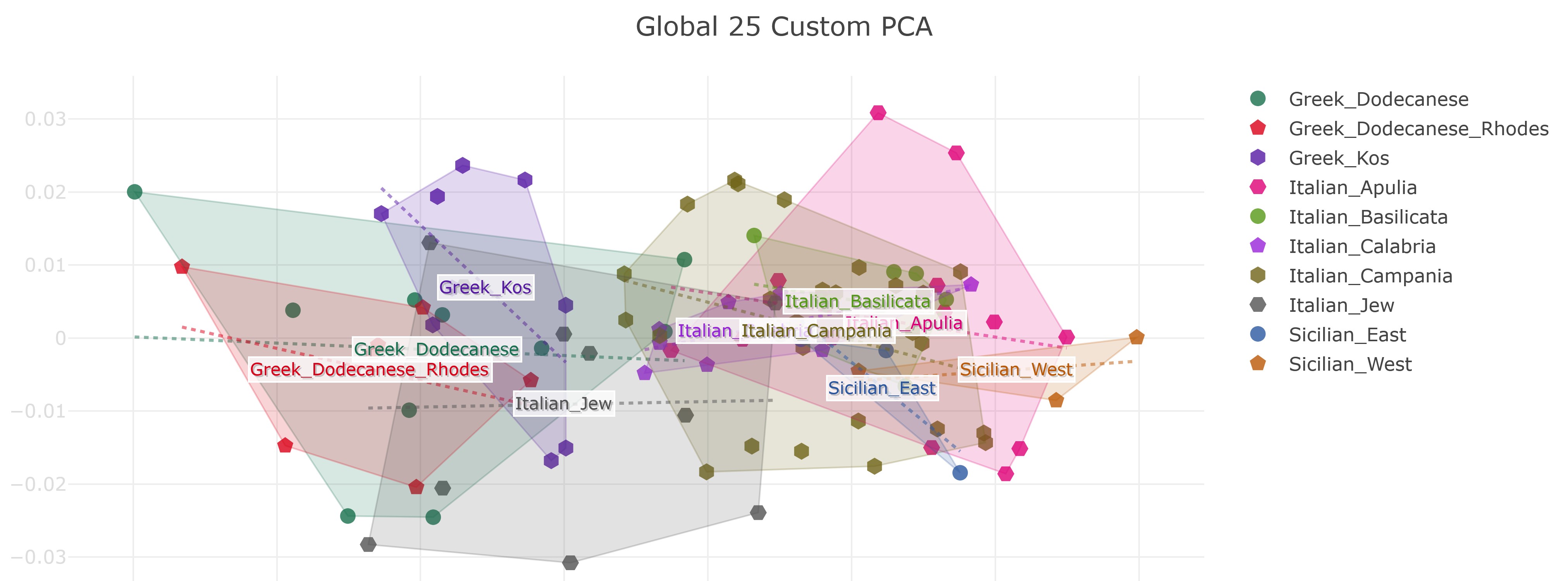
The PCA plot places Italkim Jews near Dodecanese Greeks and southern Italian populations. This is exactly the region of the plot where a Magna Graecia and Roman-era Mediterranean profile would be expected to appear. The clustering is not random, and it is not easily dismissed as a side effect of modern European admixture.
This matters because PCA is based on genome-wide autosomal data, not only maternal lineages. Autosomal DNA is inherited from both parents and reflects total ancestry across the genome. If Ashkenazi affinity with southern Italians were only the result of European maternal input added onto an otherwise Levantine population, then a historically rooted southern Italian Jewish population should not reproduce the same broader southern Italian and Aegean-related pattern. But Italkim Jews do.
Their placement supports the interpretation that southern Italian and Aegean-related ancestry is part of the core historical structure of Ashkenazi-related Jewish populations, not an accidental overlay and not something that can be reduced to maternal European admixture alone. The Italkim comparison forces the issue back to total ancestry, where the southern Italian and Greco-Roman signal is visible across the autosomal profile.
Regional Ashkenazi PCA: Western Ashkenazim, Italkim Jews, and Slavic Admixture

The regional Ashkenazi PCA strengthens the central argument of this article because it challenges the common online model that reduces Ashkenazi ancestry to Levantine paternal lines and European maternal ancestry. That model treats the southern Italian signal as secondary, as if Ashkenazi Jews are basically ancient Levantine males mixed with northern Italian, central European, or eastern European women. The PCA does not fit that simple story.
French and German Ashkenazi Jews sit closest to the Italkim Jewish cluster. This is important because those western Ashkenazi groups are less shifted by the later eastern European and Slavic-related admixture visible in eastern Ashkenazi populations. Their closeness to Italkim Jews points to an older southern Italian Jewish foundation, not a late artifact produced by eastern European ancestry.
Eastern Ashkenazi Jews move farther away from the Italkim and western Ashkenazi position. That shift is consistent with later layers of admixture: first from Knaanic Jews and western Slavic populations in the medieval Central European and western Slavic borderlands, and later from additional eastern Slavic and broader eastern European populations as Ashkenazi communities expanded farther east.
This matters because the direction of movement is the opposite of what the "European mother" explanation would predict. If southern Italian affinity were merely the result of generic European maternal admixture, then eastern Ashkenazim, who carry more later European and Slavic-related ancestry, should move closer to Italkim Jews and southern Italians. They do not. They move away.
The PCA therefore supports a total-ancestry model rather than a uniparental myth. The southern Italian and Italkim-like signal is visible in the autosomal profile, inherited from both parents across the genome. It cannot be reduced to mtDNA, Y-DNA, or a story where Levantine fathers mixed with random European mothers. The older Ashkenazi-related profile appears to have been already strongly southern Italian, Italkim-related, and Greco-Roman before later Knaanic, western Slavic, and eastern Slavic layers modified it.
G25 Similarity Map: Autosomal Clustering Patterns
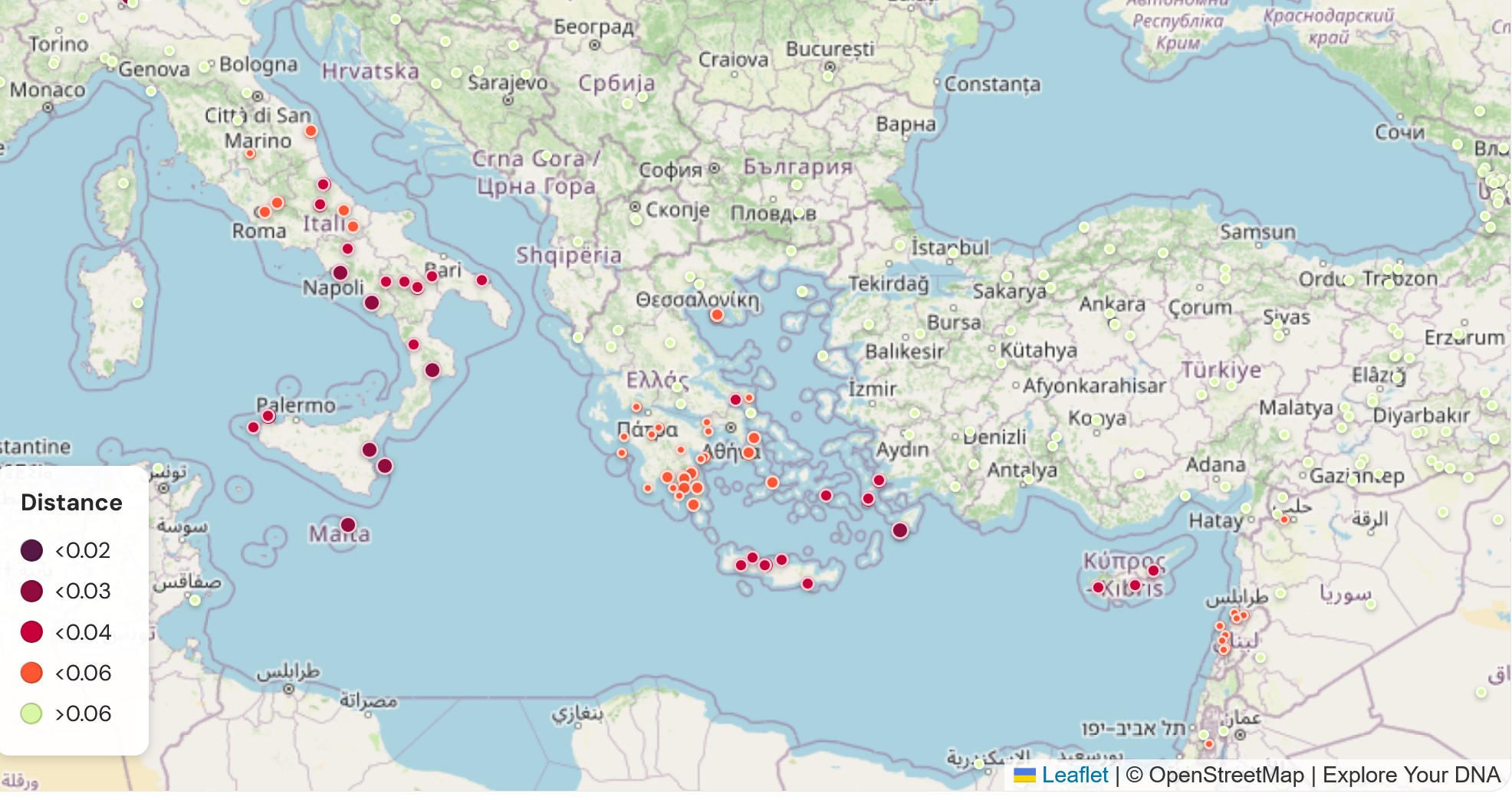
The G25 similarity map shows the same basic pattern from another angle. Italkim Jews cluster with Sicilians, mainland southern Italians, Maltese, and Aegean Greek populations. These are exactly the populations that should be included when testing Ashkenazi ancestry in relation to the central and eastern Mediterranean.
As with PCA, the G25 pattern is autosomal. It reflects genome-wide ancestry inherited from both parents, not only Y-DNA or mtDNA. That is why the Italkim comparison matters so much: it shows a total-ancestry relationship with southern Italy, Sicily, Malta, and the Aegean rather than a narrow maternal-line explanation. A model that tries to explain Ashkenazi southern Italian affinity only through European mothers fails to account for the broader autosomal structure.
This matters because older models often used weak or incomplete Italian reference panels. Northern Italians, Tuscans, and Sardinians do not represent southern Italy, Sicily, Calabria, Campania, Apulia, Malta, Crete, or the Dodecanese. When those populations are missing, Ashkenazi Jews can be misread as simply intermediate between Europe and the Levant. When they are included, the picture changes.
The Italkim pattern shows why southern Italy cannot be treated as a side issue. Southern Italy, Sicily, Malta, and the Aegean form a connected Mediterranean zone shaped by Greek colonization, Roman rule, Byzantine influence, trade, migration, and long-term Jewish presence. Ashkenazi genetic analysis that ignores this region is missing one of the most relevant comparison spaces.
FST Analysis: Genetic Proximity of Italkim Jews
The FST table shows the populations closest to Italkim Jews. These data confirm their genetic affinity with southern Italian and Greek populations.
| # | Population | FST Distance |
|---|---|---|
| 1 | Maltese | 0.0239 |
| 2 | Italian Calabria | 0.0242 |
| 3 | Sicilian Central | 0.0264 |
| 4 | Italian Campania | 0.0273 |
| 5 | Italian Campania Naples (Campanian) | 0.0277 |
| 6 | Greek Dodecanese | 0.0289 |
| 7 | Sicilian East | 0.0290 |
| 8 | Sicilian Syracuse | 0.0291 |
| 9 | Sicilian | 0.0295 |
| 10 | Greek Crete Lasithi | 0.0303 |
| 11 | Greek Crete | 0.0305 |
| 12 | Sicilian Trapani | 0.0309 |
| 13 | Greek Dodecanese Kos | 0.0310 |
| 14 | Greek Kos | 0.0310 |
| 15 | Italian Calabria (Cosentian) | 0.0310 |
| 16 | Greek Cyprus | 0.0322 |
| 17 | Cypriot | 0.0326 |
| 18 | Italian Basilicata | 0.0326 |
| 19 | Italian Basilicata (Lucanian) | 0.0328 |
| 20 | Greek Crete Rethymno | 0.0331 |
| 21 | Italian Apulia | 0.0341 |
| 22 | Turkish Cyprus | 0.0342 |
| 23 | Greek Cyclades Amorgos | 0.0350 |
| 24 | Sicilian West | 0.0357 |
| 25 | Greek Euboea Central | 0.0365 |
| 26 | Italian Apulia (Apulian) | 0.0368 |
| 27 | Greek Crete Heraklion | 0.0381 |
| 28 | Greek Crete Chania | 0.0385 |
| 29 | Italian Campania Benevento (Campanian) | 0.0389 |
| 30 | Italian Campania Salerno (Campanian) | 0.0391 |
All of the tools used in this analysis, from FST to PCA, can be found on ExploreYourDNA, and the full results are documented in the author's study available on Preprints.org.
Conclusion
Italkim Jews provide a strong autosomal test of whether Ashkenazi affinity with southern Italians is real. Their history is rooted in Italy, not in the later Ashkenazi migration path through the Rhineland, Central Europe, or Slavic lands. Yet their genome-wide profile still points toward southern Italy, Sicily, Malta, and the Aegean Greek world. The regional Ashkenazi PCA also shows how western Ashkenazi Jews overlap with Italkim Jews and southern Italians, while eastern Ashkenazim are shifted toward eastern European and Knaanic populations. This confirms that southern Italian and Italkim-related ancestry forms a central component of Ashkenazi genetic history across multiple lines of evidence.
That makes them a serious problem for arguments that dismiss Ashkenazi-southern Italian clustering as an artifact or reduce it to maternal European admixture alone. Autosomal DNA comes from both parents, and the same broad Mediterranean pattern appears in PCA, G25, and FST. The result is consistent across multiple analyses and figures.
Original source: ashkenaziresearch.org
Author: Steven Parker. Republished on ExploreYourDNA with the author's permission. Tags: Italkim Jews, Jewish genetics, Magna Graecia, Mediterranean populations, PCA genetics, Population genetics, Southern Italy genetics, Ashkenazi ancestry.