
Project a Sino-Mauritian genome into the 25-dimensional Global25 space and the result defies any single continental assignment: a coordinate pulled simultaneously toward the Hakka heartland of Guangdong, the Bantu corridor of southern Africa, the colonial parishes of Normandy, and the Austronesian archipelago of the Indian Ocean. This is not genetic noise. It is the compressed record of an island that had no human population until 1638, then became one of history's most precisely documented demographic experiments , Dutch explorers who left without settling, French planters who built a sugar economy on enslaved East African and Malagasy labour, Hakka merchants from Guangdong who arrived as free traders, Tamil and Bihari indentured workers shipped across the Indian Ocean after abolition, and a British colonial administration that added its own genetic thread after 1810. Mauritius has no pre-colonial genetic baseline. Every component of its modern population arrived at a documented date, from a documented place, under a documented legal regime , making it one of the rare territories where colonial economic history can be read with unusual directness from DNA.
Key Findings at a Glance
- The individual analysed (Dad_scaled) carries approximately ~62% East Asian ancestry , predominantly Hakka Chinese (Guangdong/Fujian), confirmed by 23andMe's 59.9% Chinese assignment and G25 K105's dominant Vietnam/Japan proxy cluster , making this an atypical Mauritian profile that preserves remarkable Chinese founder ancestry across generations of island life.
- ~15% Sub-Saharan African, predominantly Congolese and Southern East African (Angolan & Congolese 9.9%, Southern East African 1.4%), a signature of the Mozambique-corridor and Malagasy slave trade that supplied Bourbon/Mauritius throughout the 18th century. West African (Nigerian 0.9%) is secondary , the same Indian Ocean trade-route signature that distinguishes Mauritian and Réunionnais creoles from Atlantic ones.
- ~14% Northwestern European, split between French & German (7.0%) and British & Irish (4.4%), directly reflecting the island's dual colonial history , French administration 1715–1810, British from 1810 to independence in 1968. Both layers left a genetic trace.
- ~6% South Asian, predominantly Dravidian (Southern Indian & Sri Lankan 3.0%), with smaller North Indian and broadly Central & South Asian components. Mauritius received both Tamil/South Indian and Bihari North Indian indentured workers, distinguishing it from Réunion where South Indian Dravidian ancestry dominates almost exclusively.
- The G25 K105 "Vietnam" component (54.6%) and the Tomenable deep ancestry showing 32.23% Kra-Dai Peoples and 28.08% China Zhou Dynasty collectively confirm genuine East/Southeast Asian ancestry , not Malagasy Austronesian as in the Réunion case. The Vietnamese/Japanese G25 proxies in this context represent actual Chinese (Hakka) genetic heritage.
- The "Latvia" component (4.6%) in G25 K105 and MyHeritage's "Scandinavian" (9.8%) and FTDNA's "East Slavic" (11%) are consistent reference-panel artifacts: Northern European populations (Latvian, Scandinavian) are used as proxies for the steppe-ancestry fraction within French colonial European heritage, not as evidence of actual Eastern European ancestry.
I. The Uninhabited Island , Before 1638
Like La Réunion, Mauritius has no pre-colonial genetic layer. Arab sailors knew of it from the 10th century, calling it Dina Arobi; Portuguese navigators charted it as Cirne around 1507. The Dutch East India Company (VOC) made the first permanent European settlement in 1638, on an island the Dutch had already named after Prince Maurice of Nassau in 1598. But Dutch colonisation was halfhearted and ultimately abandoned in 1710 , leaving behind feral deer, introduced sugarcane, and the first signs of the ecological devastation that would extinguish the dodo. When French forces of the Compagnie des Indes Orientales took possession in 1715, renaming the island Isle de France, they found the same genetic void that greeted French settlers in Réunion: no indigenous population, no pre-existing human genetic substrate.
This absence is genetically decisive. Every individual alive in Mauritius today traces descent from populations that arrived after 1638 , and for most Mauritians, the relevant founding events occurred between 1715 and 1835. The population genetics of Mauritius is, even more than Réunion, a direct readout of colonial economic transactions: slave purchases on the Mozambique coast, recruitment contracts signed in Madurai and Patna, merchant passages from Guangdong, and soldier rosters of the British Indian Army. No pre-colonial filter exists to obscure this record.
II. The Slave Trade , Africa and Madagascar in Mauritius
The African ancestry component in Dad_scaled , approximately 15% sub-Saharan African, predominantly Congolese and Southern East African , is the genetic legacy of the 18th-century Indian Ocean slave trade that supplied Isle de France. As in Réunion, this trade operated on an axis fundamentally different from the Atlantic slave trade that supplied the Caribbean and Brazil. Mauritius's enslaved population came primarily from Mozambique, Madagascar, the Comoros, and the broader East African coast , not from the Guinea Coast that supplied Yoruba, Fon, and Mandinka ancestry to Atlantic Creoles.
The 23andMe breakdown is geographically specific: 9.9% Angolan & Congolese (with a "Shona & Nguni peoples" genetic group match , Highly Likely), 1.4% Southern East African, and 1.7% Broadly Congolese & Southern East African. The West African component (1.6%) is secondary , reflecting the smaller "Cafres de Guinée" trade route that existed alongside the dominant Mozambique corridor. This East-African dominance in the African ancestry of Indian Ocean Creoles is the key genetic distinguisher from Atlantic Creoles, and is clearly visible in G25 PCA space.
Madagascar: The Austronesian Bridge
A fraction of the African ancestry in Mauritius , particularly in older Creole families , carries Malagasy ancestry with its embedded Austronesian (Borneo-derived) component (~30–40% of Malagasy ancestry). In a predominantly Sino-Mauritian individual like Dad_scaled, the Malagasy signal is small and is partly absorbed into the "Vietnamese/Japanese" G25 proxy pool alongside the genuine Chinese ancestry. This makes interpretation of the Southeast Asian G25 component more complex for Sino-Mauritian individuals than for Réunionnais: both genuine Hakka Chinese ancestry AND Malagasy Austronesian ancestry contribute to the same proxy cluster. The Tomenable calculator's explicit "Asia_Proto_Malayo_Polynesians: 0.20%" component represents this Malagasy Austronesian residual.
African Origins of Mauritius's Enslaved Population , Historical Trade Routes
Primary , Makua, Yao, Swahili + Madagascar
Large , Bantu + Austronesian + Comoros Islands
Secondary + Guinea / Benin
Minor , "Cafres de Guinée" + Congo Basin
Minor , Kongo, Kwango → Isle de France
~65,000 enslaved by 1810
III. The Hakka Chinese Community , Free Merchants of the Indian Ocean
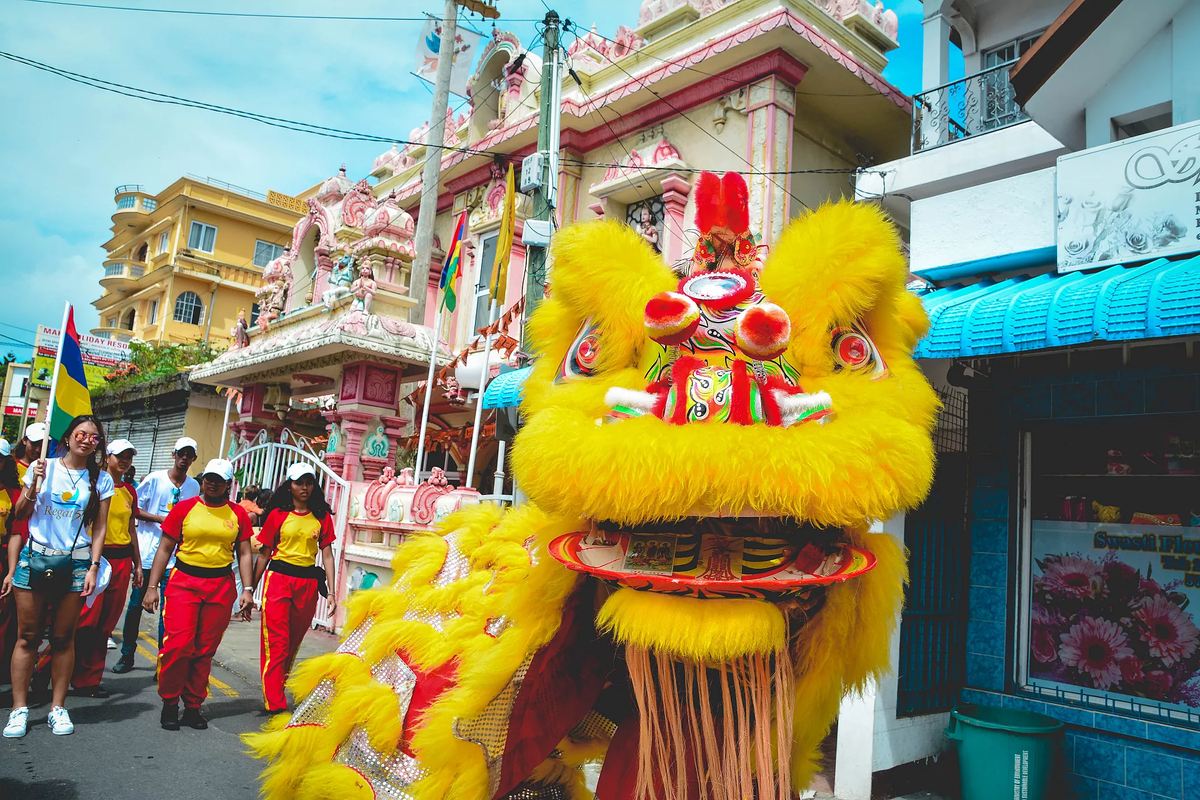
What makes Dad_scaled's genetic profile remarkable , and distinctly Mauritius rather than Réunion , is the dominant East Asian component (~62%), which reflects substantial Chinese ancestry preserved across generations in a Sino-Mauritian family. The Hakka Chinese community of Mauritius, known locally as the "Chinois" or "Sino-Mauritians," arrived predominantly from the Hakka-speaking regions of Guangdong and Fujian provinces between the 1820s and 1900s. Unlike the Indian indentured workers who came under coercive multi-year contracts, the Hakka Chinese came as free merchants, establishing themselves as the island's retail and wholesale trading class.
23andMe's regional breakdown is precise: South Chinese 35.2% (with a specific Guangdong country match), Southern Chinese & Taiwanese 23.8% , a combined 59.9% Chinese assignment that maps directly onto the documented Hakka Guangdong origin. The Tomenable deep ancestry confirms this with Asia_Kra_Dai_Peoples (32.23%) and Asia_China_Zhou_Dynasty (28.08%) as the top two components , together representing the Kra-Dai and Han Chinese ancient ancestry layers that characterise Hakka populations from southern China. The Asia_Formosan_Peoples (3.03%) captures the Austronesian-influenced ancestry that is part of the genetic profile of southern Chinese coastal populations.
Why G25 K105 Uses "Vietnam" as a Proxy for Hakka Chinese
The G25 World Countries calculator assigns 54.6% "Vietnam" to Dad_scaled , a counterintuitive label for a person with documented Hakka Chinese ancestry. This reflects a known property of the K105 model: in a reference panel dominated by contemporary population centroids, southern Chinese populations (Hakka, Cantonese, Teochew) cluster very close to Vietnamese in PCA space because both groups carry substantial Kra-Dai ancestry alongside East Asian ancestry. The G25 coordinates for Hakka Chinese fall within the zone that the K105 calculator resolves as "Vietnam" by proximity. The Tomenable calculator, which uses ancient DNA references and explicitly models Kra-Dai peoples, gives the more interpretively accurate result: ~60% Kra-Dai + Chinese Zhou Dynasty ancestry. Neither "Vietnam" nor "Japan" in this profile implies Vietnamese or Japanese ancestry , they are proxies for the same East Asian / Hakka Chinese genetic signal.
IV. Indian Indentured Labor , Tamil and Bihari Contributions
The abolition of slavery in British Mauritius (1835) triggered the "Great Experiment" in indentured labour , the system that would bring over 450,000 Indian workers to the island between 1835 and 1910, transforming Mauritius into an Indian Ocean extension of South Asia. Unlike Réunion, where the Tamil and Malabar South Indian wave dominated almost exclusively, Mauritius received two distinct Indian migration streams: the "Madrasis" , Tamil and Telugu workers from the Madras Presidency , and the "Coolies" , Bihari and Bhojpuri speakers from Bihar, eastern Uttar Pradesh, and Bengal. This dual origin is why Mauritian 23andMe results typically show both "Southern Indian & Sri Lankan" and "Northern Indian & Pakistani" components, distinguishing them from Réunionnais results where the Dravidian signal predominates.
In Dad_scaled's results, the South Asian component (~6%) is relatively small , consistent with a Sino-Mauritian family background where inter-community marriage with Indian-origin Mauritians occurred but was not the primary family structure. The breakdown (Southern Indian & Sri Lankan 3.0%, Bengali & Northeast Indian 0.3%, Northern Indian & Pakistani 0.2%, Broadly Central & South Asian 2.0%) confirms both South Indian and North Indian contributions, with the Tomenable's India_Munda_Peoples (2.27%) capturing the ancient AASI (Ancient Ancestral South Indian) ancestry component carried by Dravidian populations.
V. The European Foundation , French and British Colonial Layers
The European component in Dad_scaled (~14%) reflects the island's dual colonial history. The French layer , French & German 7.0% in 23andMe, with MyHeritage's additional genetic group specifically identifying France (Bourgogne-Franche-Comté and Auvergne-Rhône-Alpes) , derives from the French planter families who established Isle de France's sugar economy. The G25 K105 "France" component (9.8%) is the primary European signal in the countries model. The British layer , British & Irish 4.4% , reflects the 1810–1968 British colonial period, during which British military officers, administrators, merchants, and Scottish trading families introduced Northwestern European ancestry.
The apparent "Latvia" (4.6% in G25 K105), "Scandinavian" (9.8% in MyHeritage), and "East Slavic" (11% in FTDNA) components all require careful interpretation. These Northern and Eastern European proxies are reference-panel artifacts: Baltic and Scandinavian populations carry substantial Yamnaya/Bell Beaker steppe ancestry, as do all Northwestern French populations. When G25 and FTDNA models attempt to decompose French colonial European ancestry, they often partially use Baltic or Scandinavian reference populations as proxies for the steppe ancestry fraction that is present in any Norman French genome. There is no historical evidence for Latvian, Estonian, or Scandinavian settlement in Mauritius; these components are best read as "the steppe-ancestry fraction of French colonial European heritage."
The Franco-Mauritian Community , "Grand Blancs" of the Indian Ocean
The Franco-Mauritian community , descended from the original French planter families of the 18th century , represents approximately 2% of the modern Mauritian population but retains disproportionate economic influence in the sugar industry. Genealogically, many Franco-Mauritian families can trace their ancestry to specific French provincial origins: Normandy, Brittany, Île-de-France, and the Languedoc. Their genetic profile is predominantly European (>90%), with minor African and South Asian admixture from centuries of island life. DNA results for Franco-Mauritians typically show French & German 40–60%, British & Irish 15–25% (reflecting the British colonial period), and smaller Mediterranean and broadly European components. The "Bourgogne-Franche-Comté and Auvergne-Rhône-Alpes" genetic group identified by MyHeritage for this individual specifically points to south-central French provincial ancestry rather than coastal Normandy , worth investigating for its genealogical implications.
VI. Modern Mauritians in G25 Space
In Global25 PCA space, Mauritius presents a more complex picture than Réunion because of the island's stronger community stratification. While Réunionnais Creoles show a broadly four-way admixed profile, Mauritius has maintained relatively distinct genetic clusters corresponding to the four main communities: Indo-Mauritian, Creole, Sino-Mauritian, and Franco-Mauritian. A Sino-Mauritian individual like Dad_scaled occupies a dramatically different position in G25 space from an Indo-Mauritian or a Mauritian Creole.
Dad_scaled's G25 coordinates (PC1: -0.075, PC2: -0.253) place this individual at a very specific intersection: the strongly negative PC2 value reflects the dominant East Asian pull , a direction almost unique in the Indian Ocean island population space. The relatively moderate PC1 value (-0.075, versus -0.256 for a heavily African-admixed Réunionnais Creole) reflects the lower total sub-Saharan African ancestry (~15% versus ~40–50%). No reference population from the continental African, South Asian, or European clusters alone can capture this coordinate , only a composite model involving Hakka Chinese, East African, and Northwestern French references achieves a good fit.
VII. Ancestry Profiles , Dad_scaled and the Sino-Mauritian Mosaic
VIII. Comparison Table , Mauritius in the Indian Ocean Creole World
| Population | E. Asian ~% | African ~% | European ~% | S. Asian ~% | Key note |
|---|---|---|---|---|---|
| Dad_scaled (Mauritius , Sino-Mauritian) | ~62 % | ~15 % | ~14 % | ~6 % | Dominant Hakka Chinese (Guangdong); well-preserved endogamous ancestry |
| Avg. Mauritian Creole | <5 % | ~25–30 % | ~18–22 % | ~35–40 % | High Indian (Tamil + North Indian); E. African dominant African |
| Franco-Mauritian | <2 % | ~5–10 % | ~80–92 % | <3 % | Predominantly French; minor African/Indian admixture |
| Avg. Réunionnais Creole | <2 % | ~38–45 % | ~25–30 % | ~20–25 % | Higher African; Tamil dominant South Indian; minimal N. Indian |
| Seychellois Creole | <2 % | ~50–60 % | ~25–35 % | ~10–15 % | Highest African fraction in Indian Ocean; French colonial only |
| Malagasy (average) | ~30–40 % | ~60–70 % | <2 % | <2 % | Bantu + Austronesian 2-way; source of SE Asian signal in Creoles |
IX. Myths and Realities
Common Misconception
"The 'Vietnam' component in my G25 results means I have Vietnamese ancestry."
Genetic Reality
For Sino-Mauritians, G25 K105's "Vietnam" is a proxy for Hakka Chinese (Guangdong) ancestry. Southern Chinese populations (Hakka, Cantonese, Teochew) cluster close to Vietnamese populations in PCA space due to shared Kra-Dai genetic ancestry. The Tomenable calculator, using ancient DNA references, explicitly models this as Kra-Dai + Chinese Zhou Dynasty ancestry (~60% combined). The 23andMe Chinese assignment (59.9%, Guangdong-specific) confirms the true origin.
Common Misconception
"FTDNA's 11% Eastern European / East Slavic means I have Russian or Polish ancestry."
Genetic Reality
FTDNA's "East Slavic," MyHeritage's "Scandinavian," and G25's "Latvia" all point to the same underlying signal: the steppe-ancestry fraction of Northwestern French colonial European heritage. All NW European populations , Norman French, Breton, British , carry substantial Yamnaya/Bell Beaker steppe ancestry that is shared with Baltic and Slavic populations. Reference-panel algorithms distribute this shared ancestry across Northern and Eastern European proxies. There is no documented Latvian, Swedish, or Russian settlement history in Mauritius.
Common Misconception
"All Mauritians have similar genetics , it's a Creole island."
Genetic Reality
Mauritius shows the most pronounced inter-community genetic differentiation of any Indian Ocean island. The four communities , Sino-Mauritian (~62% East Asian), Indo-Mauritian (~70–80% South Asian), Franco-Mauritian (~85% European), Mauritian Creole (~30% African + ~35% South Asian) , remain genetically distinct clusters in PCA space. A Sino-Mauritian like Dad_scaled has almost no genetic overlap with an Indo-Mauritian neighbor. The island's Creole category is itself heterogeneous, reflecting admixture across all four founding populations at different rates by family.
Common Misconception
"The African ancestry in Mauritius is like Caribbean African ancestry , West African Yoruba."
Genetic Reality
The African ancestry in Mauritius is predominantly East and Southeast African , Mozambican Bantu corridor, Malagasy, and Congolese , not West African Guinea Coast. 23andMe confirms: Angolan & Congolese (9.9%), Southern East African (1.4%), Nigerian (0.9%). The "Shona & Nguni peoples" genetic group match is geographically specific to the Zimbabwe/South Africa corridor, reflecting the Mozambique slave trade route. This same East African signature distinguishes all Indian Ocean Creoles from Atlantic ones.
References
- Allen R.B. (1999). Slaves, Freedmen, and Indentured Laborers in Colonial Mauritius. Cambridge University Press. Book , slavery and indenture Mauritius
- Carter M. (1995). Servants, Sirdars and Settlers: Indians in Mauritius 1834–1874. Oxford University Press. Book , Indian indentured migration
- Ly-Tio-Fane Pineo H. (1984). La Diaspora Chinoise dans l'Océan Indien Occidental. Aix-en-Provence: Institut d'Histoire des Pays d'Outre-Mer. Book , Hakka Chinese Mauritius
- Brucato N. et al. (2017). The Malagasy Ancestry Comes from an Historical Malay Trading Post in Southeast Borneo. Molecular Biology and Evolution 34(12): 2996–3010. DOI:10.1093/molbev/msx226 Malagasy genetics , Austronesian origin
- Pierron D. et al. (2014). Genome-wide evidence of Austronesian–Bantu admixture and cultural reticulation in Madagascar. PNAS 111(3): 936–941. Madagascar admixture , whole genome
- 23andMe Ancestry Report , Dad_scaled. Updated July 20, 2022. East Asian 62.1% (Chinese 59.9% , Guangdong); Sub-Saharan African 15.3%; European 14.1%; Central & South Asian 6.1%. Commercial ancestry test
- G25 World Countries Calculator K105 , Vahaduo (Davidski). Dad_scaled distance 1.4342%. ExploreYourDNA Calculator 148. G25 NNLS modelling
- Tomenable Deep Ancestry Calculator. Dad_scaled , Asia_Kra_Dai_Peoples 32.23% + Asia_China_Zhou_Dynasty 28.08% + Africa_Bantu_Peoples 15.20% + Europe 13.9%. Ancient DNA modelling
- MyHeritage DNA , France How Kong Fah. Nigerian 11.4%; Kenyan 5.4%; Scandinavian 9.8%; North and West European 6.7%. Additional group: France (Bourgogne-Franche-Comté and Auvergne-Rhône-Alpes). Commercial ancestry test
- FamilyTreeDNA myOrigins. Europe 11% (East Slavic 11%). Commercial ancestry test