
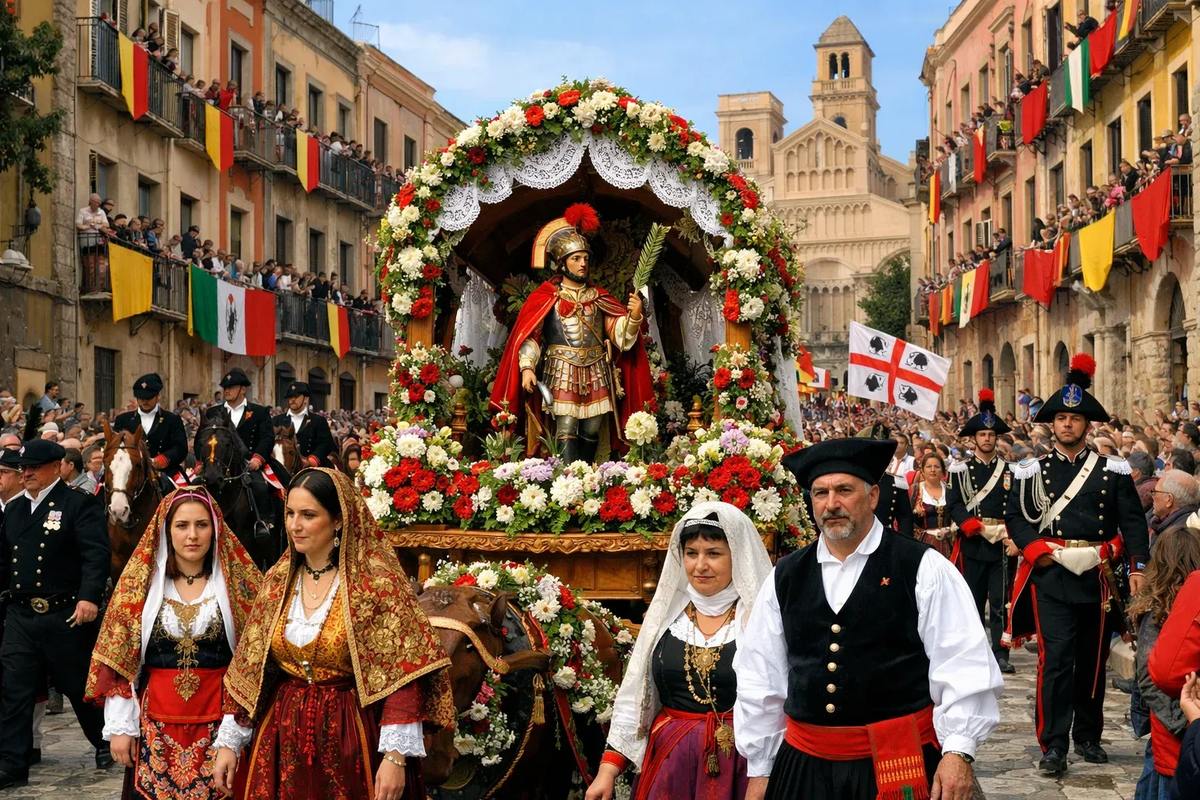
Sardinia occupies a unique position in the European genetic landscape. Shielded by the Mediterranean and largely spared from the great migratory waves that transformed the continent, Yamnaya, Bell Beaker, Slavic, the island has preserved to the present day a gene pool derived more than 75 % from the Neolithic farmers who first colonised western Europe from Anatolia. Modern Sardinians are, in population-genetic terms, the most faithful living representatives of those Early European Farmers (EEF) who spread across Europe from around 7000 BCE, a population effectively erased everywhere else on the continent, but frozen in Sardinia like a genetic time capsule.
? Key Findings
- Modern Sardinians carry ~75, 78 % Anatolian Neolithic (EEF) ancestry, the highest proportion in all of Europe, compared with 35, 50 % in northern and western European populations.
- Yamnaya-related steppe ancestry in Neolithic and Nuragic Sardinia is essentially zero (0, 3 %), whereas the French carry ~40 % and the British ~47 % of this component.
- Western Hunter-Gatherer (WHG) ancestry in Sardinia (~12, 15 %) is markedly lower than in most continental Neolithic populations, reflecting an early and genetically concentrated agricultural colonisation.
- Nuragic Bronze Age individuals (1700, 800 BCE) are genetically near-identical to Sardinian Neolithic populations from 4500 BCE, demonstrating a remarkable demographic continuity spanning more than 3 000 years.
- The Y-chromosome of Nuragic Sardinians is dominated by haplogroup G2a, the paternal lineage of Neolithic farmers, virtually replaced by R1b-M269 across continental Europe but surviving in Sardinia where G2a still reaches ~10 % among modern men.
- The modest rise in steppe ancestry observed in modern Sardinians relative to Nuragic individuals (~7 % vs. ~2, 3 %) reflects continental contact during the Roman and medieval periods, not a large-scale steppe migration.
I. Historical Context: Neolithic Colonisation and Island Isolation
Sardinia was colonised by the first farmers around 6000, 5500 BCE, as part of the Neolithic expansion along the western Mediterranean seaways, the so-called Cardial Ware horizon, named for its shell-impressed pottery. These colonists were Anatolian agriculturalists who, over several millennia, had crossed the Balkans, followed the Danube corridor and spread along Mediterranean coastlines. By the time they reached Sardinia, their genetic profile was already distant from local hunter-gatherers but still closely anchored to their Near Eastern ancestors.
It is the subsequent geographic isolation that makes Sardinia a genetic anomaly. Continental Europe absorbed a series of major demographic shocks from 3000 BCE onwards: the Corded Ware expansion (~2900 BCE), the Bell Beaker migration (~2500 BCE), and later Iron Age and medieval movements. Each of these events diluted the EEF heritage across the continent by injecting Pontic steppe ancestry. Sardinia, far removed from the overland migration corridors, was largely bypassed. The result is unique in Europe: a near-intact Neolithic gene pool, preserved under the form of the Nuragic civilisation and transmitted to modern Sardinians.
Agricultural Colonisation Route to Sardinia
First farmers, ~8000, 7000 BCE → Balkans & Greece
Balkan Neolithic, ~6500 BCE → Central Mediterranean
Cardial Ware, ~6000 BCE → Sardinia
Colonisation, ~5800, 5500 BCE → Nuragic Civilisation
Demographic continuity, ~1700, 238 BCE
What the ancient DNA data make clear is that the arrival route of Sardinia’s first farmers is not merely a historical inference, it is legible in the genome. Sardinian Neolithic populations share a profile closely related to Anatolian Neolithic groups, but with a slightly higher WHG fraction, reflecting admixture with local European hunter-gatherers during the westward expansion before the ancestral Sardinians settled their island.
II. The Y-Chromosome: G2a, a Living Fossil
The uniparental evidence is entirely independent of admixture modelling, and it tells a remarkable story. G2a, the paternal haplogroup of Anatolian farmers, was the dominant lineage across all of Neolithic Europe between 5500 and 2800 BCE. The Bell Beaker wave and associated steppe migrations eliminated it almost completely from the continent: today, G2a accounts for just 1, 3 % of men in France or Britain. In Sardinia it persists at ~10 % among modern men, and was dominant in the Nuragic Bronze Age.
III. Ancestry Composition by Period
The estimates below are derived from qpADM and NNLS models reported in the primary literature (Lazaridis et al. 2016; Marcus et al. 2020; Chiang et al. 2018), calibrated against G25 scaled coordinates for visual verification. Four-component models (EEF = Early European Farmer / Anatolian Neolithic-related; WHG = Western Hunter-Gatherer; EHG = Eastern Hunter-Gatherer; Steppe = Yamnaya-related) are used for the continental comparison populations. Note that Yamnaya steppe ancestry itself already contains a large internal EHG fraction; the EHG component reported separately here represents direct eastern hunter-gatherer input arriving via Scandinavian Hunter-Gatherer (SHG) and related northern routes, independently of the steppe migration. Sardinian populations carry essentially no direct EHG and are represented by a three-component model. Values are approximate.
IV. Sardinia and Europe: A Comparative Overview
The table below places the Sardinian profile across time alongside representative European populations. The gap in steppe ancestry between modern Sardinians and their continental neighbours is one of the largest documented between any two contemporary European populations.
| Population | EEF (Anatolian) | WHG | EHG (direct) | Steppe (Yamnaya) | Main Y-DNA |
|---|---|---|---|---|---|
| Sardinia Neolithic (~5000 BCE) | ~88 % | ~12 % | 0 % | 0 % | G2a |
| Sardinia Nuragic (~1300 BCE) | ~84 % | ~13 % | 0 % | ~2, 3 % | G2a dominant |
| Sardinia modern | ~75 % | ~13 % | 0 % | ~7 % | R1b ~40 %, G2a ~10 % |
| Modern France | ~47 % | ~11 % | ~2 % | ~40 % | R1b >60 % |
| Modern Germany | ~38 % | ~10 % | ~8 % | ~44 % | R1b ~45 %, R1a ~15 % |
| Modern Britain | ~38 % | ~12 % | ~3 % | ~47 % | R1b >70 % |
| Modern Sweden | ~28 % | ~10 % | ~10 % | ~52 % | R1b ~40 %, I1 ~35 % |
| Anatolian Neolithic (reference) | 100 % | 0 % | 0 % | 0 % | G2a, J2 |
Note on the steppe ancestry increase in modern Sardinians
The gap between Nuragic Sardinians (~2, 3 % steppe) and modern Sardinians (~7 %) deserves an explanation. This steppe ancestry did not arrive via a direct steppe migration: it reflects cumulative continental input through Roman domination (238 BCE), Vandal settlement (455, 534 CE), Byzantine reconquest, and later Aragonese and Spanish administration. Each episode introduced small quantities of continental European ancestry, itself carrying the accumulated steppe component from the Bronze Age. The progression is gradual, never catastrophic, which distinguishes Sardinia from every other region of western Europe.
V. G25 Coordinates for Vahaduo
The three coordinate blocks below allow you to visualise Sardinia’s position in European PCA space within Vahaduo (scaled G25 mode). The first block provides the three anchor populations defining the EEF / WHG / Steppe triangle. The second covers Sardinia from the Neolithic through the medieval period. The third presents sequenced Nuragic individuals one by one, illustrating the remarkably low internal variation of this population.
VI. Myths and Realities
Common Misconception
“Sardinians are a Mediterranean population like any other, genetically similar to southern Italians or Greeks.”
Genetic Reality
In G25 PCA space, Sardinians sit clearly apart from all other modern Mediterranean populations. Greeks, southern Italians, Spaniards and Portuguese all carry 15, 25 % steppe ancestry. Sardinians carry ~7 %. This gap structurally places them closer to Anatolian farmers of 6000 BCE than to their contemporary Mediterranean neighbours.
Common Misconception
“Sardinia’s low steppe ancestry simply means the Bell Beaker migration arrived there later than elsewhere.”
Genetic Reality
Sardinia was not significantly affected by the Bell Beaker migration at all, neither earlier nor later. Nuragic individuals sequenced between 1700 and 800 BCE show steppe levels of 0, 3 %, quasi-identical to those of Sardinian Neolithic populations 3 000 years earlier. This is not a delayed impact but a near-total absence of demographic effect.
Common Misconception
“The sophistication of Nuragic civilisation implies significant external population contributions.”
Genetic Reality
The architectural and metallurgical sophistication of the Nuragic culture (more than 7 000 stone towers constructed) is entirely the product of a genetically homogeneous indigenous population. Ancient DNA data detect no significant external contribution during the 1 500 years of Nuragic florescence. The genetic continuity between Sardinian Neolithic and Nuragic populations is one of the most remarkable documented anywhere in Europe.
Common Misconception
“Since Sardinians are so close to Anatolian farmers, they must be identical to Neolithic populations of the Italian peninsula.”
Genetic Reality
Neolithic Italy does show a strongly EEF profile, but its Copper Age and Bronze Age populations were progressively transformed by steppe and WHG input from central Europe. Sardinia escaped these transitions entirely. Nuragic Sardinians therefore plot even closer to Anatolian Neolithic groups than mainland Italian Neolithic populations themselves, because island isolation protected the founding profile.
VII. Key Takeaways
Sardinia represents what palaeontologists call a living fossil in population genetics: not a frozen or degenerate population, but one that has preserved an ancestral profile the rest of Europe progressively lost. The Anatolian farmers who colonised Europe from 7000 BCE are today untraceable in near-pure form on the continent. In Sardinia, they are still there.
This situation results from a convergence of factors: island isolation limiting mass migration; a resilient Nuragic cultural identity resistant to external demographic intrusion; and geographic distance from the steppe migration corridors that cut across continental Europe from the north. G25 analysis confirmed by qpADM shows that even periods of foreign domination (Roman, Vandal, Aragonese) introduced only modest quantities of continental ancestry into the Sardinian gene pool.
The Sardinian case is also methodologically invaluable to population geneticists: modern Sardinians are routinely used as an EEF proxy in qpADM and NNLS models precisely because their ancestral profile approaches Anatolian Neolithic groups more closely than any other living European population. They are not the Anatolian Neolithic farmers, but they are their most faithful surviving descendants.
References
- Haak W. et al. (2015). Massive migration from the steppe was a source for Indo-European languages in Europe. Nature 522: 207, 211. DOI:10.1038/nature14317
- Lazaridis I. et al. (2016). Genomic insights into the origin of farming in the ancient Near East. Nature 536: 419, 424. DOI:10.1038/nature19310
- Mathieson I. et al. (2015). Genome-wide patterns of selection in 230 ancient Eurasians. Nature 528: 499, 503. DOI:10.1038/nature16152
- Olalde I. et al. (2018). The Beaker phenomenon and the genomic transformation of northwest Europe. Nature 555: 190, 196. DOI:10.1038/nature25738
- Marcus J.H. et al. (2020). Genetic history of the Italian peninsula revealed by 14 ancient genomes. Science Advances 6(38): eaax8884. DOI:10.1126/sciadv.aax8884
- Chiang C.W.K. et al. (2018). Genomic history of the Sardinian population. Nature Genetics 50: 1426, 1434. DOI:10.1038/s41588-018-0215-8
- Novembre J. et al. (2008). Genes mirror geography within Europe. Nature 456: 98, 101. DOI:10.1038/nature07331
- Allentoft M.E. et al. (2015). Population genomics of Bronze Age Eurasia. Nature 522: 167, 172. DOI:10.1038/nature14507