
The North, South Gradient: A Long-Standing Mystery
Multiple sclerosis is a neuro-inflammatory and neurodegenerative disease in which the immune system mistakenly attacks myelin, the protective sheath surrounding nerve fibres of the brain and spinal cord. With roughly 1.2 million people affected in Europe, it is the leading cause of neurological disability in young adults.
For decades, epidemiologists have observed a striking north, south gradient: MS prevalence increases nearly linearly with latitude, with the highest rates concentrated between 45° and 65° N. Hypotheses ranging from vitamin D deficiency, reduced sunlight, and environmental factors only partially accounted for this distribution. The missing piece of the puzzle lay in ancient DNA.
MS Prevalence Across Europe
Data from the MS Barometer 2020 and the Atlas of MS reveal dramatic differences between European countries. North-western Europe, the direct heir of steppe migrations, has some of the highest MS rates in the world.
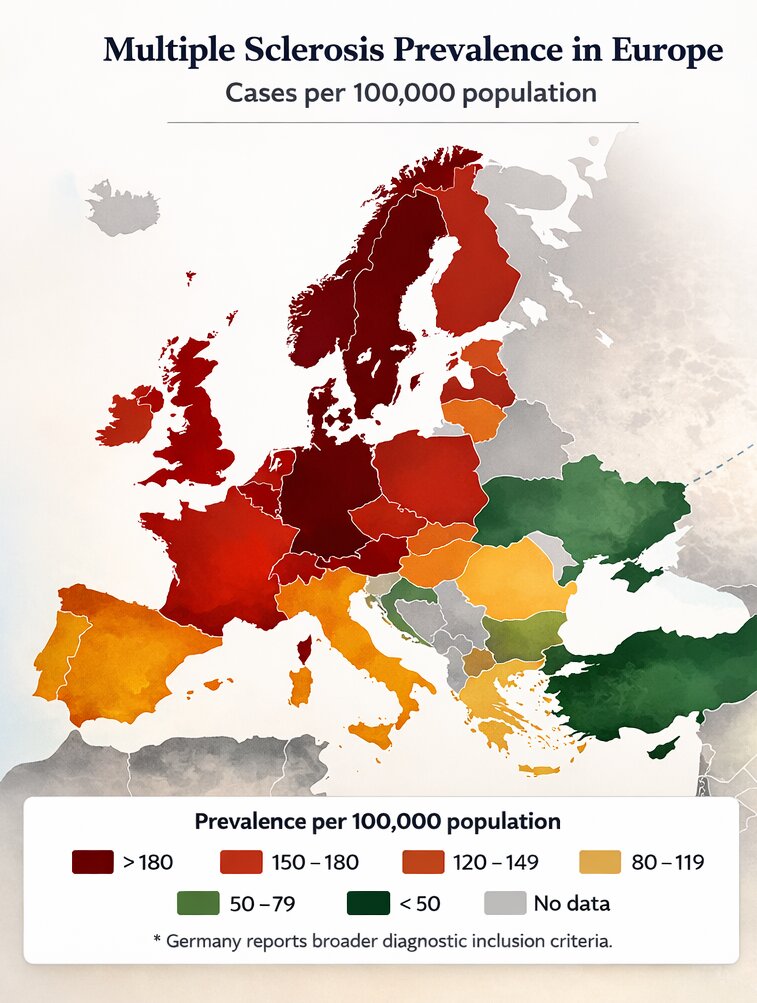
MS Prevalence by Country
| Country | Prevalence / 100k | Region | Category |
|---|---|---|---|
| Germany | 299 | Central Europe | Very high |
| Sweden | 215 | Scandinavia | Very high |
| Norway | 212 | Scandinavia | Very high |
| Denmark | 193 | Scandinavia | Very high |
| United Kingdom | 190 | British Isles | Very high |
| Ireland | 169 | British Isles | High |
| Czech Republic | 168 | Central Europe | High |
| Netherlands | 161 | Western Europe | High |
| France | 155 | Western Europe | High |
| Belgium | 155 | Western Europe | High |
| Finland | 155 | Scandinavia | High |
| Switzerland | 148 | Central Europe | Elevated |
| Austria | 148 | Central Europe | Elevated |
| Poland | 120 | Eastern Europe | Elevated |
| Iceland | 120 | Nordic | Elevated |
| Estonia | 115 | Baltic | Elevated |
| Italy | 113 | Southern Europe | Moderate |
| Spain | 100 | Southern Europe | Moderate |
| Hungary | 89 | Central Europe | Moderate |
| Greece | 70 | Southern Europe | Low |
| Bulgaria | 62 | Balkans | Low |
| Croatia | 59 | Balkans | Low |
| Portugal | 56 | Southern Europe | Low |
| Romania | 55 | Eastern Europe | Low |
| Serbia | 53 | Balkans | Low |
| Ukraine | 42 | Eastern Europe | Very low |
| Moldova | 37 | Eastern Europe | Very low |
The Steppe Migrations: From the Pontic Steppe to the Atlantic
To understand the present-day distribution of MS, we must travel back to the 4th millennium BCE, to the Pontic-Caspian steppe. This is where the Yamnaya lived, nomadic pastoralists who herded cattle and sheep, carrying a genetic ancestry distinct from the Neolithic farmers who then populated Europe.
Yamnaya culture, Nomadic pastoralists of the Pontic-Caspian steppe. Carried Y-chromosome haplogroup R1b-Z2103. Mixed Eastern Hunter-Gatherer (EHG) and Caucasus Hunter-Gatherer (CHG) ancestry. The first major carriers of MS risk variants.
Corded Ware culture, Expanded into Northern and Eastern Europe. ~75% steppe ancestry. Dominant haplogroup: R1a-M417/Z282. Not directly descended from Yamnaya despite shared steppe ancestry.
Bell Beaker phenomenon, Expanded across Western and Southern Europe. ~50% steppe ancestry. Dominant haplogroup: R1b-P312 (L21, U152, DF27). Massive population replacement, notably in Britain (~90% replacement by c. 2500 BCE).
European Bronze Age, Stabilisation of mixed populations. Gradual admixture between steppe descendants and Neolithic remnants. MS risk variants continued undergoing positive selection.
Steppe Ancestry & MS: A Striking Correlation
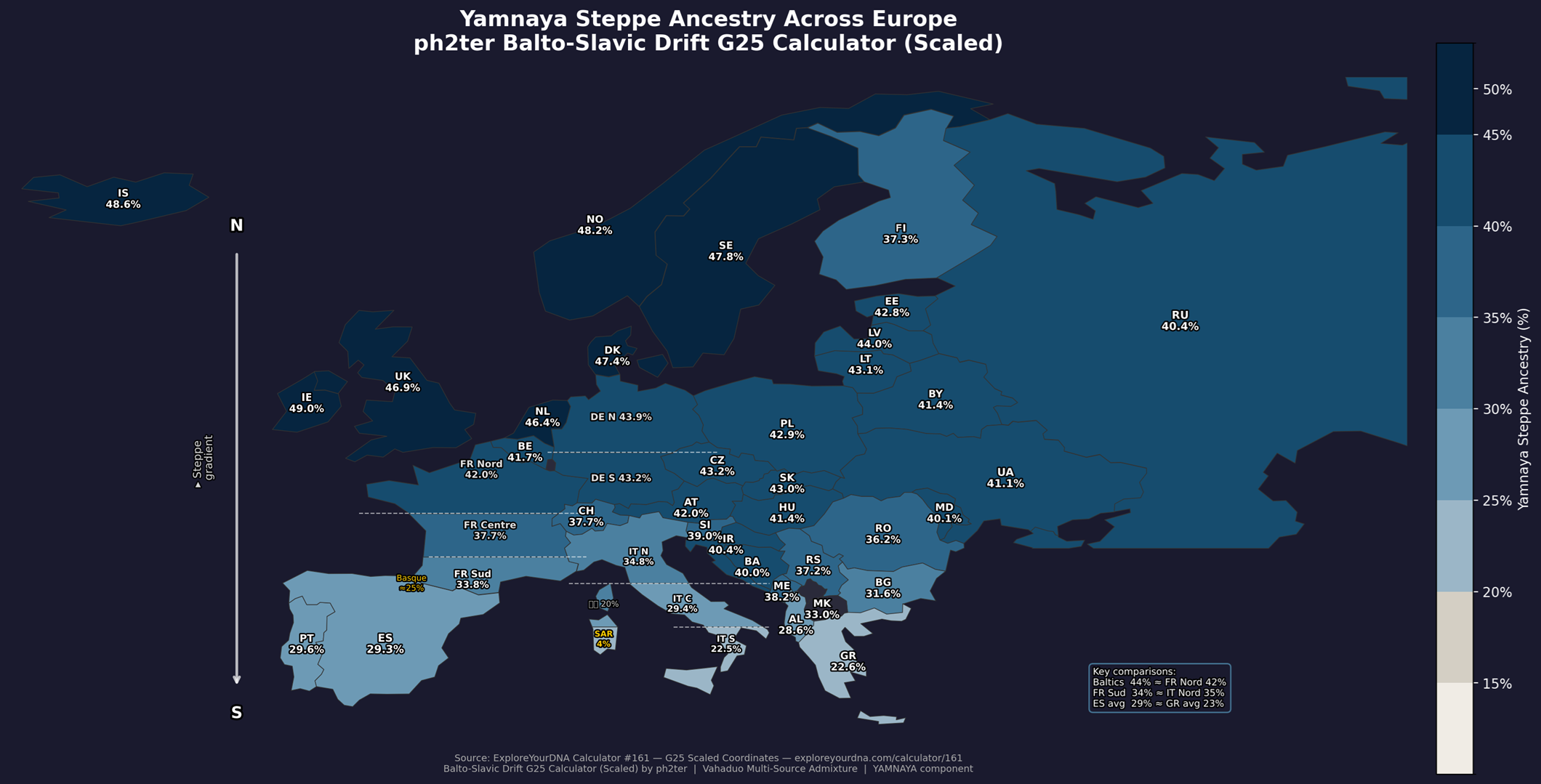
The study by Barrie et al. (2024) revealed a remarkable correlation between the proportion of steppe ancestry in modern populations and MS prevalence. The countries that received the most steppe ancestry via Bell Beaker and Corded Ware migrations are precisely those where MS is most common today.
? High steppe ancestry, High MS prevalence
Scandinavia, British Isles, Germany, Netherlands
Steppe ancestry: 45, 55%. MS prevalence: 155, 299/100k. Dominant haplogroups R1b-U106, R1b-P312, I1. Massive Neolithic population replacement in the 3rd millennium BCE.
? Low steppe ancestry, Low MS prevalence
Balkans, Sardinia, Southern Italy, Greece
Steppe ancestry: 15, 30%. MS prevalence: 37, 70/100k. Strong persistence of Neolithic farmer ancestry (EEF). Haplogroups J2, E-V13, G2a more frequent.
The Specific Role of Bell Beakers
Among the vectors of steppe migrations, the Bell Beaker phenomenon holds a central place in explaining the current distribution of MS across Western Europe. Unlike Corded Ware, which spread mainly into Northern and Eastern Europe, Bell Beakers covered an immense territory from Ireland to Sicily, from Scotland to Portugal.
Bell Beaker Genetic Profile
Steppe ancestry: ~50% on average (variable by region and phase)
Neolithic ancestry (EEF): ~40, 45%
WHG ancestry: ~5, 10%
Dominant Y-haplogroup: R1b-P312 (with subclades L21, U152, DF27)
British replacement: ~90% of the Neolithic population replaced by c. 2500 BCE
The case of Britain is particularly instructive. The arrival of Bell Beakers around 2500 BCE triggered a near-total population replacement, replacing the builders of Stonehenge with populations carrying high levels of steppe ancestry. This massive turnover largely explains why the British Isles today have some of the highest MS rates in the world (190/100,000 in the UK, 169 in Ireland).
In the Iberian Peninsula, replacement was more gradual and modern populations retain more Neolithic farmer ancestry, reflected in more moderate MS rates (100/100,000 in Spain, 56 in Portugal). Sardinia, which was largely spared from steppe Bell Beaker migrations, remains one of the European populations with the highest residual Neolithic ancestry.
The Genetic Mechanism: HLA and Positive Selection
The link between steppe ancestry and MS is not merely a statistical correlation. It rests on precise genetic mechanisms, identified through ancient DNA analysis.
The HLA complex and the DRB1*15:01 allele
The main genetic risk factor for MS is the HLA-DRB1*15:01 allele, located in the major histocompatibility complex (MHC) region on chromosome 6. Carriers of this allele face roughly 3-fold increased risk of developing MS. Barrie et al. demonstrated that this allele is preferentially carried on steppe ancestry haplotypes: at every MS-associated HLA locus, steppe ancestry showed the highest risk ratio.
An advantage turned liability
The evolutionary explanation is elegant. The Yamnaya were herders living in close contact with cattle and sheep, exposed to numerous zoonotic pathogens. A more reactive immune system conferred a considerable survival advantage. The genetic variants that enhanced immune response, which we now identify as MS risk variants, were therefore favoured by natural selection.
This advantage persisted for millennia, including after arrival in Europe, where mixed populations continued herding. Only with modern lifestyle changes (improved hygiene, reduced pathogen exposure, processed diets) did these same variants become detrimental, predisposing carriers to autoimmune diseases, of which MS is the most prominent example.
“This means we can now understand and seek to treat MS for what it actually is: the result of a genetic adaptation to certain environmental conditions that prevailed in our prehistoric past.” , Professor Lars Fugger, co-author, University of Oxford
The Three Ancestries and Their Relationship to MS
The study decomposed the genetic risk for MS according to the three main ancestries that compose modern European populations. This decomposition reveals why certain regions are more affected than others.
| Ancestry | MS Risk Score | Geographic Origin | Current Distribution |
|---|---|---|---|
| Steppe (Yamnaya) | Highest | Pontic-Caspian steppe | Peak in NW Europe (45, 55%) |
| CHG (Caucasus HG) | High | Southern Caucasus | Component of steppe ancestry |
| EHG (Eastern HG) | Moderate | Russian plains | Component of steppe ancestry |
| WHG (Western HG) | Moderate | Atlantic Europe | Low everywhere (5, 15%) |
| Farmer (ANA + Neolithic) | Lowest (protective) | Anatolia / Fertile Crescent | Peak in Southern Europe (50, 70%) |
This table is telling: Neolithic farmer ancestry is the most protective, while steppe ancestry carries the highest risk. Southern European populations, with their strong Neolithic farmer component and lower steppe contribution, benefit from a relative “genetic shield” against MS. Conversely, north-western populations, heavily shaped by Bell Beaker and Corded Ware migrations, concentrate the risk variants.
Migration Routes and Transmission of Risk Variants
Beyond Genetics: Environmental Co-Factors
While the steppe ancestry gradient explains a major share of MS prevalence variation in Europe, environmental factors remain important. Several co-factors modulate the expression of these genetic risk variants.
Vitamin D deficiency, more common at high latitudes, potentiates the steppe-derived MS risk variants.
Near-universal EBV infection is a recognised co-factor, potentially interacting with steppe-derived HLA variants.
Tobacco independently increases MS risk and interacts with HLA region genetic variants.
Women are 2, 3 times more affected than men, a ratio relatively constant across Europe.
The interaction between steppe-derived genetic predisposition and these environmental factors creates a “fertile ground” for MS development. A Scandinavian carrying multiple risk variants inherited from Bell Beaker or Corded Ware ancestors, living at a latitude where sunlight is scarce and vitamin D deficiency common, accumulates risk factors synergistically.
Implications for Research and Treatment
The discovery of the steppe origin of MS genetic risk opens new therapeutic avenues. By understanding that MS results from an immune system “calibrated” to combat the infections of Bronze Age herders, researchers can develop targeted approaches that rebalance the immune response rather than simply suppressing it.
Furthermore, ancestral risk mapping enables personalised approaches to preventive medicine. Individuals with strong steppe ancestry in the HLA region could benefit from earlier screening and monitoring, particularly if they carry additional risk factors.
Conclusion: When Prehistory Illuminates Medicine
The story of MS is ultimately a story of migration, adaptation, and unintended consequences. Five thousand years ago, Yamnaya steppe pastoralists carried immune variants that protected them from livestock diseases. Their descendants, the Corded Ware to the north-east, the Bell Beakers to the west, spread these variants across the entire European continent.
The north, south MS gradient, long unexplained, faithfully mirrors the steppe ancestry gradient in modern Europe: high in the north-west (Scandinavia, British Isles, Germany), where Bell Beaker and Corded Ware populations massively replaced Neolithic farmers; low in the south (Balkans, Mediterranean), where Neolithic farmer ancestry predominates and provides relative protection.
This major discovery, made possible by ancient DNA analysis on an unprecedented scale, beautifully illustrates how paleogenomics can not only illuminate our past but also transform our understanding of present-day diseases and guide the therapies of tomorrow.
References
- Barrie, W., Yang, Y., Irving-Pease, E.K. et al. Elevated genetic risk for multiple sclerosis emerged in steppe pastoralist populations. Nature 625, 321, 328 (2024). doi:10.1038/s41586-023-06618-z
- Allentoft, M.E. et al. Population genomics of post-glacial western Eurasia. Nature 625, 301, 311 (2024). doi:10.1038/s41586-023-06865-0
- MS Barometer 2020. European Multiple Sclerosis Platform (EMSP). emsp.org
- Walton, C. et al. Rising prevalence of multiple sclerosis worldwide: Insights from the Atlas of MS, third edition. Multiple Sclerosis Journal 26(14), 1816, 1821 (2020).
- Haak, W. et al. Massive migration from the steppe was a source for Indo-European languages in Europe. Nature 522, 207, 211 (2015). doi:10.1038/nature14317
- Olalde, I. et al. The Beaker Phenomenon and the Genomic Transformation of Northwest Europe. Nature 555, 190, 196 (2018). doi:10.1038/nature25738
- Papac, L. et al. Dynamic changes in genomic and social structures in third millennium BCE central Europe. Science Advances 7(35), eabi6941 (2021). doi:10.1126/sciadv.abi6941
- Koch, M., Kingwell, E., Tremlett, H. et al. The epidemiology of multiple sclerosis: a systematic review. BMC Neurology 13, 128 (2013). doi:10.1186/1471-2377-13-128
- Attfield, K.E., Jensen, L.T., Kaufmann, M., Friese, M.A. & Fugger, L. The immunology of multiple sclerosis. Nature Reviews Immunology 22, 734, 750 (2022). doi:10.1038/s41577-022-00718-z
- Heyd, V. Yamnaya, Corded Wares, and Bell Beakers on the Move. In: Proceedings of the International Colloquium (2021).
- Wade, B.J. Spatial Analysis of Global Prevalence of Multiple Sclerosis Suggests Need for an Updated Prevalence Scale. Multiple Sclerosis International (2014). doi:10.1155/2014/124578