If you've taken a DNA test with 23andMe, AncestryDNA, or MyHeritage and received results like "British & Irish," "French," or "Northwestern European," you may have wondered: "Do I have Celtic DNA?" Perhaps you've even searched for evidence of ancient Celtic ancestry in your genetic results.
The short answer may surprise you: there is no distinct "Celtic DNA." The most recent paleogenomic studies from 2021-2025 reveal a far more nuanced and fascinating reality. The Celts were never a single, genetically distinct people, they were diverse populations across Europe who shared a language family and cultural practices, not a unique genetic signature.
What Does "Celtic" Actually Mean?
The term "Celtic" comes from ancient Greek writers (Keltoi) describing populations in central and western Europe from the 6th century BCE onward. However, this single term actually encompasses three distinct concepts that are often incorrectly conflated:
Figure 1: The three different meanings of "Celtic", linguistic, archaeological, and genetic, which do not necessarily overlap.
The crucial point is that these three categories do not align. A population could adopt Celtic language and La Tène art styles without any significant genetic input from central Europe. This is exactly what the ancient DNA evidence now shows happened across much of western Europe and Britain.
The Geographic Paradox: Why Celtic Survives on the Margins
Here's a puzzle that has long intrigued scholars: if the Celtic heartland was in central Europe (modern eastern France, Switzerland, southern Germany, Austria), why do Celtic languages today survive only on the far western fringes, Ireland, Scotland, Wales, Cornwall, and Brittany?
The traditional interpretation assumed that these peripheral regions must have received the heaviest Celtic migrations, making them strongholds of Celtic identity. However, genetics tells us the opposite story.
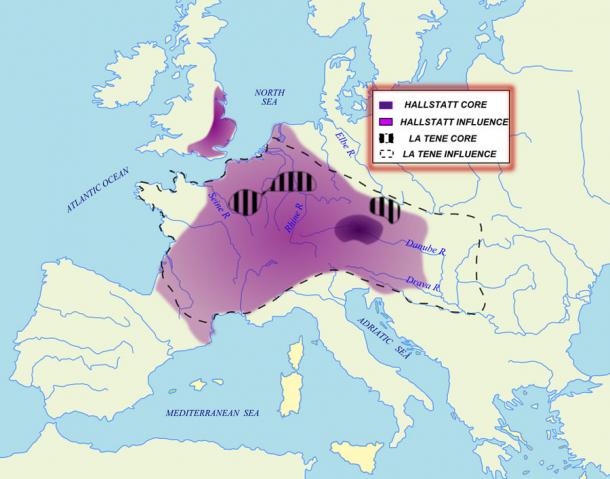
Figure 2: The Hallstatt (c. 800-450 BCE) and La Tène (c. 450-50 BCE) archaeological cultures spread across most of Western and Central Europe. Note that Ireland, Scotland, and Wales, where Celtic languages survive today, were on the periphery of this cultural expansion, not at its core. The heartland was in central Europe (eastern France, Switzerland, southern Germany, Austria).
What Ancient DNA Reveals: The 2021-2025 Revolution
Three landmark studies have transformed our understanding of Celtic origins and the genetic history of western Europe:
1. Patterson et al. 2022, Large-scale migration into Britain during the Bronze Age
This Nature study analyzed 793 ancient individuals and found that between approximately 1000-875 BCE, there was indeed an increase in ancestry related to populations from France in southern Britain. However, this migration predates the La Tène cultural expansion and occurred during the Bronze Age, not the Iron Age when Celtic culture spread.
Key Finding from Patterson et al.:
The migrants who contributed ~50% of Iron Age English and Welsh ancestry arrived during the Middle to Late Bronze Age (before 875 BCE), centuries before the La Tène Celtic cultural expansion. This means the genetic foundation was already in place before "Celtic culture" as we know it even existed.
2. Gretzinger et al. 2024, Dynastic succession among early Celtic elites
This study examined the actual La Tène heartland in southwestern Germany and made remarkable discoveries about elite Celtic society. Crucially, it showed that the "Celtic" populations of Iron Age Germany shared a genetic continuum with Bronze Age France and Iberia, a broad similarity across western and central Europe, not a distinct genetic identity.
Figure 3: Ancient ancestry composition shows remarkable similarity between Iron Age populations across "Celtic" Europe. Notably, modern Germans have less Early European Farmer ancestry than Iron Age "Celts" from the same region, due to later migrations from northern Europe during the Migration Period.
3. McColl et al. 2025, Tracing the spread of Celtic languages using ancient genomics
This groundbreaking preprint directly tested the three main models for Celtic language spread and concluded that the genetic evidence does not support a Late Bronze Age/Iron Age mass migration from central Europe. Instead, the data support a model where Celtic languages spread primarily through cultural transmission along established Bronze Age trade networks.
"Celtic DNA" spread from central Europe (La Tène heartland) to Britain, Ireland, and Iberia through massive population movements during the Iron Age.
Prediction: Iron Age populations in newly "Celtic" areas should show sudden genetic shifts toward central European profiles.
Celtic culture spread through elite networks, trade, and cultural adoption without replacing local populations. The genetic foundations of Britain and Ireland were established in the Bronze Age.
Evidence: Genetic continuity from Bronze Age through Iron Age across western Europe, with only gradual, low-level gene flow.
The Evidence in Detail: No "Celtic Invasion"
The ancient DNA data reveal several key patterns that disprove the traditional "Celtic invasion" model:
| Evidence Type | What Migration Model Predicts | What DNA Actually Shows |
|---|---|---|
| Iron Age Britain | Sudden genetic shift ~450-200 BCE matching La Tène populations | Genetic continuity from Bronze Age; French-related ancestry arrived earlier (1000-875 BCE) |
| Iron Age Ireland | Continental Celtic genetic signature in Iron Age burials | Strong continuity from Bronze Age; essentially same population as before "Celticization" |
| Y-chromosome lineages | Central European male lineages should dominate in "Celtic" regions | R1b-L21 (Atlantic marker) dominates Ireland/Britain; predates Iron Age |
| La Tène heartland elites | Should be genetically distinct founders of Celtic identity | Part of broad west-central European continuum; not genetically distinct |
| Iberian Celtiberians | Central European genetic influx during Iron Age | Continuation of local Bronze Age population with Celtic cultural adoption |
?? What Your DNA Test Results Actually Mean
So when your DNA test shows "British & Irish," "French," or "Northwestern European" ancestry, what are you actually seeing?
Understanding Your "Celtic" Ancestry Results
Commercial DNA tests don't detect "Celtic DNA" because no such distinct genetic category exists. Instead, they identify broad regional patterns that reflect:
- Bronze Age foundations: The mixture of Neolithic farmers, Western Hunter-Gatherers, and Steppe ancestry that characterized western Europe by ~2000 BCE
- Regional drift: Subtle genetic differences that accumulated through centuries of relative isolation between regions
- Recent historical events: Viking Age, Norman conquest, and later migrations that shaped modern genetic patterns
The genetic signature that tests label as "British & Irish" or "Celtic" largely predates the Iron Age Celtic cultural expansion by centuries or even millennia.
Figure 4: The major genetic events that shaped western European populations occurred long before La Tène Celtic culture spread. The Bronze Age genetic foundations were already established centuries before anyone could be called "Celtic."
How Culture Spread Without Mass Migration
If there wasn't a massive Celtic invasion, how did Celtic languages and culture spread across such a vast area? The answer lies in understanding how pre-modern societies actually functioned:
Elite Networks and Prestige
The Gretzinger et al. 2024 study revealed that early Celtic elites in Germany practiced dynastic succession, with biological relatives ruling across sites more than 100 km apart. These elite networks facilitated cultural exchange without requiring mass population movement. The La Tène art style, religious practices, and eventually language spread along these aristocratic connections.
Trade Routes
The Bronze Age had already established extensive trade networks connecting Britain, Ireland, France, Iberia, and central Europe. Commodities like bronze, gold, tin, salt, and amber moved along these routes, and so did ideas, technologies, and languages. Celtic culture likely spread along the same pathways.
Language Shift Without Replacement
Historical examples show that populations can completely change their language while maintaining genetic continuity. Consider:
- Modern Turks speak a Turkic language but are genetically largely descended from ancient Anatolians
- Hungarians speak a Uralic language but are genetically Central European
- The entire Roman Empire adopted Latin without mass Italian migration
Celtic language adoption in Ireland, Britain, and Iberia likely followed similar patterns, local populations adopted the prestigious language of trading partners and cultural elites.
The Modern "Celtic" Regions: A Genetic Perspective
So what is genetically distinctive about modern populations in Ireland, Wales, Scotland, and Brittany? The answer is not "Celtic DNA" but rather relative isolation:
Figure 5: Each "Celtic" region has a distinct genetic and linguistic history. Their Celtic languages arrived through different pathways at different times, none through an Iron Age mass migration from central Europe.
Conclusions: What "Celtic" Really Means
- "Celtic" is a linguistic and cultural designation, not a genetic one. There never was a genetically distinct "Celtic race."
- Celtic culture spread primarily through elite networks, trade, and cultural adoption, not through massive population migrations.
- The genetic foundations of Ireland, Britain, and western Europe were established in the Bronze Age, centuries before La Tène Celtic culture existed.
- Celtic languages survive in Ireland, Wales, Scotland, and Brittany because these isolated regions were Celticized last and later protected from Romanization and Germanization.
- Your DNA test results showing "British & Irish" ancestry reflect Bronze Age genetic patterns, not Iron Age Celtic migrations.
Understanding this distinction doesn't diminish the rich Celtic cultural heritage, if anything, it makes the story more fascinating. Celtic languages, art, and traditions spread across a vast region precisely because they were compelling enough to be adopted by diverse populations, not because they were imposed by conquering armies. The Celtic identity was always about shared culture, beliefs, and ways of life, not shared bloodlines.
So the next time someone asks if you have "Celtic DNA," you can explain that while you may have ancestry from regions where Celtic languages were spoken, the genetic signature they're looking at is far older than Celtic culture itself, and that's what makes the story of human migration and cultural transmission so wonderfully complex.
References
- Patterson, N., Isakov, M., Booth, T., et al. (2022). Large-scale migration into Britain during the Middle to Late Bronze Age. Nature, 601, 588, 594. https://doi.org/10.1038/s41586-021-04287-4
- Gretzinger, J., Schmitt, F., Mötsch, A., et al. (2024). Evidence for dynastic succession among early Celtic elites in Central Europe. Nature Human Behaviour, 8, 1467, 1480. https://doi.org/10.1038/s41562-024-01888-7
- McColl, H., Kroonen, G., Pinotti, T., et al. (2025). Tracing the spread of Celtic languages using ancient genomics. bioRxiv. https://doi.org/10.1101/2025.02.28.640770
- Olalde, I., et al. (2018). The Beaker phenomenon and the genomic transformation of northwest Europe. Nature, 555, 190, 196.
- Cassidy, L.M., et al. (2016). Neolithic and Bronze Age migration to Ireland and establishment of the insular Atlantic genome. PNAS, 113, 368, 373.
- Cunliffe, B. (2013). Britain Begins. Oxford University Press.
- Koch, J.T. & Cunliffe, B.W. (eds) (2013). Celtic from the West 2: Rethinking the Bronze Age and the Arrival of Indo-European in Atlantic Europe. Oxbow Books.
- Sims-Williams, P. (2020). An alternative to 'Celtic from the East' and 'Celtic from the West'. Cambridge Archaeological Journal, 30, 511, 529.