
Recent advances in paleogenomics are radically transforming our understanding of human mobility in prehistoric Europe. Thanks to IBD (Identity by Descent) analysis techniques, researchers can now identify kinship links between individuals separated by thousands of kilometers, revealing an ancient world where migrations were not one-off events but recurring phenomena involving continuous family exchanges across the continent.
Overview of IBD (Identity by Descent) analysis capabilities and key findings from recent ancient DNA studies. IBD segments reveal direct biological relatedness between ancient individuals.
1. Understanding Identity by Descent (IBD)
What is IBD?
IBD (Identity by Descent) segments are portions of chromosomes inherited from a common ancestor. When two individuals share an IBD segment, it means they inherited that DNA fragment from the same ancestor. The longer the segment, the more recent the common ancestor.
In 2023, 2024, Harald Ringbauer and his team at the Max Planck Institute developed ancIBD, a revolutionary tool for detecting these segments in ancient DNA, even when highly degraded. This methodological breakthrough, published in Nature Genetics, has opened a new window on prehistoric mobility that traditional ancestry analyses could not reveal.
(≤5 generations)
(few centuries)
(several centuries)
analyzed
Application of this method to over 4,000 ancient genomes from Eurasia has revealed hundreds of pairs of related individuals, sometimes buried thousands of kilometers apart. The most spectacular case involves two individuals from the Afanasievo culture buried 1,410 km apart, one in central Mongolia, the other in southern Russia, who share multiple long IBD segments.
"We found exciting links between ancient cultures, and the signal of long shared segments allowed us for the first time to specifically demonstrate close relationships between important ancient cultures, sometimes over vast spaces over the order of only a few hundred years." , Harald Ringbauer, Max Planck Institute for Evolutionary Anthropology
2. The Steppe Migrations (~3000 BCE)
The first major revelation from European paleogenomics came in 2015 with the simultaneous studies by Haak et al. and Allentoft et al. published in Nature. These works demonstrated that a massive migration from the Pontic-Caspian steppes transformed Europe's gene pool between 3300 and 2500 BCE.
The Yamnaya Culture: Starting Point
The Yamnaya culture (from Russian "pit," referring to their burial practices in kurgans) developed in the steppes north of the Black Sea and Caspian Sea. Genetically, these populations resulted from a mixture of:
- Eastern Hunter-Gatherers (EHG), northern Eurasian populations
- Caucasus Hunter-Gatherers (CHG), southern populations linked to Iran and the Caucasus
A 2024 study in Nature (Allentoft et al.) provided unprecedented detail on this formation, showing that Yamnaya ancestry formed gradually along several genetic "clines," including a "Caucasus-Lower Volga Cline" and a "Volga Cline" where EHG and CHG populations mixed.
Figure 1: Yamnaya expansions (~3300, 2500 BCE). Solid arrows indicate major migrations with strong genetic replacement. The bar chart shows the proportion of Steppe ancestry in different European regions.
The Unexpected Role of the Globular Amphora Culture
A surprising discovery concerns the Globular Amphora Culture (GAC) of Poland and Ukraine. Although this population did not yet carry Steppe ancestry, IBD analysis revealed elevated links with Corded Ware groups.
"These IBD links appear for all Corded Ware groups across Central Europe to Russia, indicating that individuals related to GAC contexts must have had a major demographic impact early on in the genetic admixtures giving rise to various Corded Ware groups." , Ringbauer et al., Nature Genetics 2024
This suggests that Corded Ware culture formation involved not only Steppe migrants but also significant absorption of local Neolithic farmer populations.
3. The Bell Beaker Phenomenon: A Pan-European Network
The figure below, from the recent publication "Tracing the Bell Beaker phenomenon through ancient DNA studies" by Mittnik, Olalde, Cavazzuti, and Haak, is truly sensational. It reveals the extent of family connections across Europe between 4000 and 3000 BCE.
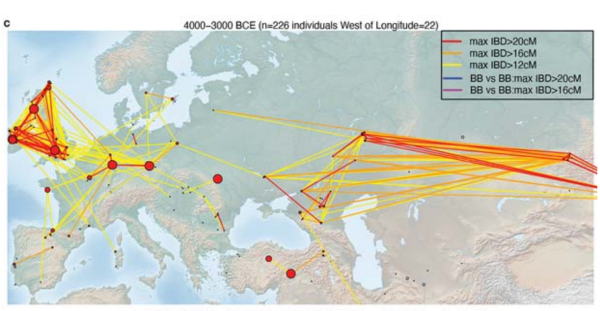
Figure 2: IBD network between individuals from the period 4000, 3000 BCE (n=226 individuals west of Longitude 22). Colored lines represent shared IBD segments: Red >20cM, Orange >16cM, Yellow >12cM. Blue/pink connections show specifically Bell Beaker-to-Bell Beaker links. From Mittnik, Olalde, Cavazzuti & Haak.
A Remarkably Mobile Europe
If we interpret this figure correctly, all individuals connected by lines share a recent common ancestor, separated by at most 5 generations for segments >20 cM. This means prehistoric Europe was even more mobile than earlier DNA studies had shown.
"With only one exception, all 52 Bell Beaker sites are connected to each other through long IBD segments between at least one pair of individuals. These links across the whole geographical range very often involve IBD segments longer than 20 cM, which are usually broken down rapidly beyond the 6th degree of relatedness, meaning that the majority of Bell Beaker-associated individuals share common ancestors with other Bell Beaker individuals in the relatively recent past, in other words, they were distant cousins." , Mittnik, Olalde, Cavazzuti & Haak
The Iberia vs. Central Europe Contrast
The landmark 2018 study in Nature by Olalde et al. demonstrated a striking contrast in Bell Beaker diffusion mechanisms:
| Trajectory | Mechanism | Genetic Impact |
|---|---|---|
| Iberia → Central Europe | Cultural diffusion | Limited genetic affinity |
| Central Europe → Britain | Massive migration | ~90% gene pool replacement |
| Central Europe → France | Massive migration | ~60, 90% gene pool replacement |
| Central Europe → Northern Italy | Limited migration + diffusion | ~10% Steppe ancestry |
| Continent → Sardinia | Migration followed by local absorption | <1% but IBD links present |
This is the first clear example from ancient DNA where "pots do not always go hand-in-hand with people", Bell Beaker pottery spread culturally from Iberia, but the major human expansion to northwestern Europe came from Central European populations already mixed with Steppe ancestry.
4. The Fascinating Case of Sardinia
One of the most intriguing aspects revealed by IBD analysis concerns Sardinia. Despite the absence of detectable Steppe ancestry in their overall genomic profile, Bell Beaker individuals from Sardinia were related to Bell Beaker individuals from the mainland.
The Sardinian Paradox Explained
The ancestors of Sardinian Bell Beakers originally carried Steppe ancestry, but their descendants quickly lost it due to immediate and massive mixing with local Neolithic populations. In other words, Bell Beaker migrants arriving in Sardinia mixed so quickly and completely with the local population that their Steppe genetic signature was "diluted" within a few generations, but the IBD kinship links still testify to their continental origin.
This phenomenon perfectly illustrates the fundamental difference between:
| Metric | What It Measures | Sardinian Case |
|---|---|---|
| Genomic Ancestry | Ancestral components averaged across the whole genome | <1% Steppe → "no migration" |
| IBD Kinship | Specific segments inherited from recent common ancestors | Links to continent → real migration |
The two metrics don't always tell the same story, and IBD can reveal connections invisible to classical ancestry analysis. Sardinia also represents an exceptional genetic refuge for European Neolithic ancestry, preserving a genomic signature close to the first farmers until today.
5. Cross-Channel Mobility and the Transformation of Britain and France
Among the most dramatic population replacements documented by paleogenomics are those of Britain and France during the Bronze Age. The Olalde et al. (2018) study with over 80 British genomes showed that the arrival of the Bell Beaker complex was associated with the replacement of approximately 90% of the British gene pool within a few centuries. Similarly, France experienced a massive genetic turnover of 60, 90%, demonstrating that this was not an isolated British phenomenon but a broader transformation of northwestern Europe.
Before the Bell Beakers: The Megalith Builders
The British Neolithic population, responsible for building monuments like Stonehenge, descended primarily from Early Neolithic farmers who had colonized Britain around 4000 BCE. Genetically, they resembled other Western European Neolithic populations:
- ~80% Anatolian Farmers
- ~20% Western Hunter-Gatherers (WHG)
The Arrival of the Bell Beakers (~2450 BCE)
Starting around 2450 BCE, a new population carrying Bell Beaker pottery crossed the Channel. These individuals had high levels of Steppe ancestry, acquired during their passage through Central Europe.
Persistent Continental Connections
The 2023 study on adult-child graves from Altwies (Luxembourg) and Dunstable Downs (Britain), published in Scientific Reports, used IBD analysis to reveal the continental connections of British Beakers:
"Ancestry modelling and patterns of shared IBD segments between the individuals examined, and contemporary genomes from Central and Northwest Europe, highlight the continental connections of British Beakers. [...] Extended family, such as a paternal aunt at Dunstable Downs, could also act as 'substitute parents' in the grave." , Scientific Reports, 2023
These data suggest that Channel crossings were not isolated events but part of a mobility network maintained over multiple generations, with family ties extending on both sides of the strait.
6. The Iron Age: Stability Despite High Mobility
A fascinating paradox emerges from the study of the Iron Age and historical period: despite high levels of documented individual mobility, European population structure has remained remarkably stable from the Iron Age to the present.
The eLife 2024 Study: A Paradox Revealed
Antonio et al. analyzed 204 genomes from Europe and the Mediterranean covering the historical period (from ~1000 BCE onwards). Their findings are surprising:
The Paradox: Mobility vs. Stability
Despite this high level of mobility, overall population structure across western Eurasia has remained relatively stable through the historical period up to the present, mirroring geography.
How to Explain This Paradox?
The authors show that, under standard population genetics models with local panmixia, the observed level of dispersal would lead to a collapse of population structure. The persistence of this structure therefore suggests a lower effective migration rate than indicated by observed dispersal.
Hypothesis: This phenomenon could be explained by extensive transient dispersal resulting from drastically improved transportation networks and the Roman Empire's mobilization of people for trade, labor, and military, but these migrants did not contribute permanently to the local gene pool.
Fine-Scale Temporal Resolution: The Nature 2025 Study
A very recent study in Nature (2025) developed "Twigstats," a new approach of time-stratified ancestry analysis, applied to 1,556 ancient whole genomes from Europe in the historical period. This method improves statistical power by an order of magnitude by focusing on recent coalescences.
The results show that during the first half of the first millennium CE, at least two distinct streams of Scandinavian-related ancestry expanded across western, central, and eastern Europe, revealing population movements previously below the detection thresholds of traditional genetic studies.
7. Implications for DNA Test Interpretation
These discoveries about prehistoric mobility have direct implications for interpreting modern commercial DNA tests.
What Your DNA Test Reflects
Ancestry estimates from 23andMe, AncestryDNA, or MyHeritage are based on modern reference populations. Yet we now know that:
- European population structure has been stable for ~3,000 years
- But it results from massive Bronze Age migrations
- Individual mobility (long-distance marriages) was much higher than previously thought
For Today's Europeans
If you have European ancestry, your DNA carries traces of these migration waves:
| Component | Origin | Integration Period |
|---|---|---|
| Anatolian Farmers | Anatolia/Near East | ~7000, 4000 BCE |
| Hunter-Gatherers (WHG) | Pre-Neolithic Western Europe | Present for >10,000 years |
| Steppe Pastoralists | Pontic-Caspian Steppes | ~3000, 2000 BCE |
Conclusions
Prehistoric Europe was a world in constant motion. The new IBD analysis techniques reveal that:
- Migrations were continuous processes, not single events
- Family networks extended over thousands of kilometers, with cousins buried from Brittany to Mongolia
- The exchange of exotic objects (obsidian, jade axes) was accompanied by intermarriage
- Ancestry and kinship ties can tell different stories (Sardinian case)
- Population structure can remain stable despite high individual mobility
These discoveries continue to rewrite our understanding of the past, and of our own genetic heritage.
8. Using G25 Data for Mobility Research
While G25 coordinates measure overall genetic ancestry rather than specific kinship links, understanding population structure helps contextualize prehistoric mobility patterns. Populations with high EHG and Steppe ancestry show genetic profiles consistent with Yamnaya-derived groups, while those with high WHG ancestry reflect pre-Steppe Western European populations.
For modeling the genetic composition of ancient and modern Europeans, use tools like Vahaduo or ExploreYourDNA Calculators with the following source populations:
| Source Population | Associated Mobility Pattern | Example G25 Samples |
|---|---|---|
| WHG | Pre-migration local Europeans; high IBD within regions | Loschbour, La Braña, Cheddar Man |
| EEF | Neolithic expansion from Anatolia | Anatolia_N, LBK, Cardial |
| Yamnaya/Steppe | Long-distance IBD links (up to 1,410 km) | Yamnaya_Samara, Afanasievo |
| ANE | Deep Siberian connections; KITLG blond origin | AG3, MA1 |
Data sources: Published ancient DNA studies; Ringbauer et al. (2024); Antonio et al. (2024); Olalde et al. (2018); Mittnik et al. (2022); ExploreYourDNA database.
9. References
- Mittnik A, Olalde I, Cavazzuti C, Haak W. Tracing the Bell Beaker phenomenon through ancient DNA studies. iScience. 2022. doi:10.1016/j.isci.2022.103939
- Ringbauer H, Huang Y, Akbari A, et al. Accurate detection of identity-by-descent segments in human ancient DNA. Nature Genetics. 2024;56:143-151. doi:10.1038/s41588-023-01582-w
- Antonio ML, Weiß CL, Gao Z, et al. Stable population structure in Europe since the Iron Age, despite high mobility. eLife. 2024;13:e79714. doi:10.7554/eLife.79714
- Olalde I, Brace S, Allentoft ME, et al. The Beaker phenomenon and the genomic transformation of northwest Europe. Nature. 2018;555:190-196. doi:10.1038/nature25738
- Haak W, Lazaridis I, Patterson N, et al. Massive migration from the steppe was a source for Indo-European languages in Europe. Nature. 2015;522:207-211. doi:10.1038/nature14317
- Allentoft ME, Sikora M, Sjögren KG, et al. Population genomics of Bronze Age Eurasia. Nature. 2015;522:167-172. doi:10.1038/nature14507
- Allentoft ME, et al. Population genomics of post-glacial western Eurasia. Nature. 2024;625:301-311. doi:10.1038/s41586-023-06865-0
- Lazaridis I, et al. The Genetic Origin of the Indo-Europeans. bioRxiv preprint. 2024. doi:10.1101/2024.03.15.585102
- Schiffels S, et al. High-resolution genomic history of early medieval Europe. Nature. 2025. doi:10.1038/s41586-024-08275-2
- Zhang B, Zheng J, Sun L, et al. Multidisciplinary analyses and ancient DNA reveal social inequality and mobility in the Central Plains during the Eastern Zhou period in China. Nature Human Behaviour. 2025. doi:10.1038/s41562-025-02356-6
- Goldberg A, Günther T, Rosenberg NA, Jakobsson M. Ancient X chromosomes reveal contrasting sex bias in Neolithic and Bronze Age Eurasian migrations. PNAS. 2017;114:2657-2662. doi:10.1073/pnas.1616392114
- Rivollat M, et al. Biological and substitute parents in Beaker period adult, child graves. Scientific Reports. 2023. doi:10.1038/s41598-023-45612-3
- Mittnik A, et al. Kinship-based social inequality in Bronze Age Europe. Science. 2019;366:731-734. doi:10.1126/science.aax6219
- Olalde I, et al. The genomic history of the Iberian Peninsula over the past 8000 years. Science. 2019;363:1230-1234. doi:10.1126/science.aav4040
- Gnecchi-Ruscone GA, et al. Network of large pedigrees reveals social practices of Avar communities. Nature. 2024;629:376-383. doi:10.1038/s41586-024-07312-4