
The genetic origins of Poles from Volhynia are particularly interesting because this group emerged at the intersection of long-term historical, migratory, and cultural processes occurring in one of the most ethnically diverse areas of Central and Eastern Europe. For centuries, Volhynia was a borderland region, where influences from Polish, Ruthenian (Ukrainian), Lithuanian, and to a lesser extent, other groups (e.g., Jews, Germans, Czechs) intersected. Changes in state borders, social, and religious structures fostered both settlement and the gradual assimilation of the population. As a result, the Polish community of Volhynia was not homogeneous in terms of origin, but rather emerged as a result of overlapping waves of settlement and long-term assimilation processes.
Genetic analysis of the Volhynian Poles allows us to examine these processes from a biological perspective, complementing historical, demographic, and linguistic data. Of particular importance here is the distinction between noble, urban, and rural (peasant) settlement from ethnically Polish lands, and the subsequent Polonization of a portion of the Ruthenian population. Each of these elements may have left a distinct mark on the genetic structure of the Volhynian Polish population, visible today in the distribution of Y-chromosome haplogroups and autosomal analyses.
The aim of this article is to present the genetic origins of Poles from Volhynia against the background of the region's history, with particular emphasis on the internal diversity of this group and its genetic relationships with other populations of Poland and Ukraine. This approach allows for a better understanding of the extent to which the Polish population of Volhynia was the result of settlement from central Poland and the extent to which it was the effect of multigenerational assimilation processes occurring in Poland's eastern borderlands.
According to the 1931 census, Poles in the Volhynian Voivodeship of the Second Polish Republic comprised:
- 33.0% of the population of cities with more than 20,000 inhabitants (42,410 people),
- 21.8% of the population of cities with less than 20,000 inhabitants (27,089 people),
- 15.1% of the rural population (277,141 people), a total of 346,640 people.
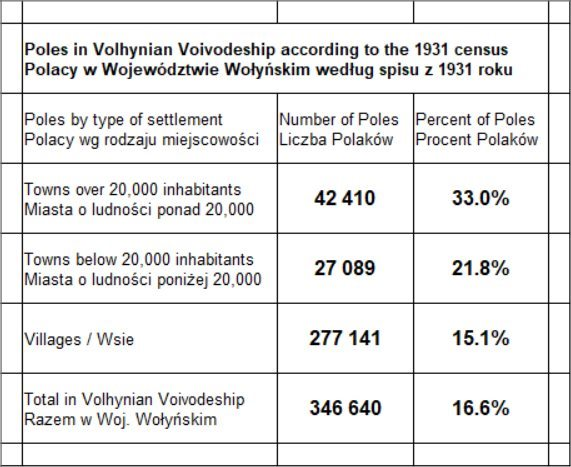
Poles in Volhynian Voivodeship according to the 1931 census
Polish rural settlement in Volhynia, as reflected in the 1931 census, which showed Poles comprising 15.1% of the rural population, was not the result of a single, one-time colonization effort, but the result of long and multi-layered historical processes. Its origins date back to the early modern era, when Volhynia became part of the Crown of the Kingdom of Poland, within the Polish-Lithuanian Commonwealth. Polish magnates and noble families conducted internal colonization of sparsely populated or newly cleared areas of the forest and forest-steppe zones. To develop their estates, they brought settlers from ethnically Polish lands, primarily from Mazovia, Lesser Poland, Kuyavia, and Central Poland. These settlers were peasants of the Latin rite who founded villages under Polish or German law, often taking advantage of temporary tax exemptions. Although this settlement was never truly mass, many such villages survived uninterruptedly until the 20th century, creating a lasting bloc of Polish rural population, especially in the western part of Volhynia.
Alongside this early peasant settlement, a gradual process of cultural and social Polonization played a significant role in shaping the size of the Polish rural population. Over the generations, some Ruthenian rural populations adopted the Polish language and customs, often in conjunction with a change of religion. The conversion from Orthodoxy or the Uniate Church to the Roman Catholic rite was crucial, as Catholicism was widely associated with Polishness in the region. Social advancement within rural communities, including the roles of village heads, craftsmen, courtiers, and so on, also fostered the adoption of Polish language and culture. During the interwar period, a significant portion of rural residents listed as Polish in censuses were of mixed Polish-Ruthenian or Ruthenian descent, but they had long identified culturally and religiously as Polish; this was a spontaneous process, not the result of direct state pressure.
The period of Russian rule following the partitions of Poland did not lead to the disappearance of this Polish rural presence. Although the Russian authorities pursued a policy of Russification and restricted Polish political and cultural life, there were no mass expulsions of Polish peasants from Volhynia. Numerous Catholic villages associated with Polish landed estates continued to function, sustained by a parish network that fostered the preservation of the language and customs. As a result, by the beginning of World War I, Volhynia had a significant rural population identifying as Polish, regardless of the subsequent settlement policies of the interwar period.
After 1921, when the western part of Volhynia became part of the Second Polish Republic, new forms of rural settlement were introduced, but their demographic significance was less significant than some believe. Military settlers received land as a reward for their service, while civilian settlers arrived from overpopulated regions of central Poland. In Volhynia, however, these groups remained relatively small, a result of poor soil quality, limited land availability, and tensions with the local Ukrainian population. Although they contributed to the increase in the number of Poles in rural areas, they constituted only a small fraction of the more than 277,000 Poles living in rural Volhynian Voivodeship recorded in 1931.
Demographic factors further strengthened the Polish presence in the countryside. Polish rural communities were characterized by high birth rates and stable family structures, supported by parish life and multigenerational settlement networks. This natural population growth fostered a systematic increase in the number of Poles in the Volhynian countryside. Polish villages were unevenly distributed, with larger concentrations found in the western counties (those that were assigned to Poland in the 1921 Treaty of Riga) and in areas with a dense network of Catholic parishes. Overall, the 15.1% Polish population of Volhynia's rural population in 1931 represents the cumulative result of centuries of settlement, Polonization, and demographic growth. This Polish presence in the Volhynian countryside was formed over generations and was ultimately destroyed by wartime violence (the Volhynian Massacre) and the post-war population displacements following World War II.
Of course, Polish settlement in Volhynia was not limited to rural areas; from the very beginning, it was significantly influenced by the presence of Polish townspeople and nobility, whose influx was closely linked to the region's political incorporation into the Crown of the Kingdom of Poland in the early modern period. When Volhynia was incorporated into Poland in the 16th century, as part of the Polish-Lithuanian Commonwealth, it was gradually integrated into Polish legal, administrative, and social structures. This process created strong incentives for representatives of the Polish nobility and urban population to settle in the region, as bearers of political power, economic capital, and the state's institutional culture.
The Polish nobility played a key role in this process. From the 16th century, Polish nobles and Polonized Ruthenian boyars received extensive land grants in Volhynia in exchange for military and administrative service. These estates became the foundation of noble settlement and a lasting pillar of Polish influence in rural areas. Over time, many families of the Ruthenian nobility adopted the Polish language, Polish customs, and Roman Catholicism, fully integrating into the nobility of the Polish-Lithuanian Commonwealth. As a result, the Volhynian nobility became increasingly Polish culturally and politically, even where its genealogical roots were local. Manors, magnate residences, and estate administrations served as centers of Polish social and cultural life, strengthening the Polish character of the landed elite throughout the early modern period.
Ethnically Polish townspeople settled in Volhynia primarily due to the development and expansion of towns incorporated under Magdeburg law. Beginning in the late Middle Ages, and particularly intensively from the 16th century onward, urban centers such as Lutsk, Volodymyr-Volynskyi, Kremenets, and Dubno were reorganized or newly incorporated according to legal patterns common in central Poland. These incorporations fostered the influx of Polish townspeople, merchants, craftsmen, and professionals, who brought with them the municipal government, guild organization, and commercial practices familiar from central Polish towns. In towns, Polish often dominated city administration and the judiciary, while Roman Catholic parishes and institutions organized the religious life of the Polish population. Although the towns of Volhynia were ethnically diverse, with large Ruthenian and Jewish populations, Polish townspeople held a disproportionately strong position in the municipal government and in the more prestigious crafts and trade.
In the 17th and 18th centuries, the combined presence of Polish nobility and townspeople gave Volhynia a distinctly Polish administrative and cultural framework. The nobility controlled land, local courts, and political representation, while the towns served as hubs of economic exchange and centers of legal authority linked to the state. Even periods of profound crisis, such as the Cossack uprisings and the wars of the 17th century, failed to completely destroy this structure, although they significantly weakened the Polish population's numbers and security. After the partitions of Poland and Volhynia's incorporation into the Russian Empire, the Polish nobility and townspeople remained socially visible despite intensified political repression. The landed elite retained significant estates, and Polish urban communities survived in the towns thanks to Catholic institutions, education, and family networks, even as the Russian authorities sought to curtail their influence.
In the late 19th and early 20th centuries, this centuries-long tradition of noble and urban settlement meant that Poles in Volhynia were significantly overrepresented in cities and among landowners relative to their share of the total population. This phenomenon is clearly confirmed by the 1931 census, which shows a significantly higher percentage of Poles in cities, both large and small, than in rural areas. The Polish urban population of Volhynia was therefore not a product of the settlement policies of the interwar period, but a continuation of a settlement pattern developed over centuries, rooted in the region's political integration with the Polish state, its legal system, and its social structure. It was the Polish townspeople and nobility who constituted the historical core of the Polish presence in Volhynia, shaping the region's administration, economy, and cultural landscape long before the 20th century.
Y-DNA Analysis of Volhynian Poles
Let us now move on to the genetic analysis of the DNA of Volhynian Poles.
As part of the Poles from Kresy project by FamilyTreeDNA, we have so far (as of January 18, 2026) collected a total of 26 male lineages (Y-DNA haplogroups) of Poles descending from Volhynia, along with 13 autosomal DNA samples of Poles with 100% Volhynian ancestry (going back several generations). Below, I will analyze each of the collected male lineages, paying particular attention to whether they might originate from Polish settlers in Central Poland or from local Polonized Ruthenians. Next, I will analyze the autosomal DNA of Poles from Volhynia.
The map shows the origin of the oldest known ancestors in the male lines of Poles from Volhynia (the red line marks the eastern border of interwar Poland, I also include a link to the Google Map of the Project):
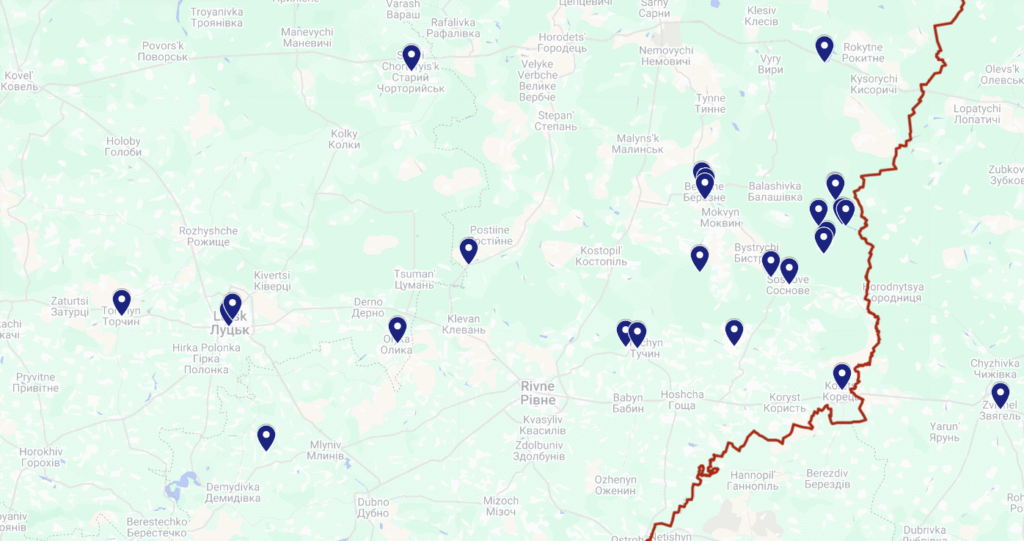
Geographic origins of the earliest known paternal ancestors of Volhynian Poles
Below I am attaching a chart showing the distribution of Y-DNA haplogroups among Poles from Volhynia:
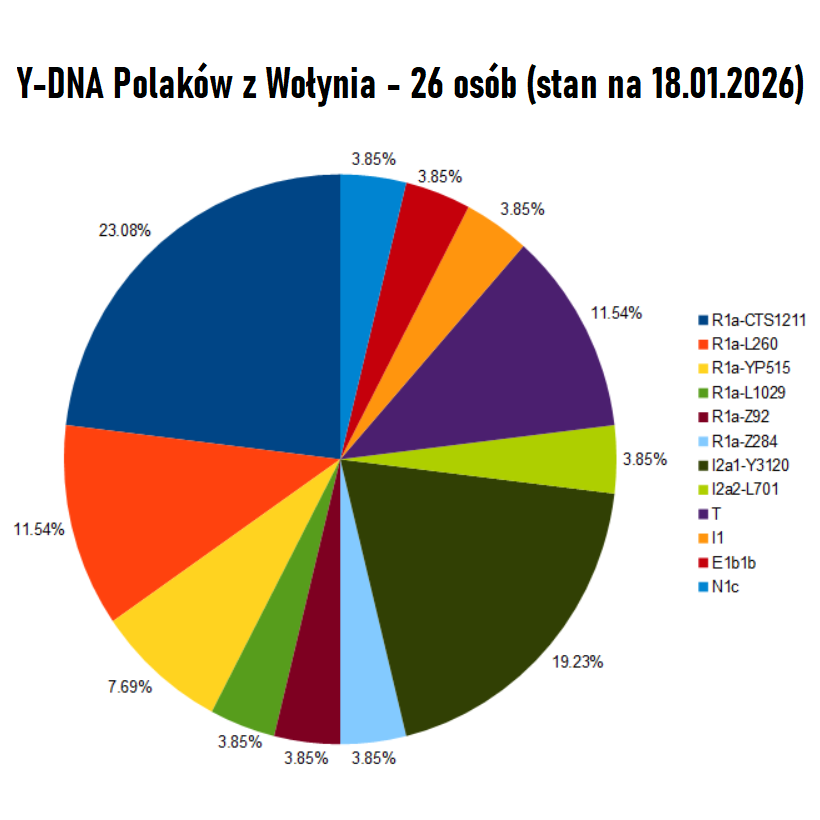
Distribution of Y-DNA haplogroups among Poles from Volhynia
In total, we identified the following haplogroups among Poles from Volhynia:
As you can see, we have a mixture of likely West Slavic lineages (likely descended from Polish settlers from the lands west of the Bug River) with those that were most likely Ruthenian and culturally Polonized. There are also Germanic, Balkan, and other lineages.
Autosomal DNA Analysis
Let's now move on to the autosomal analysis of Poles from Volhynia. To this end, I used the ADMIXTURE method and averaged the results for all 13 Poles analyzed, so that subsequent analyses could be conducted on this average (since, for research purposes, we are interested in the origins of the Volhynian Polish population as a whole, not individual individuals).
These are the distances between Poles from Volhynia and other populations from around the world (as can be seen, ethnic Ukrainians from Volhynia, the population of UA_Rivne-Oblast, are only in thirteenth place):
This is what the map of similarities between Poles from Volhynia and the regional populations of Europe looks like (as you can see, the greatest similarity is to the lands of Central Poland, although there is also a large similarity to the Eastern Slavs):
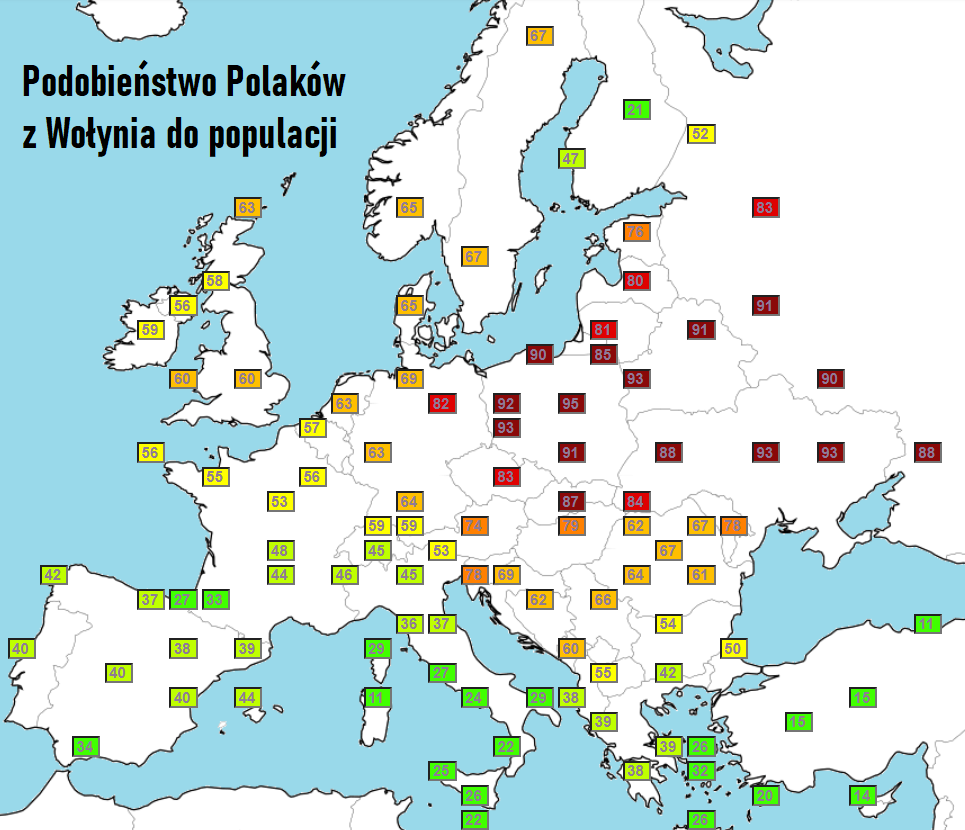
Genetic similarity map of Poles from Volhynia to regional populations of Europe
Modeling ancestry using the nMonte method (Monte Carlo algorithm) with populations from all over the world (the algorithm shows the percentage distribution of ancestry of the tested population from individual world populations):
"distance%=0.5162"
Polish_Volhynia_N13
- Europe_BY_Brest-Region = 23.6%
- Europe_PL_Central-Poland = 16.6%
- Europe_PL_Warmia-Masuria = 15.6%
- Europe_PL_Lodzkie = 12%
- Europe_PL_Mazowieckie = 10.1%
- Europe_UA_Kharkiv-Oblast = 6.8%
- Europe_PL_Wielkopolskie = 3.5%
- Europe_PL_Lubuskie = 2.8%
- Europe_PL_Kujawsko-Pomorskie = 2.6%
- Europe_LT_Lithuania-Utena = 2.4%
- Europe_UA_Ivano-Frankivsk-Oblast = 1.7%
- Europe_GB_Scotland-Highland = 1.3%
- Europe_GB_Scotland-Central = 1%
This indicates a predominance of settlers from the Polish lands west of the Bug River, while the contribution of Polonized Ruthenians seems to be less than half of the ancestry. Interestingly, the Ruthenian component appears slightly more northerly than geography would suggest (instead of the Volhynian population of UA_Rivne-Oblast, the algorithm prefers the population of BY_Brest-Region).
Similarly, in Neighbor Joining clustering, most Poles from Volhynia, 10 out of 13, as well as the average score for all 13, group with Poles from Central or Southern Poland. One Volhynian is grouped with Poles from Podlasie, and the remaining two with Ukrainians.
On the PCA (Principal Component Analysis) chart, most Poles from Volhynia fall within the area occupied by Poles from the Oder-Bug area (red cloud labeled Poland). Only two individuals, PL_Vol4 and PL_Vol13, fall within the area occupied by Ukrainians (blue cloud labeled Ukraine, with the exception of Galician Ukrainians, labeled SW UKR on the PCA chart, who fall closer to Carpatho-Rusyns and Slovaks):
PCA graph for the European population, with Poles from Volhynia marked with black dots:
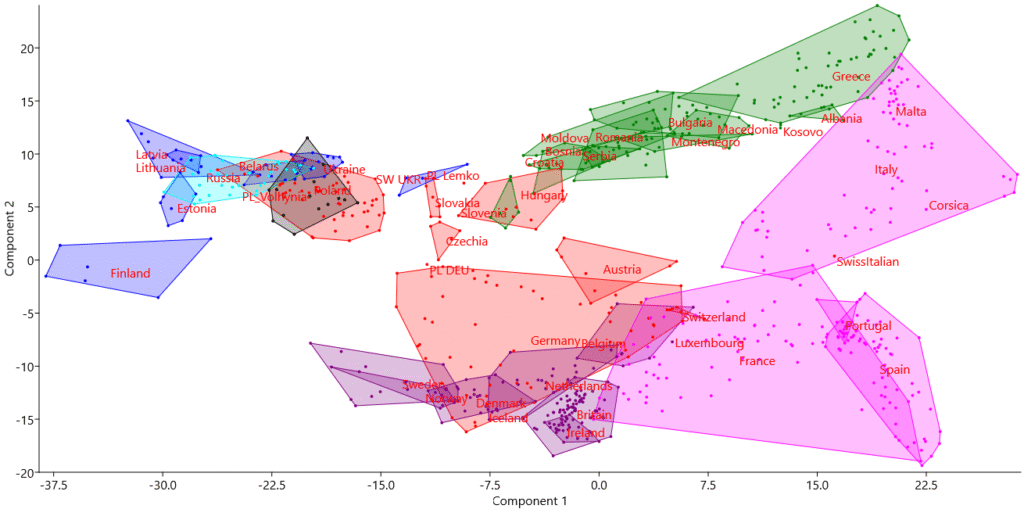
PCA plot of European populations with Volhynian Poles marked as black dots
The same PCA graph, zoomed in on the populations of Poland and surrounding areas (Poles from Volhynia are black dots):
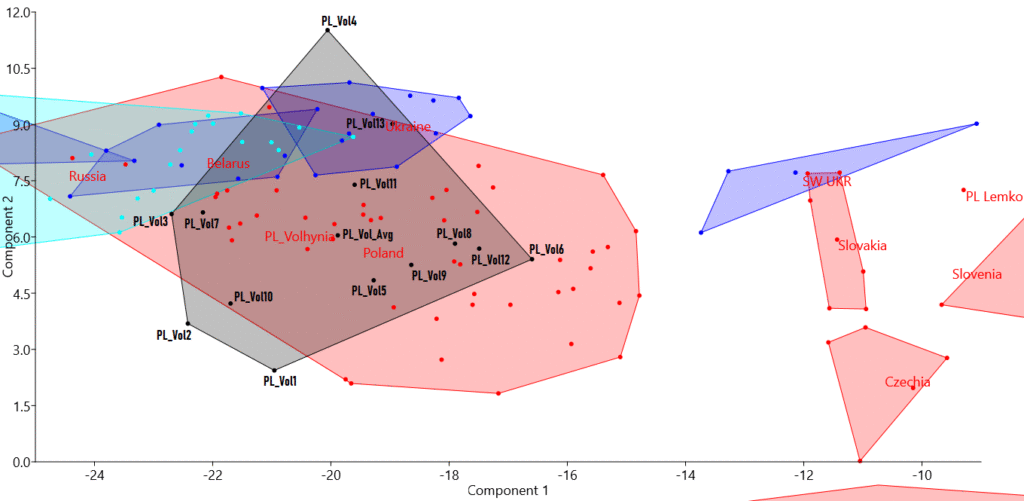
PCA plot zoomed in on Poland and surrounding populations
Conclusions
In summary, the genetic results, both Y-DNA haplogroup analyses and autosomal DNA analyses, seem to indicate a significant, greater-than-commonly-believed, contribution of settlers from the Polish lands west of the Bug River to the ethnogenesis of Volhynian Poles. The analyses also point to the possibility of north-south settlement movements within the Kresy region (from the Grand Duchy of Lithuania to Volhynia). This is suggested both by certain haplogroups and by the fact that the nMonte model primarily selects the Brest Oblast of Belarus over ethnic Ukrainians from Volhynia.
I would like to emphasize that the above analyses and findings are not yet final, as the increasing amount of data continually coming in from the Poles from Kresy FTDNA Project may change the overall picture. Furthermore, it should be noted that so far we only have samples of Volhynian Ukrainians from the Rivne Oblast, not from the more western Volhynian Oblast, which may have led the nMonte algorithm to select Brest Oblast. However, I don't believe that Ukrainians from the Volhynian Oblast would differ significantly from those from the Rivne Oblast autosomally.
The analysis of the genetic origins of Poles from Volhynia, based on both historical data and the results of Y-DNA and autosomal DNA studies, allows for several important synthetic conclusions. Primarily, it confirms that this community was not homogeneous in terms of biological origin, but rather developed as a result of complex and long-term settlement and assimilation processes that occurred over many centuries on the Polish-Russian border.
The results of Y-chromosome haplogroup analyses indicate the distinct presence of West Slavic lineages, frequently found in central, southern, and western Poland, which correlates well with the historically documented influx of settlers from lands west of the Bug River. At the same time, the presence of lineages typical of the East Slavic cultural circle confirms the participation of the local Ruthenian population, which, through multigenerational Polonization processes, was incorporated into the Polish ethnic and cultural community of Volhynia. The Y-DNA structure thus reflects the dual nature of the ethnogenesis of the Volhynian Poles, in which the settlement and assimilation elements coexisted and intertwined.
This picture is even more clearly visible in autosomal analyses. Genetic distances, Neighbor Joining clustering, and sample distribution in PCA plots show that most of the Poles from Volhynia studied are genetically closer to the populations of central and southern Poland than to Ukrainians. Modeling ancestry using the nMonte method indicates a dominant contribution of components characteristic of Polish populations, with a simultaneous significant contribution of a Ruthenian component, which additionally appears to be more northern than strictly Volhynian in nature (this may suggest the importance of intra-borderland migrations from the former Grand Duchy to Volhynia).
The overall results suggest that the contribution of settlers from ethnically Polish lands to the formation of the Volhynian Polish population was greater than is often assumed in historical narratives. At the same time, these studies demonstrate that the process of Polonization of the Ruthenian population was also a real ethnogenetic factor.
It should be emphasized, however, that the presented conclusions are tentative and open-ended. Increasing the number of samples, both from the Poles of Volhynia and from comparative Ruthenian populations (for example, from the Volhynia Oblast), may in the future clarify or partially correct the presented picture. Despite these limitations, the current state of research allows us to treat genetics as a valuable tool complementing classical historical and demographic studies, enabling a more comprehensive understanding of the origins and complex identity of the Poles of Volhynia.
Tools used to determine the origin of Y-DNA haplogroups:
About This Article
Author: Piotr Kapuscinski
Original article: Pochodzenie genetyczne Polaków z Wolynia (YourRootsDNA.net, January 18, 2026)
Data source: Poles from Kresy FTDNA Project
Published on ExploreYourDNA with the author's permission.