
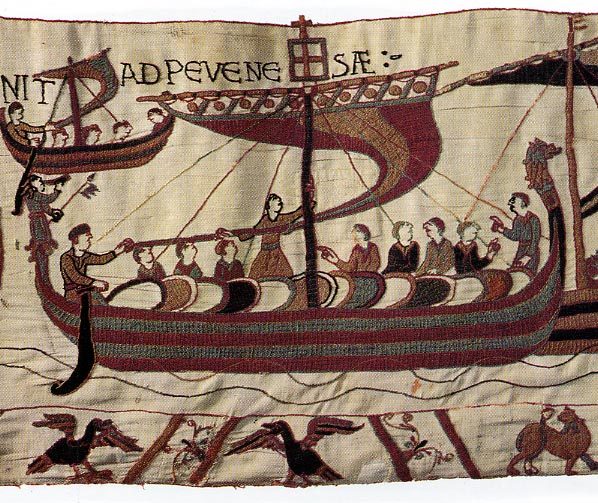
Normandy, a region in northwestern France along the English Channel, carries in its very name the memory of its founders: the Northmen, Scandinavian Vikings who settled there in the early Middle Ages. While written sources and archaeology have long documented Viking activity in this region, Y-chromosome DNA now provides a direct biological link between modern Normans and their Scandinavian ancestors.

Map of Normandy in northern France, showing its position along the English Channel.
1. The Birth of Normandy: From Raiders to Settlers
In 911 CE, the Viking leader Rollo was granted land along the lower Seine by the Frankish king Charles the Simple through the Treaty of Saint-Clair-sur-Epte. This agreement marked the foundation of Normandy as a Scandinavian principality within the Frankish world.
Unlike temporary raiding zones, Normandy became a region of permanent Viking settlement. Over time, the settlers adopted Christianity and the local Romance language, but many of their paternal lineages survived. The descendants of these Northmen would go on to conquer England in 1066, establish kingdoms in Sicily and southern Italy, and participate in the Crusades.
2. Why the Y Chromosome Matters
The Y chromosome is passed almost unchanged from father to son, making it an ideal marker for tracing paternal ancestry. Because Viking expansion was largely male-driven, warriors, traders, and settlers who often married local women, Scandinavian ancestry is frequently far more visible in Y-DNA than in autosomal DNA.
Certain Y-chromosome haplogroups are strongly associated with Scandinavia during the Viking Age. Among them, haplogroup I (particularly I1 and certain I2 branches) plays a key role. These lineages expanded dramatically in Scandinavia during the Iron Age and Viking Age, and have been repeatedly identified in archaeological Viking burials across Europe.
3. Three Living Viking Lines in Normandy and the Channel Islands
Modern genetic testing has revealed several Y-chromosome lineages in Normandy and nearby regions that can be directly traced back to Scandinavian origins. Below we present three documented cases from La Manche, Calvados, and Guernsey, each representing a living Viking heritage.
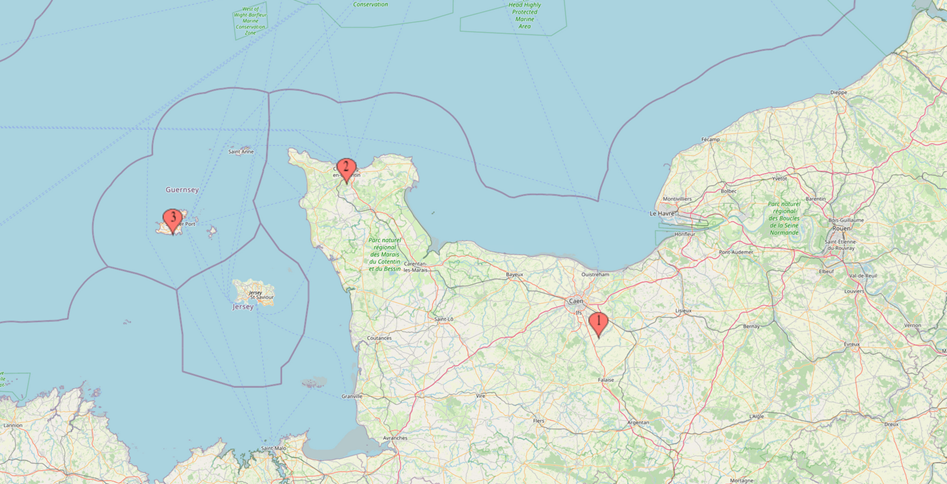
Geographic distribution of documented Scandinavian Y-DNA lineages in the Norman region.
Case 1: Haplogroup I-Y36690, La Manche (FR-50)
The first lineage, haplogroup I-Y36690, belongs to an individual from La Manche, the westernmost department of Normandy facing the Channel Islands. This lineage is a downstream branch of I-L813, strongly associated with Scandinavia.
The phylogenetic tree shows direct connections with modern Swedish individuals, and the estimated time to most recent common ancestor (TMRCA) of approximately 1,300 years before present places the lineage's diversification squarely in the Viking Age.
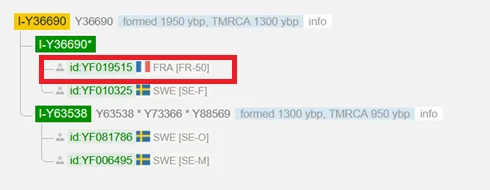
Haplogroup I-Y36690: A Norman from La Manche (FR-50) sharing ancestry with Swedish lineages.
Case 2: Haplogroup I-Y5619, Calvados (FR-14)
The second lineage, haplogroup I-Y5619, comes from an individual in Calvados, home to the historic cities of Caen and Bayeux. This branch descends from I-Y5612, which has a documented match with VK281, a Viking-Age individual excavated in Denmark (DK-85).
This archaeological connection provides direct evidence of medieval Scandinavian ancestry. The lineage formed approximately 2,200 years ago, with the TMRCA indicating shared ancestry dating back to the early medieval period.
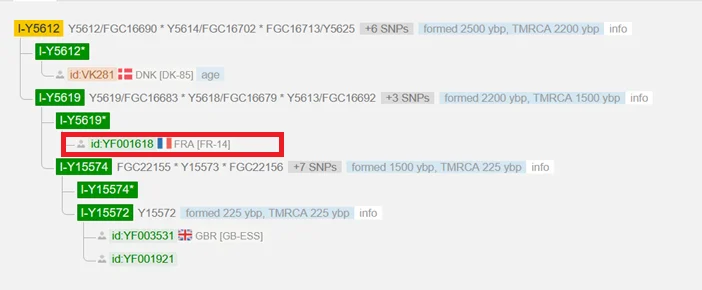
Haplogroup I-Y5619: A Norman from Calvados (FR-14) matching a Viking-Age Danish burial (VK281).
Case 3: Haplogroup I-Y3664, Guernsey (GGY)
The third lineage, haplogroup I-Y3664, belongs to an individual from Guernsey, one of the Channel Islands that were part of the Duchy of Normandy and remain Crown Dependencies of the British monarch.
This lineage shows connections to both Viking-Age Danish remains (CGG106841) and modern Swedish and Finnish individuals. The TMRCA of approximately 3,200 years indicates an ancient Scandinavian origin, with the branch splitting during the Bronze/Iron Age and descendants later participating in Viking expansion.
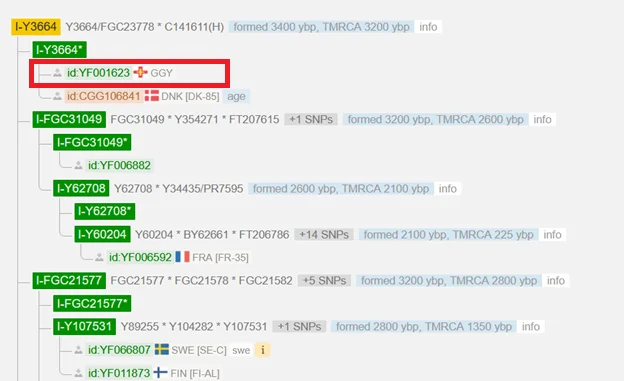
Haplogroup I-Y3664: A Guernsey native matching Viking-Age Danish DNA and modern Scandinavians.
4. Toponymy: The Linguistic Trace of the Vikings
Norman place names provide an independent line of evidence for Viking settlement. Many locations across Normandy preserve Old Norse elements:
- -tot (from toft, homestead): Yvetot, Hottot, Routot
- -bec (from bekkr, stream): Caudebec, Bolbec, Houlbec
- -dal / -dalle (from dalr, valley): Dieppedalle, Oudalle
- -fleur (from flóð, inlet/estuary): Barfleur, Honfleur, Harfleur
- -hogue / -houe (from haugr, hill/mound): La Hougue, Sahurs
- -lon / -londe (from lundr, grove): Étalondes, Yvetot-Bocage
These place names cluster precisely in areas where Scandinavian Y-chromosome lineages are found today, particularly in La Manche, Calvados, and along the Seine valley.
5. Autosomal Evidence: IBD Segments with Modern Scandinavians
Beyond Y-chromosome evidence, autosomal DNA analysis provides additional confirmation. Analysis of IBD (Identical By Descent) segments reveals that some modern Normans share significant genetic segments with contemporary Scandinavians.
In one documented case, segment sizes of 12, 22 cM shared between a Norman family and modern Scandinavians indicate a common ancestor approximately 24, 34 generations ago, placing the connection squarely in the 10th, 12th century, consistent with the Viking settlement period.
6. From Vikings to Normans: Cultural Assimilation, Genetic Persistence
Normandy illustrates a remarkable historical phenomenon: cultural assimilation does not erase biological ancestry. Within just a few generations, the Vikings:
- Adopted Christianity and abandoned Norse paganism
- Switched from Old Norse to the local Romance language
- Integrated into Frankish political structures
- Developed a distinct Norman identity
Yet their paternal lineages persisted through the centuries, carried forward by sons who may have had no knowledge of their Scandinavian origins. The Y chromosome thus acts as a biological archive of the Viking Age, preserving information that written records never captured.
7. Conclusion
By combining history, toponymy, and Y-chromosome genetics, it is possible to retrace the Viking origins of Normandy with remarkable clarity. The three haplogroups presented here, I-Y36690 from La Manche, I-Y5619 from Calvados, and I-Y3664 from Guernsey, represent living witnesses of the Scandinavian foundations of this region.
These men, separated by a millennium from their Viking ancestors, carry in their DNA the genetic signature of the Northmen who transformed a Frankish territory into one of the most influential duchies of medieval Europe.
Acknowledgments
Special thanks to the individuals from La Manche, Calvados, and Guernsey who contributed their genetic data to this research. Their participation makes it possible to connect modern genetic evidence with Norman history and to illustrate how Viking ancestry survives in the region today.