
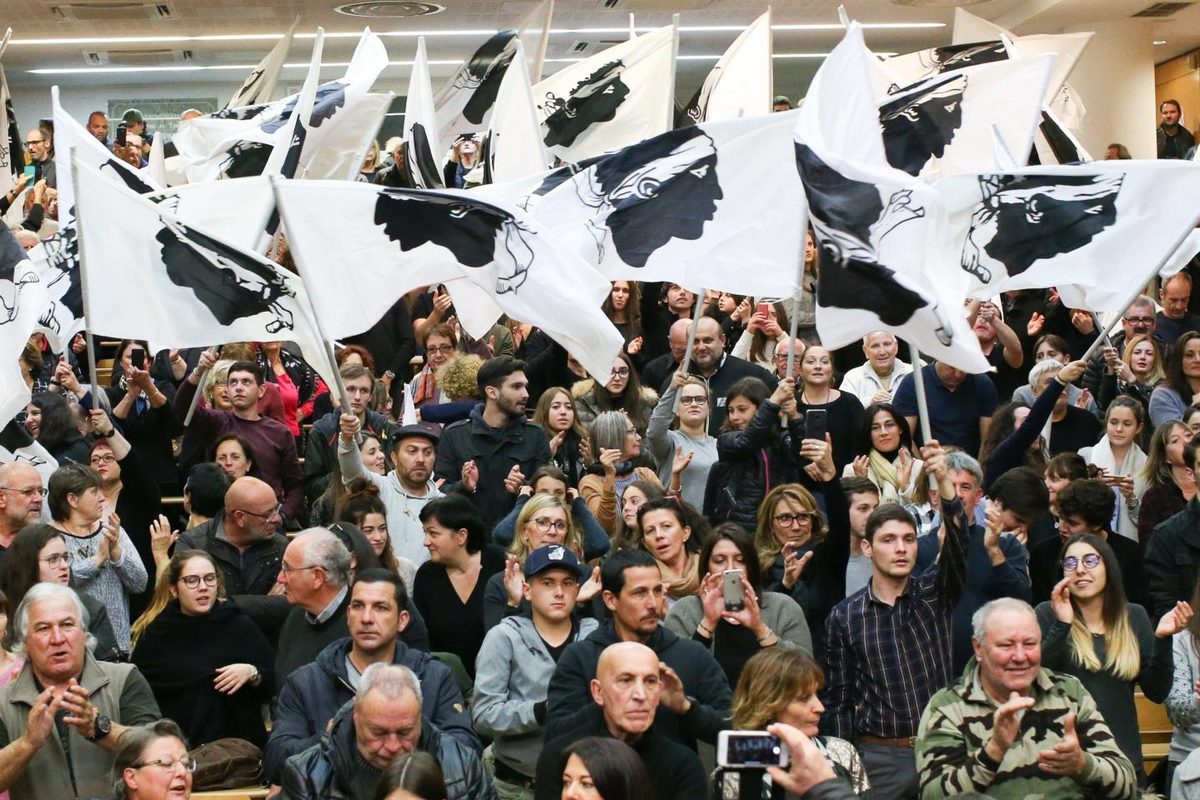
Corsica has been a French department since 1768, when the bankrupt Republic of Genoa sold the island to Louis XV in the Treaty of Versailles. The political border has been French for 258 years. The genetic profile, however, is unambiguously Italian. On the Global25 PCA, the 12 closest populations to French_Corsica are all Italian: Lombardy, Tuscany, Emilia, Piedmont, Bergamo, Umbria, Swiss_Italian, Veneto, Marche, Lazio, Trentino, and Liguria, with G25 distances between 0.0189 and 0.0314. The closest French population, French_Provence, sits at 0.0425, more than twice the distance to Lombardy and ranking 48th on the global proximity list. Northern French populations (Paris, Brittany, Nord, Pas-de-Calais, Seine-Maritime) are three to five times further than Italian Lombardy. This pattern is not a G25 quirk. The 2019 Scientific Reports genome-wide analysis by Tamm and colleagues reached exactly the same conclusion using allele frequency, haplotype-based, and ancient genome analyses: Corsicans are closest to Northern and Central Italian populations, not to French ones. The historical explanation is straightforward: massive Tuscan immigration during Pisan rule (1077 to 1284), five centuries of Genoese administration (1284 to 1768), and a continuous Tyrrhenian Italian cultural and demographic sphere going back to Etruscan and Roman times. Politically French, autosomally Italian, with Tuscan as the historical literary language until the mid-19th century.
Key Points
- On the Global25 PCA modern population averages panel, the 12 closest populations to French_Corsica are all Italian. Italian_Lombardy (0.0189), Italian_Tuscany (0.0205), Italian_Emilia (0.0210), Italian_Piedmont (0.0216), Italian_Bergamo (0.0218), Italian_Umbria (0.0257), Swiss_Italian (0.0265), Italian_Veneto (0.0277), Italian_Marche (0.0288), Italian_Lazio (0.0290), Italian_Trentino_Alto_Adige (0.0306), Italian_Liguria (0.0314).
- The closest French population, French_Provence at G25 distance 0.0425, ranks 48th in the global proximity list, more than twice as distant as Italian Lombardy and behind every Italian region from Lombardy to Apulia, plus the Spanish Balearic Islands, several Spanish mainland regions, and the Greek Peloponnese.
- Northern French populations are much further still: French_Paris 0.0687, French_Brittany 0.0893, French_Nord 0.0705, French_Seine-Maritime 0.0792. Corsica is approximately as distant from Brittany as Sicilians are from Norwegians.
- Tamm et al. 2019 (Scientific Reports), the first genome-wide study of the Corsican population, concluded that Corsicans are genetically closer to populations from continental Europe, such as Northern and Central Italy, despite their geographic proximity to Sardinia and political incorporation into France.
- The closeness to Tuscany specifically reflects the demographic legacy of Pisan rule (1077 to 1284), during which substantial Tuscan immigration occurred. This is why the northern two-thirds of Corsica still speaks a language classified linguistically as a Tuscan Italian dialect, and why the 1755 Corsican Republic constitution was written in Italian.
- Despite being separated by only 11 kilometers of the Strait of Bonifacio, Corsica is significantly closer to mainland Italian populations than to Sardinia (G25 distance 0.0742, ranking far below all Northern and Central Italian regions). This separation is one of the most striking findings of Tamm et al. 2019.
- The northern Corsican linguistic and cultural sphere (Cismonte, oriented toward Tuscany and Liguria) and the southern sphere (Pomonte, with stronger Sardinian connections) reproduce a real demographic gradient documented in surname studies (Morelli, Paoli, Francalacci 2002) and confirmed by genome-wide data.
- Politically, Corsica became French in 1768, fifteen months before Napoleon Bonaparte was born in Ajaccio (15 August 1769) as the son of a Genoese-Italian-speaking family. Italian remained the language of culture and administration on the island until the mid-19th century.
- The G25 distance pattern is therefore not a methodological artifact and not a fluke of the reference panel. It is the genetic record of one thousand years of Pisan, Genoese, and broader Tyrrhenian Italian demographic input, layered on top of an older Roman and Etruscan Italian substrate.
1. A French department since 1768, a Tuscan-Italian gene pool since the 11th century
The political history of Corsica is unusual and important to understand the genetic findings. The island was Greek, then Etruscan, then Carthaginian, then Roman from 238 BCE for six centuries. After the fall of Rome it was raided by Vandals, then administered by Byzantines, then subjected to Saracen incursions until the 11th century. In 1077, Pisa took control of the island under papal protection. The Pisan period (1077 to 1284) was demographically decisive: substantial Tuscan immigration introduced toponymy, language, settlement patterns, and a large autosomal contribution that still defines the modern Corsican population. The traditional division of the island into Cismonte (the eastern and northern part oriented toward Tuscany and Liguria) and Pomonte (the western and southern part, more isolated and with stronger Sardinian connections) dates from this period.
After the Battle of Meloria in 1284, Genoa defeated Pisa and took possession of Corsica. With a brief Aragonese interlude (1296 to 1347), Genoese rule lasted nearly five centuries, until 1768. The Bank of Saint George of Genoa administered the island as a colonial possession, building the famous chain of coastal watchtowers against Barbary pirates, fortifying Calvi, Bonifacio, Ajaccio, and Bastia, and progressively integrating the local population into the Republic of Genoa's Ligurian sphere. Corsican Italian-speakers were sent to Genoese universities. The 1755 Corsican Constitution, written by Pasquale Paoli during the short-lived Corsican Republic (1755 to 1769), was composed in Italian, not French. Italian remained the language of culture, administration, religion, and law on Corsica until the mid-19th century, almost a hundred years after the French annexation.
The Treaty of Versailles of 15 May 1768, by which a financially exhausted Genoa pledged Corsica to France as collateral for unrepayable war debts, ended the Italian phase politically. The French military conquest at the Battle of Ponte Novu in 1769 ended the brief Corsican Republic. Napoleon Bonaparte was born in Ajaccio less than four months later, on 15 August 1769, into a Genoese-Italian-speaking patrician family. The Frenchification of Corsica, in the sense of language and identity, was a 19th and 20th century project, mostly post-1860 and especially after World War I. The autosomal record of the population, however, was set centuries earlier, during the Pisan and Genoese periods, on top of an even older Roman and Etruscan Italian substrate.
The popular assumption
Corsica has been French for more than two centuries, with French as the official language and a French education system in place for six generations. Its population should now be genetically intermediate between French and Italian, perhaps closer to mainland France given the political integration.
The genetic reality
Modern French Corsicans are autosomally closer to every Northern and Central Italian regional population than to any French regional population. The 258 years of French political rule have produced French institutions, French education, and French national identity, but they have not produced French ancestry. The autosomal profile was set during the Pisan-Tuscan immigration of 1077 to 1284 and the long Genoese demographic continuity of 1284 to 1768.
2. The G25 evidence: every closest neighbor is Italian
The most direct test of the question "are Corsicans genetically French?" is to compute the Global25 distance from the modern French_Corsica population average to every other modern population in the standard scaled panel of 1,000+ populations, and to list the closest matches. The result is unambiguous. The full ranking of the top 25 closest populations to French_Corsica is given below, with G25 distances and a note on geographic location.
| Rank | Population | G25 distance | Region |
|---|---|---|---|
| 1 | Italian_Lombardy | 0.0189 | Northern Italy |
| 2 | Italian_Tuscany | 0.0205 | Central Italy |
| 3 | Italian_Emilia | 0.0210 | Northern Italy |
| 4 | Italian_Piedmont | 0.0216 | Northern Italy |
| 5 | Italian_Bergamo | 0.0218 | Northern Italy (Lombardy) |
| 6 | Italian_Umbria | 0.0257 | Central Italy |
| 7 | Swiss_Italian | 0.0265 | Italian-speaking Switzerland |
| 8 | Italian_Veneto | 0.0277 | Northern Italy |
| 9 | Italian_Marche | 0.0288 | Central Italy |
| 10 | Italian_Lazio | 0.0290 | Central Italy (Rome region) |
| 11 | Italian_Trentino_Alto_Adige | 0.0306 | Northern Italy |
| 12 | Italian_Liguria | 0.0314 | Northern Italy (Genoa region) |
| 13 | Spanish_Menorca | 0.0323 | Balearic Islands |
| 14 | Spanish_Eivissa | 0.0341 | Balearic Islands |
| 15 | Spanish_Baleares | 0.0346 | Balearic Islands average |
| 16 | Greek_Thessaly | 0.0349 | Northern Greece |
| 17 | Spanish_Mallorca | 0.0360 | Balearic Islands |
| 18 | Spanish_Murcia | 0.0364 | Southeastern Spain |
| 19 | Albanian | 0.0372 | Balkans |
| 20 | Italian_Abruzzo | 0.0378 | Central Italy |
| 21 | Spanish_Castilla_La_Mancha | 0.0379 | Central Spain |
| 22 | Spanish_Extremadura | 0.0382 | Western Spain |
| 23 | Spanish_Terres_de_l_Ebre | 0.0383 | Catalonia |
| 24 | Spanish_Andalucia | 0.0385 | Southern Spain |
| 25 | Spanish_Alacant | 0.0388 | Valencia region |
The first French population in this ranking is French_Provence at position 48 with a G25 distance of 0.0425. Every Italian regional population from the northern Alps to the southern Apennines is closer to Corsica than the geographically nearest French population. The pattern is not subtle and not borderline. Corsica is closer to Lombardy, 600 km north across the Alps and the Ligurian Sea, than to Provence, 170 km across the Ligurian Sea on the same latitude. It is closer to Tuscany, the historical Pisan motherland, than to any French region. It is closer to Lazio, the Roman heartland, than to Provence. It is closer to Liguria, the Genoese homeland, than to any French region.
3. The PCA portrait
The same finding is visible directly on a Global25 scatter plot. The figure below shows the position of French_Corsica relative to its Italian neighbors, French populations, Spanish and Basque populations, and Sardinia, using PC1 and PC2 of the standard Global25 panel. Corsica sits squarely inside the Italian cluster (Tuscany, Lazio, Umbria, Marche, Liguria, Emilia), with the French cluster pulled away to a clearly separable position dominated by the South, Provence, and Occitanie. Sardinia is an outlier in a distinct PCA region, neither French nor mainland Italian, and Spain occupies the western flank.
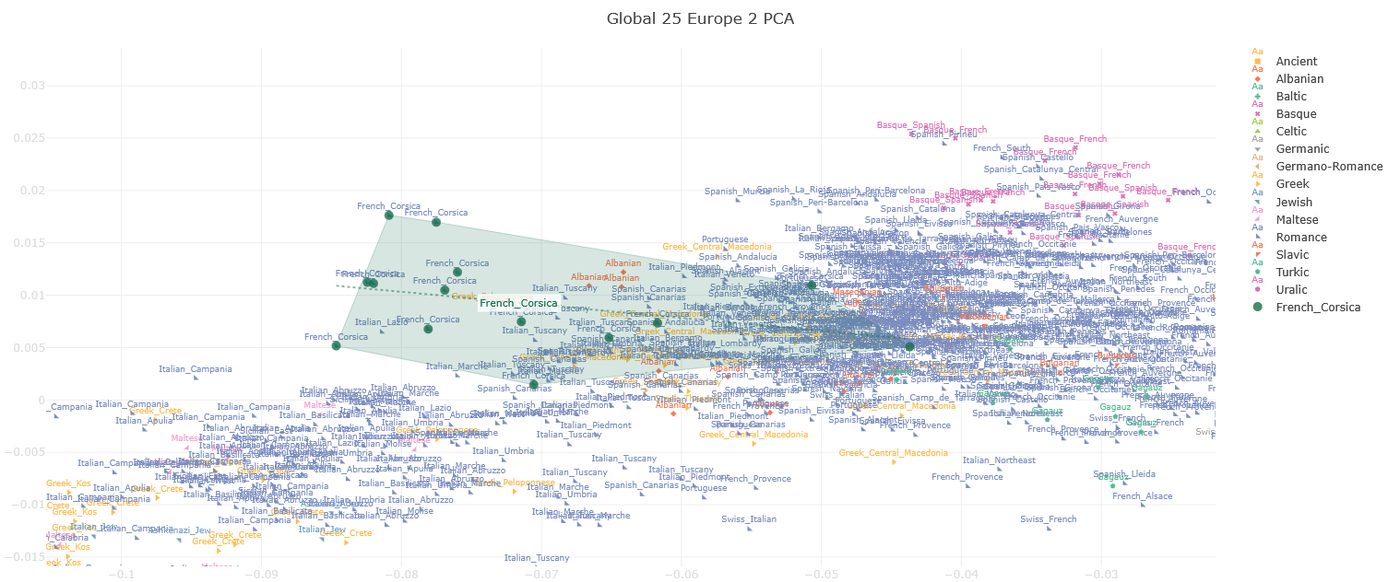
Global 25 Europe 2 PCA (Vahaduo). The green polygon outlines individual French_Corsica samples and the larger green dot marks the population centroid. Corsica sits inside the Italian cluster (close to Italian_Tuscany, Italian_Piedmont, Italian_Veneto, Italian_Lombardy, Italian_Emilia), clearly separated from the French cluster (French_Provence, French_Auvergne, French_Occitanie, French_Alsace, French_South) on the right side of PC1, and from the Spanish/Basque cluster (top right) and the Southern Italian/Greek cluster (bottom).
French_Corsica plotted on Global25 PC1 and PC2 alongside Italian regional populations (red), French regional populations (blue), Iberian populations (orange), Basque populations (sand), and Sardinia (purple). Corsica sits inside the Italian cluster, near Tuscany, Lazio, Umbria, Marche, and Liguria. The French populations form a distinct cluster shifted southeast, with French_Provence the closest French point but still further than every plotted Italian point. Sardinia sits in its own corner, neither French nor mainland Italian. The pattern is not subtle: Corsica is genetically Italian on PC1 and PC2 of the standard reference panel.
4. A Pisan-Tuscan origin: why Corsica is closest to Tuscany and Lombardy
The specific position of Corsica among Italian populations is itself revealing. Northern Italian and Tuscan populations are closer than southern Italians, and Tuscany in particular is among the top three closest populations. This is not a coincidence. The historical record explains it precisely.
Pisa, in Tuscany, ruled Corsica from 1077 to 1284. The Pisan period brought what historians describe as a massive Tuscan immigration onto the island, with two consequences that have shaped Corsica down to the present. The first is linguistic: the Corsican language, especially in the northern Cismonte region (Bastia, Corte, Aleria, Calvi), remains classified by linguists as a variety of the Tuscan Italian dialect group, structurally closer to standard Italian and to the dialects of Lucca, Pistoia, and Livorno than to any French dialect. The second is autosomal: Tuscan demographic input over two centuries left a real and quantifiable genetic signal that still dominates the modern Corsican population.
The Genoese period (1284 to 1768) added a Ligurian dimension on top of the Pisan-Tuscan core. Genoese settlers, garrisons, administrators, and merchants arrived in the coastal cities (Calvi, Bastia, Bonifacio, Ajaccio) and intermarried with the existing population. This is why Italian_Liguria sits at G25 distance 0.0314 from Corsica, only marginally behind Italian_Lombardy and Italian_Tuscany, and why the broader Lombard-Piedmont-Liguria-Tuscany northwest Italian sphere defines the closest Corsican neighbors.
The 2019 Tamm et al. paper in Scientific Reports, the first genome-wide study of the Corsican population, used IBD-based haplotype analysis to reach exactly the same conclusion through a completely different methodology. Allele frequency-based analyses, ChromoPainter-style copying matrices, and comparison with ancient genomes from the Mediterranean all converged on the result that Corsicans are closest to Northern and Central Italian populations, despite their geographic proximity to Sardinia. The G25 PCA distances reported in this article are not an artifact of the reference panel: they reproduce the published genome-wide finding.
5. The genetic history of Corsica in seven phases
The earliest evidence of human inhabitation on Corsica comes from the Dame de Bonifacio remains dating back to 6570 BCE. The Neolithic settlement of the island, contemporary with the Cardial expansion in Sardinia and the western Mediterranean, established a substrate genetically similar to other Tyrrhenian populations. Bronze Age contact with mainland Italy continued, and Torrean and Filitosa megalithic cultures linked Corsica to the broader western Mediterranean cultural sphere.
The Phocaean Greek colony of Alalia (modern Aleria) was founded around 565 BCE, marking the first major historical population input. The Etruscans, in alliance with Carthage, defeated the Greeks at the Battle of Alalia in 540 BCE and took control of the eastern coast, integrating Corsica into the Tyrrhenian Etruscan trade network. Carthaginian influence followed. The Italian-Tyrrhenian sphere of Corsica was already established before Roman annexation.
Rome annexed Corsica in 238 BCE, shortly after the First Punic War, joining it administratively with Sardinia as the province of Corsica et Sardinia. Six centuries of Roman rule integrated the island into the Latin-speaking western Mediterranean. The local population was Latinised, with a Roman administrative, economic, and demographic overlay that contributed substantially to the autosomal profile detectable today as the Italian Roman-era component.
After the fall of Rome, Corsica was successively raided and partially controlled by Vandals (5th c.), Byzantines (6th to 8th c.), Lombards, and Saracen Arab corsairs. Charlemagne reasserted nominal Frankish control in 774. None of these phases left a major autosomal signal: the Vandal occupation was brief, the Byzantine influence administrative rather than demographic, and the Saracen raids did not lead to settlement. The population remained essentially Italo-Roman with episodic violence from outside.
The transfer of Corsica to Pisa in 1077 under papal protection initiated the demographically decisive phase. Massive Tuscan immigration during two centuries of Pisan administration shaped the toponymy, the language (Corsican as a Tuscan dialect), and crucially the autosomal profile. This is the period that explains why Italian_Tuscany sits at G25 distance 0.0205 from modern Corsica, the second-closest population on the entire global panel.
The Battle of Meloria in 1284 gave Genoa control of Corsica, with a brief Aragonese interlude (1296 to 1347). Genoese settlement in the fortified coastal cities (Calvi, Bonifacio, Bastia, Ajaccio) added a Ligurian autosomal layer to the Pisan-Tuscan foundation. Italian remained the language of culture, religion, and administration. Pasquale Paoli's Corsican Republic (1755 to 1769) wrote its constitution in Italian.
The Treaty of Versailles of 1768 transferred sovereignty to France. The Battle of Ponte Novu in 1769 ended Corsican independence. Napoleon Bonaparte was born in Ajaccio four months later, into a Genoese-Italian-speaking family. Italian remained the official language of culture until the mid-19th century. French institutions, schooling, and identity were imposed progressively after 1860 and intensively after 1918, but the autosomal profile, set during the previous seven centuries, remained essentially unchanged.
Within Corsica, the historical north-south differentiation is still visible. The northern Cismonte (Bastia, Corte, Calvi, Aleria) shows stronger Tuscan-Ligurian affinities. The southern Pomonte (Ajaccio, Sartene, Porto-Vecchio) shows slightly stronger Sardinian and southern Italian affinities. Tamm et al. 2019 and the surname analysis of Morelli et al. 2002 both detect this gradient, which mirrors the linguistic boundary between northern Corsican (Tuscan-type) and southern Corsican (more Sardinian-influenced) dialects.
6. Why is Corsica closer to Tuscany than to Sardinia?
The most counterintuitive finding of the G25 analysis is that Corsica is closer to Tuscany (G25 distance 0.0205) than to Sardinia (0.0742) despite the Strait of Bonifacio being only 11 km wide while the Ligurian Sea separating Corsica from Tuscany is more than 80 km. Geography would predict the opposite. Why the inversion?
The answer combines four factors that are visible in the genetic data and confirmed by archaeology.
- Sardinia is a genetic outlier preserved by isolation. Sardinians retain an unusually high proportion of Early Neolithic farmer ancestry, with a much lower Bronze Age steppe input than any other modern Mediterranean population. This is the result of relative isolation through the post-Neolithic period and limited Indo-European demographic impact. Sardinia is therefore close to no other modern population in genetic space, even its immediate neighbors. The G25 PC2 of Sardinia is 0.167, far above the Italian and Corsican cluster around 0.148 to 0.152, reflecting this Neolithic-shifted profile.
- Corsica received its Bronze Age and Iron Age steppe input from the north. Unlike Sardinia, Corsica was integrated into the Tyrrhenian sphere from the Bronze Age onward, with continuous demographic exchange with mainland Italy. Etruscan, Roman, Pisan, and Genoese demographic input all came from the north and east, not from the south. Corsica therefore evolved a profile much closer to mainland Italy than to its southern neighbor across the strait.
- The Pisan-Tuscan demographic pulse of 1077 to 1284 was decisive. Two centuries of Tuscan immigration are recent enough to leave a strong autosomal signal that pulled Corsica firmly toward the Tuscan-Ligurian zone. This pulse had no equivalent toward Sardinia: Pisa and Genoa administered Sardinia as well, but they did not produce a comparable demographic transformation there.
- The Strait of Bonifacio was a real demographic barrier. Despite being narrow, the strait separated two distinct socio-political worlds for most of historical time. Corsica looked north to Tuscany and Liguria, Sardinia looked east to the Italian peninsula via a longer route, and the two islands had limited intermarriage between them. Tofanelli et al. 2004 explicitly noted that "all Corsican subsamples showed the highest distance with a pooled sample from central Sardinia, thus making recent gene flow between the two neighboring islands unlikely."
7. The PCA pattern from the 2019 Tamm et al. study
The Tamm et al. 2019 paper in Scientific Reports, the only published genome-wide analysis of the Corsican population to date, used three independent methodological approaches to address the same question. The first was allele frequency analysis, including ADMIXTURE-style decomposition and PCA. The second was haplotype-based analysis using ChromoPainter and FineSTRUCTURE, which compares painted haplotype copying patterns rather than allele frequencies. The third was comparison with ancient genome panels including Neolithic, Bronze Age, and Roman-era samples from across the Mediterranean.
All three approaches converged on the same conclusion. In the words of the paper's abstract, "the [Corsican population] is genetically closer to populations from continental Europe, such as Northern and Central Italy." The paper also confirmed the North-South gradient within Corsica documented by older surname and linguistic studies, with the northern Corsican subsample showing stronger Tuscan-Ligurian affinity than the southern subsample. The ChromoPainter haplotype analysis specifically identified Tuscan-Northern Italian haplotype donors as the major contributors to the modern Corsican profile, with Sardinian and Iberian contributions as secondary.
This means that the G25 PCA distance pattern reported in this article is not an artifact of the specific Davidski reference panel or of the PCA-based methodology. It reproduces a finding that was independently established with haplotype-based methods on a different sample set. The convergence of two distinct methodologies on the same conclusion strengthens the result substantially.
8. The linguistic and cultural confirmation
If Corsica were genetically French, one would expect French linguistic and cultural traditions to predate the 1768 incorporation. They do not. The Corsican language, classified by linguists in the Italo-Romance group and specifically in the Tuscan dialect family, was the dominant spoken language until the mid-20th century and remains spoken by a substantial minority today. The 1755 Constitution of the Corsican Republic was written in Italian, not French. Italian was the language of literacy, religious life, law, and administration in Corsica throughout the Genoese period and continued to be so under early French rule. The Frenchification of Corsica (linguistic, educational, administrative) was a 19th and 20th century project, and the integration of the Corsican population into French national identity was substantially completed only after World War I.
The toponymy of the island is overwhelmingly Italian, not French. Bastia, Corte, Aleria, Calvi, Ajaccio, Bonifacio, Sartene, Porto-Vecchio are Italian or Italianised place names introduced or formalised during the Pisan and Genoese periods. French place name innovations are rare and mostly recent. Family surnames, studied systematically by Morelli, Paoli and Francalacci in their 2002 surname analysis, show clear Italian distributions consistent with Tuscan and Ligurian immigration, with a North-South gradient that exactly mirrors the genetic gradient detected by Tamm et al. 2019. The cultural memory of Corsicans, when not Frenchified by the schooling system, remains Mediterranean and Italian: cuisine (charcuterie, chestnut, brocciu, pulenda), polyphonic singing, religious processions, all are part of the broader Tuscan-Ligurian cultural world.
The genetic finding is therefore not surprising. It is the expected outcome given the linguistic, toponymic, and cultural evidence, all of which independently testify to a continuous Italian demographic and cultural orientation from the 11th century until the political rupture of 1768, and culturally even later. What the G25 PCA confirms quantitatively is that political incorporation into France, even sustained over 258 years, did not erase the autosomal profile created by the preceding 700 years of Tuscan and Ligurian demographic input.
9. Distance to Italian regions versus French regions: a side-by-side comparison
G25 distance from French_Corsica to selected Italian and French regional populations
10. Myth and reality
Myth 1: 258 years of French rule must have left a strong genetic signal
Political incorporation does not equal demographic replacement. France integrated Corsica administratively, linguistically, and culturally over two centuries, but it did not transport large numbers of mainland French settlers to the island. Most population movement during the French period was Corsicans emigrating to mainland France (especially after WWI), not the reverse.
Reality 1: The autosomal profile reflects the demographic pulses of the Pisan-Genoese period
The 700 years of Tuscan-Ligurian immigration from 1077 to 1768 set the modern Corsican genetic profile. French rule since 1768 has been politically dominant but demographically light, and has not reshaped the autosomal data. The signal is not 258 years old: it is 700 to 1,000 years old.
Myth 2: Corsica is essentially a Sardinian-like island, only smaller
Geographic intuition suggests that the two big western Mediterranean islands, separated by only 11 km, should share most of their ancestry. The popular assumption is that Corsica is a kind of northern Sardinia.
Reality 2: Sardinia is a genetic outlier, Corsica is a mainland Italian extension
Sardinia preserves an unusually high Early Neolithic farmer profile due to relative isolation through the post-Neolithic period. Corsica, by contrast, has been continuously integrated into the Italian peninsula's demographic sphere since the Bronze Age. The Strait of Bonifacio was a real demographic barrier despite being narrow, and the two islands evolved separately.
Myth 3: Corsican language is just a dialect of Italian, but genetics is independent of language
The argument that linguistic affiliation does not necessarily reflect genetic ancestry is methodologically sound in general (the Hungarians speak a non-Indo-European language but are genetically European). It is sometimes invoked to dismiss the linguistic argument as irrelevant to Corsican ancestry.
Reality 3: For Corsica, language and genetics agree exactly
The Corsican Tuscan dialect was brought by Tuscan immigrants during the Pisan period, and these same Tuscan immigrants are the major demographic component of modern Corsicans. The linguistic argument is not a separate piece of evidence: it is the same demographic event, recorded in two different ways. Language and genetics converge here because they were both shaped by the same population pulse.
11. The G25 coordinates
The following coordinates correspond to the main populations cited in this article. Copy them into Vahaduo, the Davidski Standard G25 Calculator (Calculator 2 on ExploreYourDNA), the Migration Era Calculator (Calculator 186), the Modern World Regions Mythbuster (Calculator 173), or the World Modern Calculator by Joshua for your own modeling.
French_Corsica,0.120327,0.151822,0.01953,-0.023002,0.035039,-0.01004,-0.001846,-0.000561,0.015705,0.033792,-0.000603,0.007461,-0.013231,-0.007107,-0.004537,-0.000597,0.004042,0.001249,0.002451,-0.003046,-0.000392,0.000247,-0.002579,-0.001386,-0.00053
Italian_Lombardy,0.122929,0.147886,0.026728,-0.015746,0.033468,-0.00746,0.002144,0.002135,0.009408,0.030479,-0.002497,0.007493,-0.015498,-0.005453,-0.002155,-0.005386,-0.00414,0.00114,0.002891,-0.004174,-0.003603,0.00102,0.000246,0.002937,-0.001961
Italian_Tuscany,0.11881,0.147784,0.013882,-0.021011,0.025294,-0.008938,-0.001063,-0.001626,0.005649,0.023239,-0.000309,0.006066,-0.011475,-0.003703,-0.002243,-0.000814,0.002154,0.00029,0.003334,-0.003829,-0.001967,0.001407,-0.000734,0.003196,-0.001226
Italian_Emilia,0.120164,0.14435,0.018856,-0.017904,0.028093,-0.004343,0.00047,0.000725,0.007275,0.023274,-0.000534,0.009891,-0.010279,-0.005407,-0.001667,-0.001477,0.000149,0.000543,0.00264,-0.004449,-0.000713,0.001413,0.00088,0.004166,-0.000958
Italian_Piedmont,0.122848,0.147614,0.022493,-0.012505,0.029984,-0.0049,0.002333,-0.000478,0.008517,0.023209,-0.001253,0.005866,-0.011086,-0.004915,0.000543,-0.001979,0.000829,0.001927,0.002191,-0.003403,-0.001114,0.001095,-0.00184,0.004527,-0.001292
Italian_Bergamo,0.12384,0.150705,0.030698,-0.011757,0.036191,-0.002677,0.001081,0.001708,0.010758,0.027663,-0.001397,0.006804,-0.012844,-0.006276,-0.003474,-0.004163,-0.000365,0.000659,0.005154,-0.005553,-0.001048,-0.000025,-0.00419,0.003784,0.000958
Italian_Umbria,0.115937,0.148122,0.006815,-0.028447,0.020421,-0.009124,0,-0.000528,0.006063,0.025656,0.001415,0.00623,-0.009748,-0.004807,-0.003354,0.001544,0.004116,0.000588,0.002254,-0.003984,-0.002656,0.002155,-0.000308,0.002221,-0.000411
Italian_Veneto,0.126154,0.148267,0.030756,-0.00628,0.034485,-0.000821,0.002154,0.002051,0.010374,0.022901,-0.002337,0.005487,-0.011034,-0.004457,-0.002247,0.001878,0.004679,0.00183,0.002675,-0.003648,-0.000686,0.003284,-0.000219,0.001908,-0.002209
Italian_Marche,0.116043,0.148166,0.007957,-0.029425,0.02065,-0.010431,0.000376,-0.001892,0.00586,0.020155,-0.000114,0.003252,-0.007768,-0.002457,-0.004716,-0.002267,0.000456,0.000925,0.002671,-0.00307,-0.001117,0.002628,-0.000197,0.003567,-0.001688
Italian_Lazio,0.11314,0.152736,0.006788,-0.034303,0.021173,-0.010933,0.003243,-0.000277,0.006422,0.024237,0.00052,0.002548,-0.009574,-0.00523,-0.006732,0.002943,0.001043,0.000456,0.00269,-0.004227,-0.001922,0.004229,0.000567,0.000723,-0.000575
Italian_Liguria,0.113823,0.146236,0.027153,-0.011951,0.029236,-0.002231,0.00235,0.001154,0.009613,0.025331,-0.009743,0.002847,-0.013082,0.001101,-0.001086,-0.012463,-0.00665,-0.00038,0.003771,0.00075,-0.00025,0.000989,0.003944,0.000723,0.000599
Italian_Trentino_Alto_Adige,0.125838,0.146124,0.034611,-0.003948,0.039187,-0.002913,0.003421,0.002051,0.011226,0.024116,-0.003518,0.005195,-0.013181,-0.004312,-0.001282,-0.001621,0.002245,0.001337,0.004637,-0.003085,-0.002537,0.003284,-0.002533,0.001339,-0.00306
Italian_Aosta_Valley,0.12697,0.146084,0.039258,0.004748,0.036976,-0.001548,0.002409,0.002804,0.010226,0.021959,-0.004766,0.004931,-0.014725,-0.010356,0.007499,0.006258,0.005189,-0.000285,0.003375,-0.000538,0.002926,0.001948,-0.000918,0.00814,-0.00006
Italian_Northeast,0.125612,0.143552,0.035611,0.00173,0.035435,0.002032,0.003173,0.002044,0.006881,0.015946,-0.002366,0.004774,-0.008389,-0.000374,-0.004576,0.00036,0.004023,0.000887,0.003834,-0.002599,-0.00353,0.000433,-0.001796,0.00457,0.000359
Italian_Abruzzo,0.112685,0.148801,-0.000675,-0.034765,0.016116,-0.01255,0.000779,-0.002283,0.003789,0.020813,0.000513,0.003668,-0.005633,-0.003904,-0.00615,-0.001466,0.00186,0.000267,0.003361,-0.003693,-0.003809,0.001334,0.000889,0.001706,-0.000964
Italian_Apulia,0.110712,0.148267,-0.003771,-0.040138,0.015839,-0.015116,-0.000956,-0.001615,0.002795,0.02069,-0.000227,0.003877,-0.006472,0.001193,-0.008107,-0.003898,0.001669,0.0006,0.002749,-0.005152,-0.00381,0.001962,0.001758,0.001438,-0.000567
Italian_Campania,0.108263,0.148384,-0.008529,-0.043456,0.014038,-0.016154,-0.000777,-0.002201,0.004507,0.0221,0.000968,0.002265,-0.00498,-0.00144,-0.006259,-0.000806,0.002332,0,0.002814,-0.003728,-0.003964,0.001907,0.000256,0.002104,0.000189
Italian_Calabria,0.103437,0.14814,-0.010324,-0.046997,0.012618,-0.015025,-0.002438,-0.001586,0.004448,0.021231,0.002213,0.002997,-0.004887,-0.001737,-0.006549,-0.002784,0.005802,0.000728,0.002938,-0.005362,-0.002605,-0.000325,0.000339,0.000015,-0.002425
Swiss_Italian,0.122178,0.141148,0.023333,-0.014534,0.026141,-0.000405,0.001942,0.002263,0.006379,0.014892,-0.005034,0.005637,-0.013577,-0.004174,-0.003219,-0.003725,-0.001825,0.000817,0.003243,-0.005277,-0.00549,-0.001112,-0.000419,0.001962,-0.001976
Sardinian,0.121687,0.167285,0.02849,-0.050652,0.060151,-0.022134,-0.003952,0.002496,0.041574,0.077351,-0.000059,0.016649,-0.028664,-0.012974,-0.013572,-0.003001,0.011403,-0.001347,0.00168,-0.012995,-0.002121,-0.001102,-0.010084,-0.021383,0.000337
French_Provence,0.121925,0.143847,0.036891,0.005358,0.036858,0.00233,0.002267,0.003638,0.010058,0.020453,-0.003869,0.007211,-0.012138,-0.010961,0.005956,0.003174,0.001097,0.002809,0.001775,-0.001515,0.001541,0.002735,0.000355,0.005444,0.000035
French_South,0.126181,0.144785,0.049618,0.00886,0.050691,0.002669,0.000269,0.002275,0.02764,0.03866,-0.006774,0.007365,-0.021853,-0.013566,0.010373,0.002765,-0.005104,0.001792,0.000215,0.001912,0.004991,-0.00083,-0.005264,-0.007557,-0.00142
French_Occitanie,0.127039,0.144883,0.048879,0.017908,0.043376,0.003416,0.000522,0.003891,0.014856,0.023589,-0.003288,0.006582,-0.015044,-0.009458,0.010737,0.002567,-0.003709,0.002484,0.001425,0.000045,0.003671,0.002446,-0.00255,0.001767,0.000422
French_Auvergne,0.125416,0.144656,0.04742,0.012992,0.043472,0.003997,-0.000339,0.002513,0.015407,0.022172,-0.002466,0.007355,-0.013969,-0.009669,0.008299,0.001483,-0.000787,0.001497,0.003073,-0.000213,0.001858,0.003737,-0.002282,0.001816,-0.000089
French_Paris,0.127171,0.141436,0.050431,0.02399,0.040903,0.009305,0.002799,0.005454,0.011602,0.018174,-0.007706,0.006812,-0.012906,-0.010384,0.01377,0.006063,-0.001825,0.004664,0.002708,-0.000978,0.002201,0.003575,-0.001232,0.011141,-0.001905
French_Brittany,0.131466,0.13834,0.05785,0.039285,0.039169,0.015813,0.003155,0.004211,0.008186,0.00949,-0.005131,0.00559,-0.014368,-0.013102,0.018343,0.004399,-0.007302,0.00128,-0.000462,0.001773,0.004467,0.001787,-0.001254,0.010547,0.000659
French_Alsace,0.127311,0.140372,0.050317,0.022432,0.038423,0.008911,0.00292,0.004875,0.006852,0.010679,-0.003134,0.004578,-0.009444,-0.00417,0.008561,0.003066,-0.004893,0.002439,0.003243,-0.000716,0.002764,0.001156,-0.001322,0.007137,-0.000314
French_Nord,0.128275,0.140543,0.051357,0.025605,0.038273,0.008891,0.001097,0.00442,0.008373,0.012016,-0.003484,0.004033,-0.010861,-0.008182,0.011199,0.002543,-0.004607,0.002227,0.004095,0.001031,0.002133,0.001525,-0.001572,0.007471,0.000014
French_Pas-de-Calais,0.127861,0.140481,0.054305,0.026809,0.042162,0.012736,0.004152,0.001308,0.008522,0.012453,-0.008011,0.002198,-0.01001,-0.012019,0.013663,0.008132,-0.000478,0.001816,-0.003645,0.004252,0.009982,0.001443,-0.002547,0.005904,-0.001437
French_Seine-Maritime,0.136019,0.137096,0.045254,0.029555,0.039084,0.016733,0.00423,-0.000692,0.003988,0.006014,-0.003735,0.007493,-0.007582,-0.001651,0.014251,0.003514,-0.007953,-0.002344,0.000943,-0.005002,0.003931,0.005503,0.000863,0.004278,-0.004491
French_Bigorre,0.128051,0.147353,0.052269,0.00533,0.052225,-0.000837,-0.001669,0.000162,0.024809,0.03827,-0.003085,0.007883,-0.021481,-0.014148,0.00874,0.000186,-0.003559,0.002369,-0.000892,-0.002914,0.002508,-0.00089,-0.003291,-0.005904,0.00103
French_Bearn,0.126799,0.144814,0.053589,0.006008,0.053949,0.002175,-0.001692,-0.002054,0.024461,0.039891,-0.008866,0.010236,-0.018999,-0.014327,0.014169,0.001578,-0.005724,-0.000899,-0.001735,-0.003302,0.005465,0.003141,-0.006643,-0.00817,0.000683
French_Chalosse,0.128734,0.14776,0.051892,0.011176,0.051333,0.002761,0.00047,0.001777,0.025259,0.039655,-0.002696,0.008947,-0.020337,-0.015083,0.011088,0.002824,-0.005424,0.001672,-0.000779,-0.002239,0.008273,0.002844,-0.007691,-0.007664,-0.002096
Basque_French,0.128051,0.152025,0.055173,0.012823,0.056411,0.00251,-0.00141,0.003323,0.030597,0.041204,-0.009272,0.010341,-0.020976,-0.014024,0.013219,-0.001936,-0.011917,0.003028,-0.000716,-0.004415,0.010157,0.002485,-0.00864,-0.00917,0.000072
Basque_Spanish,0.126424,0.148739,0.055679,0.00879,0.05545,0.000249,-0.001754,0.000025,0.029539,0.042923,-0.005214,0.010801,-0.024986,-0.019493,0.015807,0.002614,-0.00563,0.003172,-0.002375,-0.001791,0.008819,0.002204,-0.006479,-0.008654,0.00115
Spanish_Cataluna,0.114582,0.146236,0.045883,0.002369,0.047188,0,-0.002037,0.002384,0.022361,0.030494,-0.001895,0.008592,-0.016006,-0.010643,0.008867,0.001591,-0.000652,-0.001647,-0.001131,-0.000959,0.006197,-0.005729,-0.003903,-0.001928,0.000958
Portuguese,0.106174,0.144611,0.036007,-0.004432,0.042137,-0.004049,-0.003741,0.00276,0.025598,0.029741,-0.000734,0.007421,-0.012737,-0.011263,0.012557,-0.000398,-0.001132,-0.000887,-0.005762,-0.000245,0.001138,-0.002572,0.001301,-0.001133,-0.000105
12. Three transversal lessons
The Corsican case illustrates three principles of population paleogenetics that the broader literature has been articulating for two decades.
First, political borders are much faster than genetic flow. Corsica became French in 1768. Two and a half centuries later, the autosomal record still reflects the demographic and cultural sphere of the previous millennium. This is a general principle: language, law, and identity can be reorganised in a generation through state institutions, but the genetic profile of a population is built up over centuries of marriages and births and is much slower to change. The 19th-century French nationalist project on Corsica successfully created French citizens and French-speakers but did not produce French ancestry.
Second, geographic proximity does not predict genetic affinity. Sardinia is 11 km from Corsica across the Strait of Bonifacio. Tuscany is 80 km across the Ligurian Sea. Yet Tuscany is much closer to Corsica genetically than Sardinia is. The reason is not geography but history: who actually moved, when, and in what numbers. The Strait of Bonifacio was a real demographic barrier despite its narrowness, because no major Sardinia-to-Corsica or Corsica-to-Sardinia migration occurred during the Pisan or Genoese periods, while continuous Tuscan and Ligurian immigration crossed the wider Ligurian Sea. The same principle explains why the Basques sit so far genetically from their immediate neighbors despite ten centuries of geographic proximity.
Third, the right reference panel and the right question matter as much as the algorithm. If we had only the average French and the average Italian as references, Corsica might appear to be intermediate. With fine-scale regional populations available (Lombardy, Tuscany, Emilia, Piedmont, Provence, Auvergne, Paris, Brittany), the picture sharpens enormously and the answer becomes unambiguous. A modern Corsican is not "French with some Italian admixture" or "Italian with some French admixture." A modern Corsican is, autosomally, a northern or central Italian who happens to live on an island that became politically French two and a half centuries ago. Coarser reference panels would have hidden this. The 2019 Tamm et al. study confirmed the same result with even finer haplotype-based methods.
13. References
- Tamm, E., Di Cristofaro, J., Mazieres, S., Pennarun, E., Kushniarevich, A., Raveane, A., Semino, O., Chiaroni, J., Pereira, L., Metspalu, M., Montinaro, F. (2019). Genome-wide analysis of Corsican population reveals a close affinity with Northern and Central Italy. Scientific Reports, 9, 13581. DOI: 10.1038/s41598-019-49901-8 Corsica Genome-wide
- Tofanelli, S., Taglioli, L., Varesi, L., Paoli, G. (2004). Genetic history of the population of Corsica (western Mediterranean) as inferred from autosomal STR analysis. Human Biology, 76(2), 229-251. DOI: 10.1353/hub.2004.0038 STR Internal structure
- Di Cristofaro, J., Mazieres, S., Tous, A., Di Gaetano, C., Lin, A. A., Nebbia, P., Piazza, A., King, R. J., Underhill, P. A., Chiaroni, J. (2018). Prehistoric migrations through the Mediterranean basin shaped Corsican Y-chromosome diversity. PLoS ONE, 13(8), e0200641. DOI: 10.1371/journal.pone.0200641 Y-DNA Mediterranean migrations
- Francalacci, P., Morelli, L., Underhill, P. A., Lillie, A. S., Passarino, G., Useli, A., Madeddu, R., Paoli, G., Tofanelli, S., Calo, C. M., Ghiani, M. E., Varesi, L., Memmi, M., Vona, G., Lin, A. A., Oefner, P., Cavalli-Sforza, L. L. (2003). Peopling of three Mediterranean islands (Corsica, Sardinia, and Sicily) inferred by Y-chromosome biallelic variability. American Journal of Physical Anthropology, 121(3), 270-279. DOI: 10.1002/ajpa.10265 Y-DNA Mediterranean islands
- Morelli, L., Paoli, G., Francalacci, P. (2002). Surname analysis of the Corsican population reveals an agreement with geographical and linguistic structure. Journal of Biosocial Science, 34(3), 289-301. DOI: 10.1017/s0021932002002894 Surnames North-South gradient
- Varesi, L., Memmi, M., Cristofari, M. C., Mameli, G., Calo, C. M., Vona, G. (2000). Mitochondrial control-region sequence variation in the Corsican population, France. American Journal of Human Biology, 12(3), 339-351. DOI: 10.1002/AJHB.6 mtDNA
- Sazzini, M., Abondio, P., Sarno, S., Gnecchi-Ruscone, G. A., Ragno, M., Giuliani, C., De Fanti, S., Ojeda-Granados, C., Boattini, A., Marquis, J., Valsesia, A., Carayol, J., Raymond, F., Pirazzini, C., Marasco, E., Ferrarini, A., Xumerle, L., Collino, S., Mari, D., Arosio, B., Monti, D., Passarino, G., D'Aquila, P., Pettener, D., Luiselli, D., Castellani, G., Delledonne, M., Hager, J., Franceschi, C., Garagnani, P. (2020). Genomic history of the Italian population recapitulates key evolutionary dynamics of both Continental and Southern Europeans. BMC Biology, 18, 51. DOI: 10.1186/s12915-020-00778-4 Italian fine-scale
- Aneli, S., Caldon, M., Saupe, T., Montinaro, F., Pagani, L. (2021). Through 40,000 years of human presence in Southern Europe: the Italian case study. Human Genetics, 140, 1417-1431. DOI: 10.1007/s00439-021-02328-6 Italian peninsula
- Olalde, I., Mallick, S., Patterson, N., Rohland, N., Villalba-Mouco, V., Silva, M., et al. (2019). The genomic history of the Iberian Peninsula over the past 8000 years. Science, 363(6432), 1230-1234. DOI: 10.1126/science.aav4040 Mediterranean context
- Marcus, J. H., Posth, C., Ringbauer, H., Lai, L., Skeates, R., Sidore, C., et al. (2020). Genetic history from the Middle Neolithic to present on the Mediterranean island of Sardinia. Nature Communications, 11, 939. DOI: 10.1038/s41467-020-14523-6 Sardinia Comparison
- Treaty of Versailles (15 May 1768). Cession of Corsica from the Republic of Genoa to the Kingdom of France. Historical primary source. Political history
- Davidski, A. (ongoing). Global25 PCA modern population averages, scaled coordinates v.5. Eurogenes Blog. Used as the reference panel for all G25 distances in this article. eurogenes.blogspot.com G25 panel