
Project the Eupedia red-hair distribution map onto a map of Bell Beaker R1b-L21 frequencies and the overlay is almost perfect: Ireland, Scotland, Wales, Cornwall, Brittany, the Franco-Belgian border, and parts of the southern Netherlands light up on both. The same regions where one in ten people carries the visible red-hair phenotype are also the regions where the Bronze Age genetic legacy of the Bell Beaker expansion (~2500–1800 BCE) is most concentrated. This is not a coincidence. Red hair, caused by recessive variants of the MC1R gene, was already present at low frequency in the Mesolithic and Neolithic populations of Europe, but its frequency rose sharply in the Bronze Age, and rose most where Bell Beaker founder effects, geographic isolation, and selection pressure under low-UV skies acted together. The result, four thousand years later, is one of the most strikingly localised pigmentation phenotypes on Earth.
Key Findings
- Red hair is caused by recessive loss-of-function variants in the MC1R gene; three variants (R151C, R160W, and D294H) account for the vast majority of European cases.
- The global frequency is around 1–2%, but reaches 10–13% in Ireland and Scotland, 10–15% in Wales, and 5–10% in Cornwall, Brittany, and the Franco-Belgian border.
- The geographic distribution closely tracks R1b-L21, the dominant Y-chromosome lineage of Bronze Age Bell Beaker migrants who replaced 90% or more of Britain's Neolithic male lineages between 2450 and 2000 BCE (Olalde et al. 2018).
- Ancient DNA from the Rathlin Island Bronze Age individuals (Northern Ireland, ~2000 BCE) already carried both blue-eye alleles and HFE haemochromatosis variants linked to modern Irish frequencies, the first documented "Atlantic Celtic" genome (Cassidy et al. 2016).
- A 2026 Nature study (Akbari et al.) analysing 15,836 ancient West Eurasian genomes confirms that MC1R red-hair variants have been under positive selection across the past 10,000 years, with the strongest acceleration during the Bronze Age (~4,000 years ago).
- The "Norse origin" hypothesis is partly correct for southwest Norway, where R1b-L21 enrichment via Viking-era contact with Ireland and Scotland increased local red-hair frequency, but the Bell Beaker substrate is the deeper cause.
1. The Bell Beaker Phenomenon: A Bronze Age Population Replacement
Between roughly 2750 and 1800 BCE, a cultural package known as the Bell Beaker complex swept across western and central Europe. Named after the distinctive inverted-bell-shaped pottery vessels found in burials, it spread rapidly along the Atlantic seaboard, the Rhine corridor, and the British Isles. For decades, archaeologists debated whether this was a movement of objects and ideas (cultural diffusion) or a movement of people (demic expansion). The 2018 Olalde et al. paper in Nature, based on 400 ancient genomes, settled the debate definitively: the Bell Beaker expansion into Britain and Ireland was one of the most dramatic population replacements documented in European prehistory.
Before 2450 BCE, the inhabitants of Britain were the descendants of Early European Farmers (EEF) who had built Stonehenge and the megalithic monuments of the Boyne Valley. Their genetic profile carried virtually no steppe ancestry, and their Y-chromosome lineages were dominated by haplogroup I2. Within four to six generations after the arrival of the Beaker people, this entire male lineage pool was replaced. The new population carried 50% or more steppe-derived ancestry traceable to the Yamnaya pastoralists of the Pontic-Caspian, and over 90% of male lines now belonged to R1b-P312, with R1b-L21 becoming the dominant subclade in the British Isles.
Bell Beaker emerges in the Lower Rhine and Dutch coastal zone as a fusion of Corded Ware (Single Grave) people of high steppe ancestry and local Neolithic substrate. R1b-L151 and its early descendants dominate the male lineages.
Beaker users cross the Channel and the Irish Sea. The first R1b-L21 individuals appear in Britain (Low Hauxley, ~2400 BCE). Within centuries the entire male lineage pool of the British Isles is reshaped.
Bell Beaker populations from central Europe move south and replace nearly all Neolithic male lineages of Iberia. R1b-DF27 becomes dominant in the western Iberian peninsula, foreshadowing the modern Basque, Portuguese, and Galician profile.
The Rathlin Island and Amesbury Archer genomes confirm that Bronze Age Britain and Ireland already carry the genetic substrate that defines modern populations: high steppe ancestry, R1b-L21 dominance, and rising frequencies of light-pigmentation alleles including MC1R variants.
Crucially, the western branch of the Bell Beaker expansion (R1b-P312, including L21, U152, and DF27) is genetically distinct from the contemporaneous Corded Ware expansion (R1a-M417) which dominated central, northern, and eastern Europe. This split has direct consequences for the modern distribution of red hair: the R1b-P312 territories of the Atlantic facade and Britain are precisely where red-hair frequency is highest, while the R1a Corded Ware territories of Poland, the Baltic states, and Russia show low red-hair frequencies despite carrying comparable amounts of overall steppe ancestry.
2. The Genetics of Red Hair: Three MC1R Variants
Red hair is the most strikingly Mendelian of human pigmentation traits. It is caused, in over 80% of cases, by inheriting two loss-of-function alleles of the melanocortin 1 receptor (MC1R) gene on chromosome 16. MC1R is a G-protein-coupled receptor on the surface of melanocytes that, when functional, signals these cells to produce eumelanin, the dark, photoprotective pigment that gives skin and hair their brown-to-black tones. When both copies of MC1R are non-functional, melanocytes default to producing pheomelanin instead, the red-yellow pigment that creates fiery hair, freckled skin, and the characteristic poor tanning response.
Although more than 80 MC1R variants have been documented worldwide, three of them dominate the European picture. Each has its own geographic peak, its own probable age, and its own contribution to the Bell Beaker question.
Carried by ~10% of British people. Peaks in Ireland, Scotland, Wales, and Brittany. Responsible for roughly one third of red hair cases in 23andMe customers. This is the variant most tightly correlated with Bell Beaker R1b-L21 territory.
Carried by ~9% of British people. Peaks in Sweden, Lithuania, and parts of Central and Eastern Europe. Less penetrant: only 50% of homozygotes display visible red hair. Probable Mesolithic European origin, redistributed by later Bronze Age and Iron Age movements.
Carried by ~2.5% of British people. Highest frequencies in Ireland, the UK, France, Switzerland, and Belgium. Geographic range tracks the western Continental Bell Beaker zone almost exactly. Less penetrant than R151C but strongly associated with red hair when homozygous.
Dozens of rarer MC1R variants account for the remaining red-hair cases. Some, such as R142H and R163Q, are present at low frequencies across Europe; others are essentially private to specific founder populations.
An important nuance: red hair is recessive but the variants are not uncommon. Approximately 40% of Scots carry at least one copy of an MC1R red-hair variant, while only 13% display the phenotype. This is because both parents must transmit a functional-knockout allele for visible red hair to appear. The carrier frequency is what links red hair to demographic history; the phenotype frequency is what links it to mating patterns and population structure.
3. The Geographic Distribution of Red Hair Today
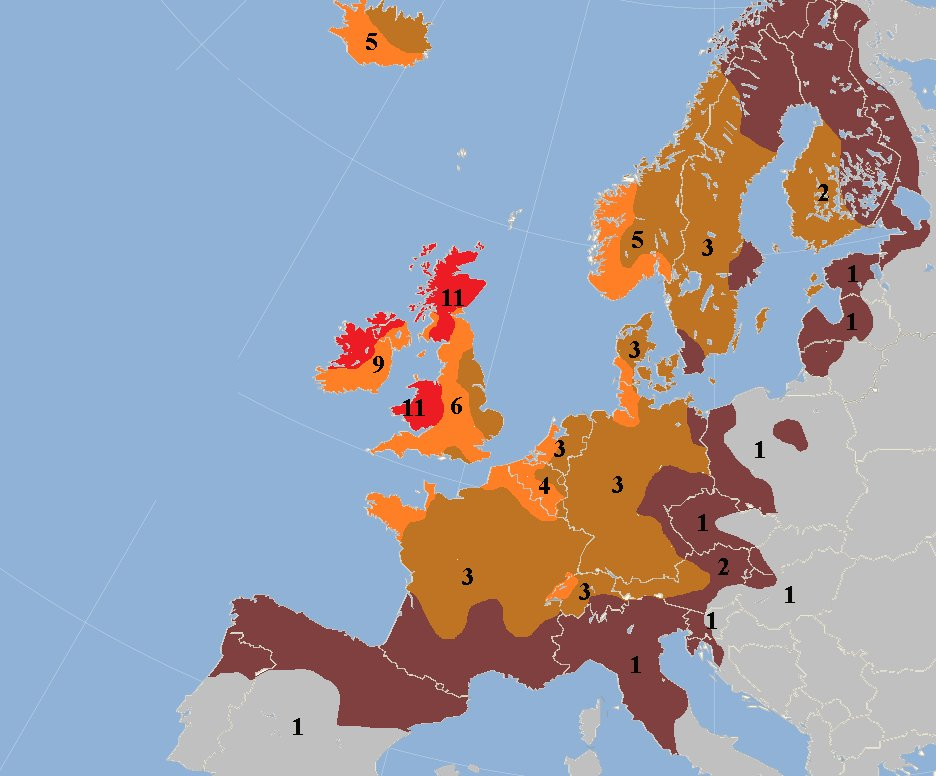
The Eupedia distribution map of red-hair frequency in modern Europe shows a remarkably sharp gradient. The bright-red core (>9%) is centred on Ireland, Scotland, and Wales. A medium-orange ring (4–6%) extends over Cornwall, the western half of England, Brittany, the Franco-Belgian border, the southern Netherlands, southern Norway, and Jutland. Beyond this ring, frequency drops below 3% within a few hundred kilometres in every direction, including the Iberian peninsula, central France, southern Germany, the Baltic states, and Finland.
Estimated Red-Hair Phenotype Frequency by Region
Compiled from Eupedia synthesis (Maciamo Hay), 23andMe customer-frequency data (Sturm et al.), and the Wikipedia Red Hair distribution overview. Scottish phenotype frequency varies between 5.3% (large 2014 study) and 13% (older estimates) depending on methodology; carrier frequency is consistently around 35–40%.
Two features of this distribution are critical. First, the gradient is sharp on the eastern side of Europe but gentle on the western side: red hair is essentially absent in Russia and the Baltic states despite their high overall steppe ancestry, but extends through every region of the Atlantic facade where Bell Beaker descendants settled. Second, the southern boundary tracks the Loire-Rhine line almost perfectly, mirroring the line that separates the heartland of Bell Beaker R1b-P312 from the Mediterranean populations who received much smaller and later doses of steppe ancestry.
4. Bell Beaker Ancient DNA: The Pigmentation Shift in Real Time
The most direct evidence linking Bell Beaker ancestry to modern red-hair distribution comes from Bronze Age genomes themselves. The Cassidy et al. 2016 PNAS paper sequenced four ancient Irish individuals: the Neolithic Ballynahatty woman (c. 3300 BCE) and three Early Bronze Age men from Rathlin Island (c. 2000–1500 BCE). The genetic gap between them is enormous. Ballynahatty was a near-Eastern-derived farmer with dark hair, brown eyes, and no steppe ancestry. The Rathlin men, by contrast, already carried the genetic signature of modern Irish populations: high steppe ancestry, R1b-L21 (or its subclade DF21), blue-eye alleles, and the C282Y haemochromatosis variant that is today found at near-record frequency in Ireland.
For red hair specifically, the picture is more nuanced. The MC1R variants R151C and D294H appear sporadically in Bell Beaker and Bronze Age European genomes, but not at high frequency. What changed dramatically was the genetic background on which they sat. As Bell Beaker populations settled into Britain and Ireland, the resulting bottleneck and subsequent demographic expansion meant that any MC1R variant present at low frequency in the founders could rise rapidly through drift and selection. By the Iron Age and certainly by the early Medieval period, red hair was already a recognised feature of Celtic populations: Roman authors describe it among the Britons and Gauls.
The selection signal makes biological sense. At high latitudes with limited UV exposure (especially in the cloudy maritime climates of Ireland, Scotland, and Wales), MC1R loss-of-function variants confer two adaptive advantages: enhanced vitamin D synthesis through pale skin, and possibly increased thermoregulatory efficiency. The trade-off is increased melanoma risk in high-UV environments, but this trade-off is essentially neutral in latitudes where UV exposure is naturally low.
5. Why These Populations Specifically? Three Reinforcing Mechanisms
The dramatic concentration of red hair in the Atlantic facade is not explained by any single mechanism. Three reinforcing processes (Bell Beaker founder ancestry, geographic isolation amplifying genetic drift, and natural selection under low-UV conditions) combined to produce the modern distribution.
The Beaker migrants who settled the British Isles, Brittany, and the Atlantic facade carried MC1R variants at modest frequency. Once they replaced the Neolithic substrate (90%+ male-line replacement in Britain), these variants became the new baseline.
Insular and peninsular populations (Ireland, Scotland, Wales, Cornwall, Brittany) experienced strong genetic drift over four millennia. Variants that were rare in continental Bell Beaker populations rose to high frequency through chance fixation in small founder groups.
Maritime western Europe receives some of the lowest annual UV doses in Europe. Pale skin and red hair confer enhanced vitamin D synthesis and reduced rickets risk. The 2026 Nature study confirms positive selection on MC1R intensified during the Bronze Age.
During the Viking Age (~800–1100 CE), Norse raiders took thousands of Irish and Scottish captives to southwestern Norway, contributing R1b-L21 lineages and red-hair variants. This explains the secondary red-hair peak in southwest Norway, despite the broader Scandinavian average being much lower.
The relative weight of these mechanisms is still debated. Most population geneticists today favour a combined model in which Bell Beaker founders provided the seed, drift in isolated coastal and island populations amplified the signal over millennia, and natural selection slowly raised the variants further wherever UV exposure was lowest. The 2026 ancient DNA study suggests selection has been the strongest single driver since the Bronze Age, but selection acts on existing variation, and that variation came in with the Beakers.
G25 Coordinates: Bronze Age Bell Beaker (R1b-L21) Reference Samples
These coordinates plot in the same region of G25 PCA space as modern Irish, Scottish, Welsh, Cornish, and Breton averages, confirming the deep genetic continuity between Bell Beaker founders and the modern populations who today carry the highest red-hair frequencies in the world.
6. Red Hair, R1b-L21, and Steppe Ancestry: A Comparison
The table below illustrates the correlation. Note that the strongest predictor of red-hair frequency is not steppe ancestry overall (which is high across all of northern Europe, including R1a-dominant regions where red hair is rare), but specifically R1b-L21 frequency, the direct genetic marker of the western Bell Beaker expansion.
| Region | Red Hair % | R1b-L21 % | Steppe Ancestry % | Pattern |
|---|---|---|---|---|
| Ireland | ~10–13% | ~73% | ~50% | PEAK Highest in all three metrics. Insular drift amplified Bell Beaker founder signal. |
| Scotland | ~10–13% | ~58% | ~50% | PEAK Comparable to Ireland; Norse Viking input added secondary R1b-L21 enrichment. |
| Wales | ~10% | ~60% | ~46% | PEAK Highest R1b frequency in Europe overall (~92% R1b including all subclades). |
| Cornwall / W. England | ~6% | ~50% | ~46% | HIGH Celtic-fringe profile; Anglo-Saxon and Norman admixture dilutes the signal eastward. |
| Brittany | ~5% | ~35% | ~46% | HIGH Western peninsular drift; reinforced by post-Roman migrations from Cornwall and Wales. |
| Wallonia / Belgium | ~5% | ~15–20% | ~44% | MODERATE Lower R1b-L21 but high R1b-U106 (Germanic Beaker branch); both contribute to MC1R load. |
| Northern France | ~3–4% | ~25–30% | ~45% | DECOUPLED Steppe ancestry is high (Beaker-level) but R1b-L21 is comparatively low; most of the R1b load is U106/U152 rather than L21. |
| SW Norway | ~4% | ~15% | ~50% | SECONDARY Local R1b-L21 enrichment via Viking-era contact with Ireland and Scotland. |
| Sweden mainland | ~2–4% | ~5% | ~50% | DECOUPLED High steppe ancestry but R1a-dominant; R160W variant present but red hair stays low. |
| Poland / Baltic | <2% | <3% | ~50% | ABSENT Corded Ware (R1a) territory; high steppe but no Bell Beaker founder signal. |
7. Common Misconceptions and the Evidence
8. Implications for Modern DNA Test Interpretation
For consumers reading 23andMe, MyHeritage, or AncestryDNA results, the Bell Beaker / red-hair connection has practical interpretive consequences. A high British or Irish ancestry assignment in a commercial DNA test is, in genetic terms, largely an assignment to descendants of Bell Beaker founders, populations characterised by R1b-L21 dominance, around 50% steppe ancestry, and elevated MC1R variant frequencies. Carrying one or two copies of R151C, R160W, or D294H is therefore expected, and informative, in any individual with substantial Atlantic-facade ancestry.
23andMe specifically reports MC1R variants in its Health Predisposition section and offers a "red hair" trait prediction. Carrying a single MC1R variant is consistent with brown or auburn hair, freckling, and reduced tanning; carrying two is highly predictive of visible red hair, with penetrance varying by variant (R151C: ~80%, D294H: ~70%, R160W: ~50%). Individuals with strong Bell Beaker ancestry but no visible red hair are very often carriers, which explains why two brown-haired parents of Irish descent can produce a red-haired child.
References
- 1 Olalde I. et al. (2018). The Beaker phenomenon and the genomic transformation of northwest Europe. Nature, 555, 190–196. DOI: 10.1038/nature25738. [Definitive evidence for population replacement; >90% Y-lineage turnover in Britain.] Genetics
- 2 Cassidy L. M. et al. (2016). Neolithic and Bronze Age migration to Ireland and establishment of the insular Atlantic genome. PNAS, 113(2), 368–373. DOI: 10.1073/pnas.1518445113. [The Rathlin Bronze Age genomes, including R1b-L21 and HFE C282Y carriage.] Genetics
- 3 Patterson N. et al. (2022). Large-scale migration into Britain during the Middle to Late Bronze Age. Nature, 601, 588–594. DOI: 10.1038/s41586-021-04287-4. [793 Bronze Age and Iron Age genomes; secondary EEF inflow ~1000 BCE.] Genetics
- 4 Morgan M. D. et al. (2018). Genome-wide study of hair colour in UK Biobank explains most of the SNP heritability. Nature Communications, 9, 5271. DOI: 10.1038/s41467-018-07691-z. [MC1R as the principal genetic factor for red hair; 213 independent loci in total.] Genetics
- 5 Sturm R. A., Duffy D. L. (2012). Human pigmentation genes under environmental selection. Genome Biology, 13(9), 248. DOI: 10.1186/gb-2012-13-9-248. [Comprehensive review of MC1R variants and their geographic distribution.] Genetics
- 6 Akbari A. et al. (2026). Ancient DNA reveals pervasive directional selection across West Eurasia. Nature. DOI: 10.1038/s41586-026-10358-1. [15,836 ancient genomes; 347 loci under directional selection in the past 10,000 years, including MC1R.] Genetics
- 7 Hay M. (Eupedia). Genetic history of the British Isles and Ireland: distribution of red hair in Europe. eupedia.com/genetics. [Synthetic distribution map and frequency commentary.] Reference
- 8 Wikipedia (2026). Red hair. en.wikipedia.org/wiki/Red_hair. [Frequency by country and overview of MC1R genetics.] Reference
- 9 Lalueza-Fox C. et al. (2007). A melanocortin 1 receptor allele suggests varying pigmentation among Neanderthals. Science, 318(5855), 1453–1455. DOI: 10.1126/science.1147417. [Independent Neanderthal MC1R variant; convergent evolution.] Genetics
- 10 Margaryan A. et al. (2020). Population genomics of the Viking world. Nature, 585, 390–396. DOI: 10.1038/s41586-020-2688-8. [Documents Irish and Scottish gene flow into Norse Scandinavia during the Viking Age.] Genetics
- 11 Heyd V. (2021). Yamnaya, Corded Wares, and Bell Beakers on the move. In: Yamnaya Interactions (Heyd V., Kulcsár G., Preda-Balanica B., eds.), The Yamnaya Impact on Prehistoric Europe 2, Budapest: Archaeolingua, pp. 383–414. academia.edu/67425075. [Archaeological framework for the Bell Beaker / Corded Ware split.] Archaeology
- 12 Beleza S. et al. (2013). The timing of pigmentation lightening in Europeans. Molecular Biology and Evolution, 30(1), 24–35. DOI: 10.1093/molbev/mss207. [Selection coefficients and arrival times for MC1R, SLC24A5, and other pigmentation alleles.] Genetics