
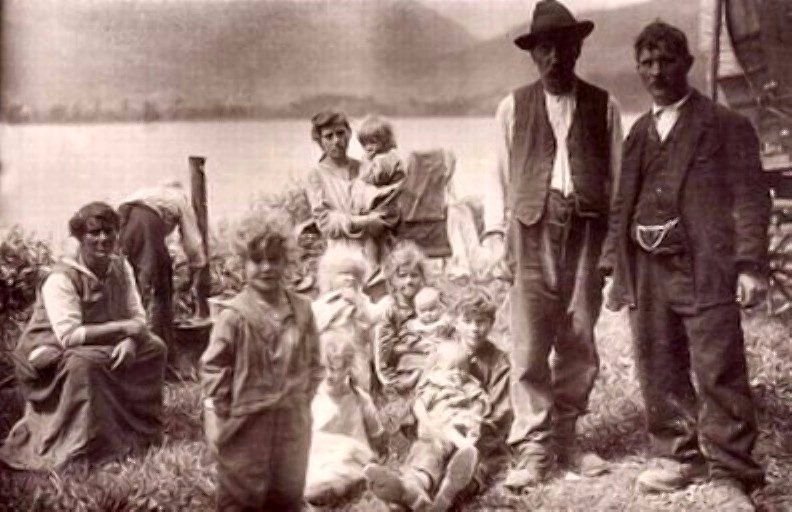
Confused with the Roma by authorities for centuries, the Yenish (Jenische in German, Yéniche in French) are in fact a people of distinct European origin, rooted in the rural and artisan margins of the Germanic and Celtic world. Their genetic profile—as illustrated by the results of our anonymous contributor, a Yenish individual of strongly Germanic background—confirms this with remarkable clarity.
Key Findings
- The Yenish are not a Roma subgroup: their language is German-based, not Indo-Aryan, and their DNA is overwhelmingly West European.
- They emerge as a distinct group by the late 18th century, crystallising from marginalised classes of Germanic society: landless peasants, itinerant craftspeople, and peddlers.
- Our contributor's G25 profile shows ~43% Northern European ancestry (Nordic Bronze Age) and only 7–11% South Asian signal—a fraction of what is expected in Roma individuals.
- Switzerland formally recognised in February 2025 that the Kinder der Landstrasse programme (1926–1973) constituted a crime against humanity under current international law.
- Estimates place the Yenish population at around 700,000 across Europe, with over 200,000 in Germany and 30,000 in Switzerland.
1. Who Are the Yenish?
The term Yenish (German Jenische, French Yéniche, Luxembourgish Jënesch) refers both to an itinerant people of Central and Western Europe and to the argot they speak—a German-based cant enriched with words from Yiddish, Romani, and Judeo-Latin. The adjective jenisch appears in print as early as 1714, designating the Rotwelsch secret language of Germanic vagrants. Its use as an ethnic self-designation spread from around 1793, when Johann Ulrich Schöll documented itinerant groups in Swabia.
Centred on the Rhineland, Alsace, German-speaking Switzerland, and Austria, the Yenish differ fundamentally from the Roma in their origins: whereas the Roma descend from North Indian migrants who reached Europe around the 10th–11th century CE, the Yenish are the product of a distinctly European ethnogenesis—a process by which marginalised groups in feudal Germanic society gradually forged a collective identity of their own.
Landless peasants, itinerant craftspeople, and beggars excluded from urban society form structured travelling communities. The Thirty Years' War (1618–1648) accelerates the process.
The jenisch argot solidifies into an ethnic self-designation. Endogamous family networks coalesce around typical trades: tinsmithing, basket-weaving, horse dealing, and itinerant music.
Many Yenish integrate into local German-speaking populations. Those who resist sedentarisation adopt horse-drawn vardos and later caravan trailers, a lifestyle persisting to the present day.
Switzerland recognises the Yenish as a national minority in 1999. In 2025, the Federal Council formally acknowledges the Kinder der Landstrasse programme as a crime against humanity.
Contrary to widespread belief, the Yenish are neither escaped Roma nor Europeanised Sinti. Linguist Yaron Matras and anthropologist Rémy Welschinger have shown that certain Yenish communities did absorb individuals of Roma or Jewish origin who left their own groups over the centuries—which explains the Romani loanwords in the Yenish argot and, in some families, a residual South Asian genetic signal.
2. A Distinct Genome: What the DNA Evidence Shows
The G25 profile of our anonymous contributor illustrates the genetic gulf between Yenish and Roma with unusual precision. With roughly 43% Northern European / Nordic Bronze Age ancestry and only 7–11% South Asian signal (depending on the calculator used), their composition is incompatible with a typical Roma identity, where South Asian ancestry routinely ranges from 20 to 35%.
Migration Era Calculator — Anonymous Yenish Contributor (strongly Germanic profile)
Migration Era Calculator (Karl Högström, #186). Fit: 1.501. Note: the "Celtic/Gaul" component in this tool behaves as a proxy for western French (Huguenot/Rhenish) ancestry rather than a strict Gaulish signal. The combined Western European signal (Celtic Gaul + Celtic GB + Germanic) reaches 73%, while the South Asian block accounts for roughly 10.8%.
Convergence Across Three Calculators
Results are strikingly consistent across the Modern World Calculator, the Ancient World Calculator, and the Migration Era Calculator. The Northern European dominance (~43%) and residual South Asian signal (7–11%) appear in all three analyses, reinforcing the reliability of the interpretation.
| Ancestry Component | World Modern (Joshua) | World Ancient (Joshua) | Interpretation |
|---|---|---|---|
| Dominant Northern European | Scandinavia_Main 43.2% | Nordic_Bronze_Age 42.6% | EUROPEAN Core Germanic/Nordic lineage. Characteristic of Yenish families from the Rhineland–Alsace corridor. |
| Mediterranean/Gaulish | France_South 26.4% | Massilian_France_South 27.4% | EUROPEAN Gallo-Roman and western Mediterranean substrate, typical of the Rhine–Rhône corridor populations. |
| Italic/Latin | Italy_Central 7.8% | Latium 7.8% | EUROPEAN Diffuse Roman-era legacy across the Germanic–Celtic world. Normal for a Rhineland-origin profile. |
| Caucasus/Steppe | Caucasus_North 7.4% | Caucasus_North_Ancient 7.2% | AMBIGUOUS Bronze Age steppe ancestry (expected in all Western Europeans) or possible Roma migration-route signal via the Caucasus. Within the normal range for a Western European. |
| South Asian (Roma signal) | India_Bengal_Delta 4.2% + South_Asia_Interior 3.6% = 7.8% | Indus_Delta_Ancient 4.4% + Indo_Aryan_Interior 3.2% = 7.6% | ROMA SIGNAL Substantially below the 20–35% typical of Roma. Consistent with partial absorption of Roma ancestors through intermarriage over several generations. |
| Arabian/Near Eastern | Arabian_Gulf 2.8% | Arabia_Ancient 2.8% | ROMA SIGNAL Roma migration route via Persia and the Persian Gulf. Coherent with the South Asian component above. |
| Sardinian/Neolithic | Italy_Sardinia 2.4% | Sardinia_Ancient 1.8% | EUROPEAN Residual Early European Farmer (EEF) ancestry. Normal in all Western European profiles. |
G25 Coordinates (Global25 Scaled)
In G25 space, our contributor plots firmly within the Western Germanic cluster, close to present-day Rhineland, Alsace, and German-speaking Swiss populations. They remain clearly distant from the Romani clusters of South-Eastern Europe, which display a pronounced shift toward South Asia and the Near East.
3. The Yenish Language: German Cant, Not Romani
The linguistic distinction is the most robust criterion for separating Yenish from Roma. Romani is an Indo-Aryan language descended from Old Hindi, with fundamentally South Asian grammar, phonology, and core vocabulary. Yenish, by contrast, is a German argot—Rotwelsch enriched with lexical borrowings from several contact languages—whose grammatical structure remains entirely Germanic.
Germanic grammatical structure throughout: conjugations, morphology, and sentence order. Comparable in register to Cockney relative to standard English.
Contact with marginalised Ashkenazi Jewish communities produced heavy lexical borrowing, especially in domains of trade, guile, and concealment.
Frequent cohabitation with Sinti on the roads and in encampments. Dozens of Romani words were absorbed without altering the underlying German grammar.
Many Yenish terms have entered mainstream German or regional dialects, evidence of centuries of porous interaction with the sedentary majority population.
4. Persecution and Resistance: the Kinder der Landstrasse
The history of the Yenish is marked by centuries of marginalisation and institutional violence. Under National Socialism, they were classified as "vagrants of gypsy type" (nach Zigeunerart umherziehende Landfahrer) and hundreds were scheduled for internment in camps including Buchenwald, Dachau, and Sachsenhausen. Yenish families were entered into a Landfahrersippenarchiv—an archive of "travelling clans"—and subjected to forced sterilisations under laws targeting "hereditary asociality."
Yet the most systematic assault on Yenish identity unfolded not in Nazi Germany but in neutral Switzerland, which conducted its own parallel campaign of forced assimilation.
The scandal was exposed in 1972 by journalist Hans Caprez in the magazine Der Schweizerische Beobachter. In 1986, Yenish writer Mariella Mehr (1947–2022), herself a victim of the programme, interrupted a Pro Juventute press conference to demand a public apology. She had co-founded the Radgenossenschaft der Landstrasse ("Wheel Cooperative of the Road"), the first political representation body for the Yenish people. In 2017, Switzerland established a 300 million Swiss franc compensation fund; survivors received up to 25,000 francs each.
5. Common Misconceptions and the Evidence
6. The Yenish Today
Estimates place the total Yenish population across Europe at around 700,000, distributed mainly between Germany (over 200,000), Switzerland (around 30,000), Luxembourg (3,000), and communities in France, Belgium, and Austria. In Pennsylvania, Yenish families with roots in Switzerland, Germany, and Luxembourg have maintained their identity across the Atlantic.
The vast majority are today sedentary. In Switzerland, only 3,000 to 5,000 individuals maintain a seasonally nomadic lifestyle. The Yenish language, protected under the European Charter for Regional or Minority Languages since 1997, is the subject of documentation and transmission efforts, though it remains endangered by urbanisation and assimilation.
Notable Yenish figures include Swiss musician Stephan Eicher (born 1960, Yenish on his father's side), painter and musician Walter Wegmüller (1937-2020), the late writer Mariella Mehr (1947–2022), whose autobiographical works contributed directly to the discontinuation of the Kinder der Landstrasse programme, and Dutch international footballer Rafael van der Vaart (born 1983).
References
- 1 Matras Y. (2002). Romani: A Linguistic Introduction. Cambridge University Press. [Comparative analysis placing Yenish outside the Indo-Aryan family.] Linguistics
- 2 Leimgruber W., Meier T., Sablonier R. (1998). Das Hilfswerk für die Kinder der Landstrasse. Swiss Federal Archives, Berne. History
- 3 Swiss Federal Council (19 February 2025). Press release: Recognition of crimes against humanity under the Kinder der Landstrasse programme. Council of Europe. Policy
- 4 Schöll J. U. (1793). Abriß des Jauner- und Bettelwesens in Schwaben. Stuttgart. [First documentation of jenisch as an ethnic self-designation.] History
- 5 Rao A. et al. (2012). Genetic origin and molecular evolution of the Roma. Current Biology, 22(24). DOI: 10.1016/j.cub.2012.10.042 Genetics
- 6 Moorjani P. et al. (2013). Genetic evidence for recent population mixture in India. American Journal of Human Genetics, 93(3). DOI: 10.1016/j.ajhg.2013.07.006 Genetics
- 7 Welschinger R. (2014). Les Yéniches, une minorité méconnue. Études Tsiganes, 52. [Anthropological overview of Yenish identity and ethnogenesis.] Anthropology
- 8 Mehr M. (1981). Steinzeit. Zytglogge Verlag, Berne. [Foundational autobiographical account of Yenish persecution in Switzerland.] Literature
- 9 Wikipedia (2026). Yenish people. en.wikipedia.org Reference