
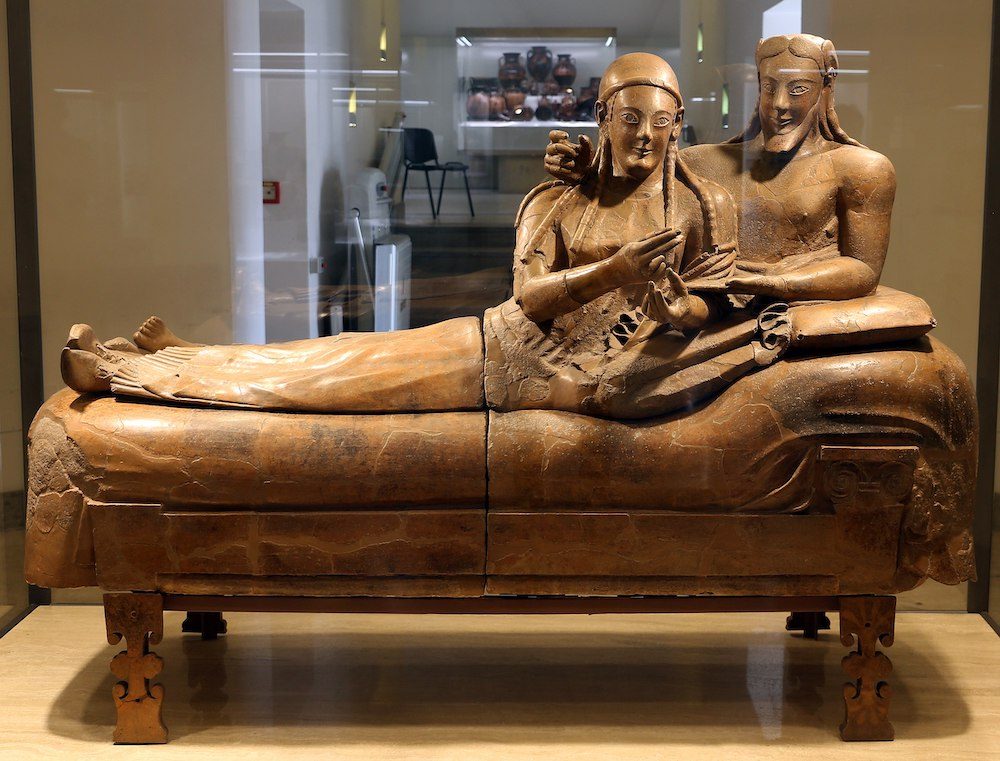
For two and a half millennia, the Etruscans resisted explanation. Their language, unrelated to any known family, defied the best efforts of classical and modern scholars alike. Their bronzework, their sophisticated urban culture, their peculiar funerary art — all seemed to announce a people who had arrived from somewhere else, as if Etruria had received, all at once, a civilisation that ought not to have grown organically out of central Italian soil. The Greek historian Herodotus was so convinced by this impression that he placed their homeland squarely in Lydia, in western Anatolia. Ancient DNA has now ended that debate with a verdict Dionysius of Halicarnassus would have savoured: the Etruscans were, in the genetic sense, thoroughly Italian.
Key Findings
- Genome-wide data from 82 individuals across 12 sites spanning 800 BCE to 1000 CE shows that the Etruscans carry no signal of recent Anatolian or eastern Mediterranean admixture; Herodotus was wrong (Posth et al. 2021).
- Etruscans are genetically indistinguishable from their Latin neighbors in Rome, sharing a profile firmly within the western European cluster despite having a radically different language and culture.
- Like most Iron Age Europeans, Etruscans carry substantial steppe-related ancestry (~20–28 %) inherited from Bronze Age migrations ultimately traceable to the Pontic-Caspian steppe — making their persistence of a non-Indo-European language a genuine and still unresolved paradox.
- The dominant Y-chromosome haplogroup among Etruscan males was R1b-U152, the characteristically Italic branch of R1b-P312, with some 75 % of male individuals falling in R1b-M269 and its subclades.
- The Etruscan gene pool remained stable for approximately 800 years, from the Iron Age through the Roman Republic, before eastern Mediterranean ancestry replaced a substantial fraction of it during the Imperial period.
- A later medieval shift, most plausibly linked to the Lombard invasion of 568 CE, introduced northern European ancestries that persist in the modern Tuscany and Lazio genetic profile to the present day.
I. The Mystery That Lasted Two Millennia
The Etruscan civilisation reached its peak between roughly 700 and 400 BCE, controlling a territory that encompassed modern Tuscany, northern Lazio, and parts of Umbria and Emilia-Romagna. At their height, Etruscan cities like Tarquinia, Vulci, Veii, and Populonia were among the most sophisticated urban centres in the western Mediterranean. Etruscan kings sat on the throne of Rome in the sixth century BCE. Etruscan religious and augural practices, architectural techniques, and the alphabet itself were transmitted wholesale to the Romans who eventually absorbed and outlasted them.
What made the Etruscans so puzzling to ancient observers was precisely the combination of sophistication and strangeness. Their language, attested in several thousand inscriptions, belongs to no known family. It is not Indo-European, not Semitic, not anything that can be linked to the major linguistic groups spreading across the Mediterranean and Near East during the Bronze and Iron Ages. Two proposals for their origin dominated ancient thinking and were still being debated by scholars in the twentieth century.
The Two Ancient Hypotheses
Lydia (Anatolia) origin, ~470 BCE → Dionysius of Halicarnassus
Autochthonous origin, ~20 BCE → Modern archaeology
Villanovan continuity, ~1960s → Early mtDNA studies
Inconclusive & contradictory → Posth et al. 2021
Genome-wide resolution: local origin confirmed
Herodotus argued, on the basis of cultural similarities and alleged Lydian traditions, that a group of Anatolians had migrated to Italy under a leader named Tyrrhenus, giving their name to the Tyrrhenian Sea. This is the hypothesis that would prove most durable in popular imagination and that left a long shadow over early genetic studies based on mitochondrial DNA, which produced inconsistent and sometimes contradictory results. Some mtDNA analyses of modern Tuscans appeared to show elevated Near Eastern affinities; others found no such signal.
Dionysius of Halicarnassus, writing in the first century BCE, disagreed emphatically. The Etruscans, he argued, resembled no other people and must therefore be a native Italian population. Modern archaeologists had largely come around to this view even before ancient DNA became available: the material continuity between the Bronze Age Villanovan culture and the subsequent Etruscan Iron Age is unmistakable in the archaeological record. What was lacking was genomic proof.
II. What the Bronze Age Bequeathed: The Villanovan Foundation
The Villanovan culture emerged in central and northern Italy around 900 BCE and represents the earliest phase of what would become the Etruscan civilisation. The Villanovans practised cremation, used distinctive biconical urns, worked bronze at a high level, and occupied settlements in many of the locations that would later become Etruscan cities. Most crucially for the genetic story, the Villanovan culture was itself the product of Bronze Age population movements that had transformed the Italian peninsula over the preceding millennium.
III. The Y Chromosome: R1b-U152, the Italic Marker
The Y chromosome of the Etruscans tells a story of steppe ancestry fully integrated into an Italian population. Approximately 75 % of the male individuals sequenced by Posth et al. (2021) fell within R1b-M269 and its subclades, with R1b-U152 emerging as the dominant branch. R1b-U152 is the canonical Italic haplogroup, closely related to R1b-L21 (Atlantic/Celtic) and R1b-DF27 (Iberian), but distinctively concentrated in the Italian peninsula, the Alpine zone, and adjacent France. Its presence in Etruscan males at high frequency is precisely what one would expect from a local Italian Iron Age population whose patrilineal ancestry traces to the Bronze Age steppe influx via Bell Beaker and related Urnfield carriers.
There is no Y-chromosome signal of a Lydian or Anatolian male migration, which would be expected to introduce J1, J2, or G2a lineages at elevated frequencies. These haplogroups exist as rare individuals in the Etruscan sample, consistent with the occasional eastern Mediterranean visitor documented in the autosomal data, but they do not constitute a founding signal. The Etruscan male lineage is, in a phylogenetic sense, Bronze Age European.
IV. Ancestry Through Time: A Four-Act Transformation
The following charts trace the genetic transformation of the populations occupying Etruria from the pre-steppe Chalcolithic through the post-Roman Early Middle Ages. The three-component model uses Sardinian Neolithic as the EEF proxy (the best available reference for pre-steppe Italian farmers), Western Hunter-Gatherer (WHG) as the forager component, and Yamnaya as the steppe source. Note that these G25 NNLS estimates are used for visual orientation and for Vahaduo modelling; published qpADM estimates from Posth et al. (2021) are cited for precise interpretation.
V. The Linguistic Paradox
The finding that Etruscans carried substantial steppe-related ancestry creates one of the most intriguing puzzles in archaeogenomics. The Pontic-Caspian steppe is the most widely accepted homeland of Proto-Indo-European, the ancestral language of the vast majority of European tongues. Where steppe ancestry went in prehistory, Indo-European languages almost invariably followed. The Basques offer a partial analogy: they carry steppe ancestry in their autosomes while speaking a non-Indo-European language, and the Etruscan case appears structurally similar.
Language survival despite genetic turnover
David Caramelli (University of Florence), senior co-author of Posth et al. (2021), proposed that the steppe-related ancestry in Etruscans may have arrived via prolonged admixture with Bronze Age Italic speakers over the second millennium BCE, during which the Etruscan language community absorbed incoming males while maintaining its linguistic tradition. On this scenario, Etruscan is not a pre-steppe survivor in the mould of Basque, but rather a language sufficiently entrenched within a prestige cultural community to resist replacement even as the underlying gene pool shifted substantially. Guus Kroonen (Leiden University), the study's linguist co-author, noted that the Etruscan case challenges straightforward equations of steppe genes with Indo-European speech: the gene flow happened, but the language did not change with it.
The Tyrsenian hypothesis offers a related perspective. Etruscan, Rhaetic (spoken in the Alps until roughly the second century BCE), and Lemnian (attested on the Aegean island of Lemnos) share structural features that have led some linguists to propose a common ancestor, Tyrsenian, which may have spread via sea routes in the Neolithic or very early Bronze Age. If correct, Tyrsenian would predate the steppe expansions and would represent one of the few language groups to survive Bronze Age replacement across much of Europe. Etruscan would then be a relic, not a recently arrived tongue, embedded in a population whose genetics were progressively Europeanised without disrupting linguistic transmission.
VI. Comparison Table: Etruscans in Context
| Population | Period | Steppe ancestry | EEF ancestry | Primary Y haplogroup | Key note |
|---|---|---|---|---|---|
| Italy, Chalcolithic | ~2900–2200 BCE | <3 % | ~97 % | G2a, I2 | Pre-steppe baseline; pure Anatolian Neolithic descent |
| Bell Beaker Italy North | ~2400–2000 BCE | ~25–35 % | ~60–70 % | R1b-P312 | Steppe ancestry enters via Alpine corridor |
| Etruscans, Iron Age | ~800–280 BCE | ~20–28 % | ~70–72 % | R1b-U152 (dominant) | Genetically indistinguishable from contemporary Latins |
| Iron Age Latins (Rome) | ~900–200 BCE | ~22–28 % | ~68–74 % | R1b-U152 | Overlapping profile with Etruscans; culturally and linguistically distinct |
| Imperial Rome burials | 27 BCE–400 CE | ~15–22 % | ~45–55 % | Mixed, including J2, E1b | Eastern Mediterranean influx dramatically shifts the profile |
| Sardinia, Nuragic / modern | ~1700 BCE / present | <5 % | ~90–95 % | I2, G2a | Island isolation preserved the pre-steppe EEF profile; used as Neolithic proxy in G25 |
| Modern Tuscans | Present | ~20–25 % | ~50–55 % | R1b, predominantly | Layer cake: EEF base + steppe + Imperial eastern Med + Lombard northern European |
VII. G25 Coordinates for Vahaduo
The coordinates below allow you to visualise the populations discussed in this article within Vahaduo (scaled G25 mode). The first block covers the key ancient reference populations and the Etruscan average computed from 41 individuals across Tarquinia, Vulci, Grosseto, Siena, Viterbo, and Pisa. The second block covers the mainstream Etruscan individuals individually, enabling scatter plots that show within-population variation. The third block provides the EEF / WHG / Steppe anchor triangle. The Etruscan outlier individuals labelled as eastern Mediterranean or Levantine in the original dataset are listed separately.
VIII. Myths and Realities
Common Misconception
“The Etruscans migrated from Anatolia or Lydia, as Herodotus described. The similarity of their language to Near Eastern tongues confirms an eastern origin.”
Genetic Reality
The genome-wide analysis of 82 individuals shows zero signal of recent Anatolian admixture. The Etruscan language is unrelated to any Anatolian family. Its perceived similarities to Greek, which led Herodotus to his hypothesis, reflect cultural contact and alphabet borrowing, not descent. (Posth et al. 2021)
Common Misconception
“The Etruscans spoke a non-Indo-European language because they had no steppe ancestry and were therefore genetically pre-Indo-European.”
Genetic Reality
The Etruscans carried approximately 20–28 % steppe-related ancestry, the same proportion as their Latin neighbors in Rome. Their non-Indo-European language coexisted with substantial steppe ancestry, demonstrating that language and genes do not map onto each other in any simple or automatic way.
Common Misconception
“Modern Tuscans are genetically distinctive because they descend from the Etruscans, preserving a unique pre-Roman genetic signature.”
Genetic Reality
Modern Tuscans carry layers of ancestry added well after the Etruscan period: a significant eastern Mediterranean component introduced during the Roman Empire, and a northern European component introduced by the Lombards in the sixth century CE. From roughly 1000 CE onwards, the Tuscan profile has been stable, but it is a complex medieval composite, not a preserved Etruscan signal. (Posth et al. 2021)
Common Misconception
“The Etruscans and the Romans were fundamentally different peoples genetically, reflecting their cultural and political opposition.”
Genetic Reality
At the population level, Etruscans and Iron Age Latins are statistically indistinguishable in the G25 PCA space. Both groups carry similar proportions of EEF and steppe ancestry and belong to the same western European genetic cluster. The Etruscan and Latin civilisations were, genetically speaking, two branches of the same Bronze Age Italian population that developed strikingly different cultures and languages.
Common Misconception
“Early mitochondrial DNA studies that showed Etruscan affinities with Near Eastern populations confirmed the Anatolian migration hypothesis.”
Genetic Reality
The mtDNA studies in question analysed modern Tuscans as proxies for ancient Etruscans, a methodologically problematic approach given the documented Roman Imperial and Lombard ancestry layers that substantially modified the Tuscan gene pool centuries after Etruscan civilisation ended. Direct analysis of ancient Etruscan DNA shows no Near Eastern admixture signal in the Iron Age samples. (Posth et al. 2021; earlier mtDNA studies reviewed in Tassi et al. 2013)
IX. Conclusions
The Etruscan question, debated for over two thousand years from Herodotus to the genomics era, now has a clear genetic answer. The people who built Tarquinia and Vulci, who transmitted the alphabet to Rome, and who produced some of the most remarkable art of the ancient Mediterranean were, in terms of ancestry, a Bronze Age Italian population. Their genomes trace their deepest roots to the Anatolian Neolithic farmers who colonised Europe starting around 6000 BCE, overlain by the steppe-related ancestry that arrived with Bell Beaker and Urnfield movements in the Bronze Age. No Lydian flotilla, no Aegean exodus, no Anatolian founding migration appears in the data.
What remains genuinely mysterious is the language. A population carrying the same steppe ancestry as their Indo-European-speaking Latin neighbors somehow maintained, for centuries, a tongue belonging to a different and unrelated family. Whether Etruscan is a Neolithic survivor, a product of the Tyrsenian group, or the result of a much earlier and now genetically undetectable population movement remains an open question. It is, as Posth and his colleagues noted, a phenomenon that genes alone cannot resolve. The answer, if it comes, will require linguistics and archaeology working alongside genomics rather than being replaced by it.
For readers using commercial DNA tests who carry Italian ancestry, the Etruscan episode sits invisibly inside whatever Italian component your test reports. The steppe ancestry that distinguishes modern Italians from the Sardinian Neolithic baseline is partly Etruscan in origin, though it arrived in the Italian peninsula before the Etruscans as a recognisable culture existed. And the eastern Mediterranean shift that lifts modern Tuscans slightly toward the Near East on PCA plots is not Etruscan but Imperial: the genetic footprint of a cosmopolitan empire that moved people across the Mediterranean at a scale the ancient world would not see again.
References
- Posth C. et al. (2021). The origin and legacy of the Etruscans through a 2000-year archaeogenomic time transect. Science Advances 7(39): eabi7673. DOI:10.1126/sciadv.abi7673
- Olalde I. et al. (2019). The genomic history of the Iberian Peninsula over the past 8,000 years. Science 363: 1230–1234. DOI:10.1126/science.aav4040
- Haak W. et al. (2015). Massive migration from the steppe was a source for Indo-European languages in Europe. Nature 522: 207–211. DOI:10.1038/nature14317
- Tassi F. et al. (2013). Genetic evidence does not support an Etruscan origin in Anatolia. American Journal of Physical Anthropology 152: 11–18. DOI:10.1002/ajpa.22319
- Achilli A. et al. (2007). Mitochondrial DNA variation of modern Tuscans supports the near eastern origin of Etruscans. American Journal of Human Genetics 80: 759–768. DOI:10.1086/513706
- Allentoft M.E. et al. (2015). Population genomics of Bronze Age Eurasia. Nature 522: 167–172. DOI:10.1038/nature14507
- Kroonen G. et al. (2022). Linguistic supplement to Posth et al.: the genetic evidence and the Tyrsenian language family. Cited in Posth et al. 2021, supplementary discussion.
- Killgrove K. & Montgomery J. (2016). All roads lead to Rome: modeling migration to the Eternal City. PLOS ONE 11(2): e0147585. DOI:10.1371/journal.pone.0147585