
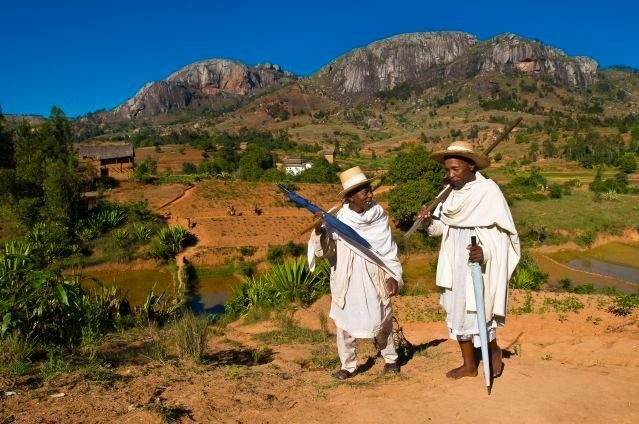
The Malagasy are the most remarkable case of long-distance maritime migration documented in the human genome. They speak a Malayo-Polynesian language whose nearest living relative, Ma'anyan, is spoken on the Barito River in southern Borneo, more than 7,500 km away across the Indian Ocean. Their autosomal genome is, in round numbers, half African and half Southeast Asian, with the African contribution traced primarily to Bantu-speaking populations of the Mozambique coast and the Southeast Asian contribution traced specifically to the Banjar people of southern Borneo. Their mitochondrial DNA preserves the Polynesian Motif (B4a1a1) at a frequency of roughly one in four women, the highest concentration of this Pacific lineage outside the Pacific itself. The Y-chromosome record tells the symmetrical story of an Austronesian founding pulse layered with later African male input. The whole package was assembled between roughly 830 and 1000 CE, when a small number of seafarers (perhaps as few as thirty founding women, according to the most stringent founder-effect estimates) crossed the Indian Ocean and reached an island that, until then, may have been completely uninhabited by humans. Within a few centuries, sustained Bantu immigration from the African mainland added the second half of the modern genome. The result is a population that has no close genetic neighbor anywhere on Earth.
Key Points
- The modern Malagasy genome is approximately 50 percent African (Bantu) and 50 percent Southeast Asian (Austronesian), with regional variation: highland populations such as the Merina lean more Austronesian (60 to 70 percent), while coastal populations on the western and northern shores lean more African.
- The Southeast Asian source has been narrowed by whole-genome and IBD-based analyses to the Banjar people of southern Borneo, an Austronesian-speaking population of the Barito River basin (Pierron et al. 2017, Brucato et al. 2016). The Malagasy language belongs to the Greater Barito subgroup of Malayo-Polynesian, sister to Ma'anyan.
- The Austronesian founding event has been dated by ROH (runs of homozygosity), IBD segment-length distributions, and mitochondrial coalescence to roughly 830 to 1000 CE, with a strikingly small founding population. Cox et al. 2012 estimated the founding maternal pool at approximately 30 women.
- Mitochondrial DNA carries the Polynesian Motif B4a1a1 at 22 to 25 percent in modern Malagasy women, the highest frequency outside Polynesia and Micronesia. The Malagasy carry a specific sub-clade (B4a1a1b, sometimes called the Malagasy Motif) with the unique 1473 mutation.
- Y-chromosome diversity shows the African pulse came later and was male-biased: O1a-M119 and O2a-M95 (Austronesian) lineages are present but at lower frequency than the maternal B4a1a1 figure would predict, while E1b1a-M2 (Bantu) reaches 30 to 50 percent of Malagasy males.
- The African contribution is traced to Bantu-speaking populations of the Mozambique coast (Makua, Sena, and related groups), with possibly a smaller earlier Bantu pulse and a larger later pulse during the Swahili-period Indian Ocean trade.
- Madagascar appears to have been uninhabited by humans before the Austronesian arrival, or sparsely visited only. There is no detectable substrate from an earlier population.
- The Indian Ocean monsoon system makes a direct Borneo-to-Madagascar crossing aerodynamically feasible during certain seasons, but the most likely route ran along the northern Indian Ocean rim: Borneo to the Maldives or Sri Lanka, then down the East African coast.
- Modern Malagasy show clear geographic structure within the island, with the central highland Merina being the most Austronesian-shifted, the Vezo and Antaisaka of the southwest and southeast intermediate, and the Sakalava of the western coast and the Antemoro of the southeast having the strongest African and Arab-Swahili input.
1. The most improbable migration in human history
Look at a map of the Indian Ocean and you understand why the Malagasy genetic record provoked, for the better part of a century, intense scholarly disbelief. The island of Madagascar sits 400 km off the coast of Mozambique, on the opposite side of the world from Indonesia. The natural assumption, given the geography, is that its first human inhabitants would have crossed from the African mainland, perhaps via the Comoros archipelago. The reality, recovered first from linguistic comparison in the nineteenth century, confirmed by mitochondrial DNA in the early 2000s, and locked in by genome-wide analyses in the 2010s, is that the founding population of Madagascar came from the opposite direction, from a river basin in southern Borneo, across an ocean basin that the founders had to traverse with no intermediate land for thousands of kilometers.
The linguistic evidence has always been clear. Malagasy is not an African language and not an Arabic-influenced creole. It belongs to the Austronesian language family, the great Pacific-rim group that includes Indonesian, Tagalog, Hawaiian, Maori, and roughly 1,200 other languages. Within Austronesian, Malagasy nests inside the Malayo-Polynesian branch, and within Malayo-Polynesian it nests specifically inside the Greater Barito subgroup, whose other members (Ma'anyan, Lawangan, Dusun Witu) are all spoken in a confined area of southeast Borneo, along the Barito River. Otto Dahl, the Norwegian linguist who established this in 1951, concluded that the speakers of proto-Malagasy must have left southern Borneo, crossed the Indian Ocean, and reached Madagascar as a recognizable speech community. For decades, archaeologists and historians regarded this as an extraordinary claim awaiting extraordinary evidence. The genetic record, when it finally arrived, provided exactly that.
2. The genome-wide signal: an almost perfect 50/50 mixture
The first genome-wide analyses of Malagasy population structure (Pierron et al. 2014 in PNAS, followed by Pierron et al. 2017 and Brucato et al. 2018) established the basic architecture of the modern Malagasy genome with unambiguous clarity. Across a panel of populations from the Highland Merina, the coastal Vezo, the Sakalava, the Antaisaka, and other Malagasy ethnic groups, the autosomal ancestry resolves into two roughly equal components. One is African, with strongest similarity to Bantu-speaking populations of southeastern Africa, particularly Makua and Sena from Mozambique. The other is Asian, with strongest similarity to Austronesian populations of insular Southeast Asia.
The Asian component was initially modeled with reference populations such as Borneo Dayaks and Filipinos as proxies. As reference samples improved, the source population was progressively narrowed. By 2016, Brucato and colleagues (Molecular Biology and Evolution) used identity-by-descent (IBD) segment analysis to identify the Banjar people of southern Borneo as the single closest living source population for the Asian component of Malagasy ancestry. This was a striking convergence with the linguistic conclusion: the Banjar speak Malay today, but they live in the territory where Ma'anyan is also spoken, and the historical Banjar population had Ma'anyan substrate. The same small region of southern Borneo gave Madagascar both its language and the Asian half of its gene pool.
3. The Polynesian Motif: how mitochondrial DNA solved the puzzle
The maternal lineage record had pointed toward Southeast Asia even before nuclear data became available. Mitochondrial DNA haplogroup B4a1a1, often called the Polynesian Motif because of its near-fixation in Polynesian populations, is defined by a specific combination of mutations that arose somewhere in island Southeast Asia in the late Pleistocene. From there, it expanded with the Austronesian dispersal eastward through the Pacific. Its presence in Madagascar, at a frequency of 22 to 25 percent among modern Malagasy women, was the first hard evidence that the Asian contribution to the island had come specifically through the Austronesian world.
The Malagasy carry a further specific sub-clade, B4a1a1b, defined by a private mutation at position 1473 that is not found in Pacific Polynesians. This sub-clade, sometimes called the Malagasy Motif, originated in the founding Malagasy population itself and represents one of the strongest founder-effect signatures known in human genetics. Cox and colleagues (2012, Proceedings of the Royal Society B) used coalescent simulations on the Malagasy Motif and other private maternal lineages to estimate that the founding maternal pool of Madagascar consisted of approximately 30 women. The number is contested at the margins (some estimates push it as high as a few hundred), but the conclusion is robust: the Austronesian founding population was small, probably arriving in a single migratory event or a tightly clustered series of voyages.
4. The sex-biased timing of the African contribution
The Austronesian and African components of Malagasy ancestry are not symmetric in their sex distribution, and this asymmetry is what reveals the order of events. On the maternal side, B4a1a1 reaches 22 to 25 percent, while other Asian lineages (M7c, F3b, E1) and African haplogroups (L0, L1, L2, L3) account for the rest. On the paternal side, the picture flips. Austronesian Y-chromosome lineages (O1a-M119 and O2a-M95, characteristic of insular Southeast Asia) are detectable in modern Malagasy men but at much lower frequency than the maternal B4a1a1 figure would suggest if both sides had arrived together. Meanwhile, the Bantu Y-chromosome lineage E1b1a-M2 reaches 30 to 50 percent of Malagasy males, with regional variation.
The interpretation, confirmed by IBD segment-length dating, is that the African contribution arrived later than the Austronesian founding and was male-biased. Bantu-speaking populations from the Mozambique coast moved into Madagascar across the Mozambique Channel, probably in successive pulses through the medieval period and the Swahili trade era (roughly 1000 to 1500 CE). Whether these African migrants came primarily as enslaved laborers, free traders, or in some combination has been debated by historians; the genetic data say only that they came in numbers sufficient to balance the Austronesian founders and that they were predominantly male.
Modern Malagasy ethnic groups: African and Southeast Asian ancestry components
5. Dating the founding: 830 to 1000 CE
Several independent lines of evidence converge on the timing of the Austronesian founding event. The first is archaeological. The oldest unambiguous human occupation layers in Madagascar (charcoal, stone tools, deforestation pollen signals) date from approximately the 7th to 9th century CE. There are scattered claims of earlier sporadic human presence going back to roughly 2000 BCE, but no sustained occupation. The first villages and settled communities are 9th-to-11th century.
The second line of evidence is genetic. Runs of homozygosity and IBD segment-length distributions in modern Malagasy populations, particularly the Highland Merina, give an estimated founding time of 830 to 1000 CE for the Austronesian component. The mitochondrial coalescence of the Malagasy Motif (B4a1a1b) gives a similar age, with confidence intervals that overlap the archaeological dates.
The third line of evidence is historical and linguistic. The Malagasy language, while clearly descended from Ma'anyan-related Borneo Austronesian, contains a substantial layer of Malay, Sanskrit, and Arabic loanwords that point to maritime contact with the broader Indian Ocean trade network in the 9th to 13th centuries. The founders did not sail directly from Borneo in one heroic leap; they were part of the Austronesian commercial diaspora that extended westward through the Indian Ocean during the medieval period, with way-stations in Sumatra, the Maldives, and the East African coast. The Borneo signal is dominant because the founding population happened to be drawn from one specific Borneo community, not because Borneo was the only port of departure.
6. The geography of the founders' route
Two routes have been proposed for the Austronesian crossing. The direct equatorial route, taking advantage of seasonal monsoon winds, runs from the Sunda Strait westward across the Indian Ocean to the Maldives, then southwest to Madagascar. The northern coastal route runs from the Strait of Malacca to Sri Lanka and southern India, then down the East African coast to Madagascar. Neither route requires more than three to five weeks of open-ocean sailing at any given leg, and both have been demonstrated to be feasible with the outrigger canoes and lateen-rigged proas of the Austronesian maritime tradition.
Genetic evidence slightly favors the northern coastal route, since traces of South Indian and Arab admixture in some Malagasy ethnic groups (particularly the Antemoro of the southeast, who preserve an oral tradition of Arabic literacy from medieval ancestors called Antalaotra) suggest contact with the broader Indian Ocean trade network. The Antemoro carry small but detectable West Asian admixture absent in other Malagasy populations.
7. Internal structure: highland Merina versus coastal populations
Within Madagascar, the eighteen recognized ethnic groups (Merina, Betsileo, Sakalava, Antaisaka, Antandroy, Antanosy, Mahafaly, Vezo, Bara, Tanala, Sihanaka, Tsimihety, Bezanozano, Antemoro, Betsimisaraka, Antakarana, Antambahoaka, Antaifasy) show a clear geographic gradient in their autosomal profile. The Highland Merina, occupying the central plateau around Antananarivo, are the most Austronesian-shifted, with 60 to 70 percent Asian ancestry. They are also linguistically and culturally the most Austronesian-conservative, with rice-paddy agriculture, fady (Polynesian-style ritual taboos), the Famadihana reburial tradition, and a hierarchical political organization that paralleled other Malayo-Polynesian polities.
The coastal populations are more African-shifted. The Sakalava of the western coast, the Antaisaka of the southeast, and the Antandroy of the southern arid zone all show African ancestry above 50 percent, reflecting later and more sustained Bantu input from the mainland. The eastern coast preserves the strongest cultural memory of medieval Indian Ocean maritime contact, particularly among the Antemoro and Antambahoaka, who trace their origin to Arab and Swahili scholars and whose oral tradition preserves the Sorabe script, an adaptation of Arabic letters used to write Malagasy from at least the 16th century.
8. The genetic history of Madagascar in five phases
Madagascar was effectively uninhabited by humans for most of its history. The endemic megafauna (giant lemurs, elephant birds, pygmy hippos) flourished in the absence of human predation. Sporadic human visits are possible from the second millennium BCE, but no founding population took root. The genetic record of modern Malagasy carries no detectable Aboriginal Madagascan substrate.
A small group of Austronesian seafarers, drawn principally from the Ma'anyan-speaking communities of the Barito River basin in southern Borneo, made landfall in Madagascar. The founding maternal pool, estimated at roughly 30 women, established the Malagasy language and the Asian half of the modern gene pool. The Polynesian Motif B4a1a1 and its private sub-clade B4a1a1b (the Malagasy Motif) date this event.
Bantu-speaking populations from the Mozambique coast, particularly Makua and Sena and related groups, crossed the Mozambique Channel into Madagascar in successive pulses during the medieval period. The flow was male-biased, as reflected in the high frequency of E1b1a-M2 Y-chromosomes. The African contribution layered itself onto the Austronesian foundation and ended up roughly balancing it.
Madagascar became part of the broader Indian Ocean trading network, with Arab, Swahili, Persian, and South Indian merchant communities establishing footholds on the east and northwest coasts. The cultural impact (Islam in some communities, Arabic-derived script, calendar systems, Sanskrit and Arabic loanwords in Malagasy) was substantial. The genetic impact, while detectable in specific east-coast groups such as the Antemoro and Antambahoaka, was modest at the autosomal level.
Portuguese, Dutch, French, and British contact from the 16th century onward, French colonial rule from 1896 to 1960, and post-independence migration patterns added marginal European ancestry to coastal urban populations. The fundamental Austronesian-Bantu architecture of the Malagasy genome was already set by 1500 CE and has not been substantially altered since.
The eighteen Malagasy ethnic groups show a clear geographic gradient. The Highland Merina (central plateau) are the most Austronesian (60 to 70 percent Asian ancestry). The Vezo, Sakalava and Antandroy of the coasts are more Bantu-shifted (50 to 60 percent African ancestry). The southeast Antemoro carry small but detectable West Asian admixture from medieval Arab and Swahili contact.
9. Why Madagascar is unique among human populations
The Malagasy case is, statistically, the most extreme transoceanic founding event documented in the human genome. Other long-distance migrations exist (the Polynesian expansion across the Pacific, the peopling of the Americas through Beringia, the Indo-European expansion across Eurasia), but none combines such a small founding population, such a long sea crossing, and such a comprehensive subsequent admixture with an unrelated population. The Polynesian dispersal involved many founders over many centuries, with detectable continuity from Taiwan through island Southeast Asia to the remote Pacific. The peopling of the Americas began with a substantial founding population (estimated at one to several thousand individuals) crossing a land bridge. The Malagasy genome, by contrast, was assembled from approximately 30 Austronesian founding women, an Indian Ocean crossing of 7,500 km, and a subsequent African contribution that arrived from a different continent across a 400 km channel.
The cultural legacy of this improbable demographic event is equally striking. Madagascar today is, in linguistic terms, the westernmost extent of the Austronesian language family. The Malagasy language, agriculture (rice paddy cultivation), traditional house architecture, music, ritual, and political organization all preserve recognizable Malayo-Polynesian patterns that were carried across the Indian Ocean in the ninth and tenth centuries and have survived in modified form to the present. Onto this Pacific cultural framework was grafted a substantial African demographic and linguistic input that shows itself in many coastal vocabularies and in physical appearance. The result is a population that is, in every meaningful sense, neither Asian nor African but something genuinely new, assembled in the middle of the Indian Ocean by a sequence of voyages that has no parallel in human history.
10. References
- Pierron, D., Razafindrazaka, H., Pagani, L., Ricaut, F.-X., Antao, T., Capredon, M., et al. (2014). Genome-wide evidence of Austronesian-Bantu admixture and cultural reversion in a hunter-gatherer group of Madagascar. Proceedings of the National Academy of Sciences, 111(3), 936-941. DOI: 10.1073/pnas.1321860111 Madagascar Genome-wide
- Pierron, D., Heiske, M., Razafindrazaka, H., Rakoto, I., Rabetokotany, N., Ravololomanga, B., et al. (2017). Genomic landscape of human diversity across Madagascar. Proceedings of the National Academy of Sciences, 114(32), E6498-E6506. DOI: 10.1073/pnas.1704906114 Madagascar Internal structure
- Brucato, N., Fernandes, V., Mazieres, S., Kusuma, P., Cox, M. P., Ng'ang'a, J. W., et al. (2018). The Comoros show the earliest Austronesian gene flow into the Swahili Corridor. American Journal of Human Genetics, 102(1), 58-68. DOI: 10.1016/j.ajhg.2017.11.011 Indian Ocean IBD
- Cox, M. P., Nelson, M. G., Tumonggor, M. K., Ricaut, F.-X., Sudoyo, H. (2012). A small cohort of Island Southeast Asian women founded Madagascar. Proceedings of the Royal Society B, 279(1739), 2761-2768. DOI: 10.1098/rspb.2012.0012 Founder effect mtDNA
- Hurles, M. E., Sykes, B. C., Jobling, M. A., Forster, P. (2005). The dual origin of the Malagasy in Island Southeast Asia and East Africa: evidence from maternal and paternal lineages. American Journal of Human Genetics, 76(5), 894-901. DOI: 10.1086/430051 Y-DNA mtDNA
- Dahl, O. C. (1951). Malgache et Maanjan: une comparaison linguistique. Egede Instituttet, Oslo. Foundational linguistic study identifying Ma'anyan as the closest relative of Malagasy. Linguistics
- Adelaar, A. (1995). Asian roots of the Malagasy: A linguistic perspective. Bijdragen tot de Taal-, Land- en Volkenkunde, 151(3), 325-356. Linguistics Borneo origin
- Crowther, A., Lucas, L., Helm, R., Horton, M., Shipton, C., Wright, H. T., et al. (2016). Ancient crops provide first archaeological signature of the westward Austronesian expansion. Proceedings of the National Academy of Sciences, 113(24), 6635-6640. DOI: 10.1073/pnas.1522714113 Archaeology Crops
- Capredon, M., Brucato, N., Tonasso, L., Choesmel-Cadamuro, V., Ricaut, F.-X., Razafindrazaka, H., et al. (2013). Tracing Arab-Islamic inheritance in Madagascar: study of the Y-chromosome and mitochondrial DNA in the Antemoro. PLoS ONE, 8(11), e80932. DOI: 10.1371/journal.pone.0080932 Antemoro Arab admixture
- Davidski, A. (ongoing). Global25 PCA modern population averages. Eurogenes Blog. eurogenes.blogspot.com G25 panel